


- With illegal logging and agricultural expansion closing in on their lands, four Indigenous Wounaan and Emberá-Wounaan villages in Panama’s Darién forest started a biodiversity monitoring project to document their forests’ conservation status.
- Their biodiversity monitoring project recorded more than 200 species across 18,000 hectares (44,500 acres) of threatened forest.
- They’re now using the data as a baseline for joining the biodiversity credits market — a nascent arm of the nature finance industry that’s being touted as a way to help pay for conservation.
- Although biodiversity credit advocates say this market has learned from the mistakes of the carbon credit markets, observers say it’s still too soon to evaluate if it will deliver on its promises.
When Elsa Quiroz saw the spotted body of a jaguar appear on her son’s computer screen, she couldn’t believe her eyes. “I’d only seen them in books,” she said. In late 2025, a camera captured the animal crossing a semi-abandoned path in Puerto Lara, a an Indigenous Wounaan village north of Panama’s Darien forest, close to the Pan-American Highway, an area known for its rich biodiversity. The community was aware of how many birds lived around them, but not of the jaguars.
Samuel Cheucarama, Quiroz’s son, reviews each photo taken by the two cameras installed in Puerto Lara every two weeks. He was as astonished as his mom when he first saw the extent of the biodiversity concealed within Puerto Lara’s forest, which covers an area less than twice the size of New York City’s Central Park. He reels off the list: agoutis, spotted rabbits, turkeys, margays, white-headed monkeys, among others, all found within this wilderness of just 600 hectares, or less than 1,500 acres.
Cheucarama’s work is a small part of a wider project promoting nature-based economic alternatives in four communities managing a combined 18,000 hectares (about 44,500 acres) of tropical forest in eastern Panama. Although the Panamanian government has made efforts to reduce deforestation in Darién National Park, deforestation from illegal logging and agricultural expansion has increasingly been putting communities under pressure, with little to no support from local and national authorities. As a result, communities have been exploring alternatives to make their conservation efforts economically viable. In 2023, they sought funding to assess the economic potential of their forests and started tracking local biodiversity.
Indigenous science and knowledge have guided all stages of the project. So far, they’ve recorded nearly 200 bird species, many of which are found only in healthy, mature forests. In the first year, the cameras recorded 73 animal species, including 15 considered threatened and three “umbrella” species whose protection cascades down to many other species throughout the ecosystem: jaguars (Panthera onca), Baird’s tapirs (Tapirus bairdii), and crested eagles (Morphnus guianensis). The communities are now among the first in Central America using this information to join the emerging biodiversity credits market.
In the last 23 years, the Darién has lost 23,000 hectares (about 56,800 acres) of humid primary forest, according to data from Global Nature Watch (previously known as Global Forest Watch). Many Indigenous communities don’t have legal rights over their lands, so loggers and non-Indigenous farmers encroach on the territories, sometimes backed by the national government, says Muriche Yeucarama, the head of the Puerto Lara community.
For example, in the Arimae community, home to some 170 Indigenous Emberá and Wounaan families, only 8,191 hectares (20,240 acres) of primary forest were legally recognized in 2015, out of 72,000 hectares (about 178,000 acres) the community originally managed, says Elivardo Membache, the community’s president. Today, more than 650,000 hectares (1.6 million acres) of Indigenous territories are still in dispute in Darién.
Scant economic opportunities and the resulting high level of poverty are common denominators across the four communities, according to Franklin Fogoná, a member of the Alto Playón community in charge of biodiversity monitoring.
“There’s no demand for jobs,” he says. The roads needed to take produce like plantains, achiote or cassava to bigger markets are nearly unusable, so they end up selling to middlemen who take a 50% cut, he tells Mongabay over a video call. “There’s not enough money to sustain us,” he said.
“Since there aren’t many economic opportunities, [some Indigenous] people prefer to log or hunt to solve their immediate needs,” says Hayro Cunampio, a member of the Emberá-Wounaan community and coordinator for free, prior, and informed consent at the FSC Indigenous Foundation, which leads the project.
“This proposal stems from the voices of these communities with very specific needs,” he adds. The FSC Indigenous Foundation, he says, talked first with the communities about what they needed, and then looked for grants to help them fulfill their goals.
The project mapped the economic activities in all four villages and developed a plan to improve them. “It opened our minds,” Quiroz says. The information, she adds, has shown her “what do we need to do next, because we need to lay the groundwork for the future.”
Communities take stock of their home
“We have our home, but we never take stock of what’s in it: what exactly do we have in our home, right?” Membache says. “It’s the same with the forest: we have the forest, but we don’t know the wealth or potential it holds.”
From the beginning, communities guided how and where the forest monitoring would take place, says Sabrina Simon, a biologist and ecologist working as the research evaluation lead for Health in Harmony (HiH), one of the partners implementing the project.
They used both bioacoustic monitoring, listening to the sounds of the forest, and camera-trapping, capturing its sights, the latter employing a methodology developed by Savimbo, a biodiversity credits company. Health in Harmony and Savimbo came up with a list of 15 species they wanted to track, including pumas, capuchin monkeys, collared peccaries, and Central American boas. Community members then contributed the local names for these species, and any spiritual, economic, or ecological value they hold for the people, Simon says.

While the list of species didn’t change, the study design did. “We had to redesign it together from scratch, keeping only essential requirements such as the minimal distance between [the monitoring] devices,” Simon tells Mongabay in an email.
Each village picked the members who would set up the devices and decide where to put the cameras, Cheucarama says. “It’s our forest, and we already know it. They don’t know a place they’ve never set foot in,” he says.
Cheucarama wasn’t picked as a tracker, but as one of the two tech experts who would identify the photographed species in their language and upload the location-tagged photos to the citizen science platform iNaturalist, where they would be validated by Health in Harmony biologists and other experts from around the world.
According to Health in Harmony, between 2024 and 2025, 12 people were trained to install 80 audio recorders, which were only in place for two months, and seven cameras that were moved every two weeks. In all, they recorded the calls of 199 bird species, of which 11 were migratory, and 81% can only be found in healthy, mature forests. In the first year, the cameras snapped 73 animal species, including 15 categorized as threatened on the IUCN Red List.
These included the mantled howler monkey (Alouatta palliata), Panamanian white-throated capuchin (Cebus imitator), and great curassow (Crax rubra), all listed as vulnerable to extinction; and the brown-headed spider monkey (Ateles fusciceps), listed as endangered. They also recorded the three umbrella species: jaguars, Baird’s tapirs, and crested eagles.
Even after the end of the monitoring project, Cheucarama says, “we own all the data and devices.”
The photos and recordings have drastically changed attitudes within the community toward their small forested area, Cheucarama adds. “People don’t go hunting anymore. They’re saying, ‘We’re going to put up a “No Hunting” sign.’”
Biodiversity credits, a nascent question
Once monitoring ended, the four Indigenous territories decided to enter the biodiversity credits market with Savimbo, a move that sits outside the FSC Indigenous Foundation project, Health in Harmony representatives tell Mongabay in an email.
Biodiversity credits are an emerging strategy to funnel funds into Indigenous and local communities that protect and restore the world’s biodiversity. Each credit represents a “unit” of habitat restored or preserved, and this quantification is an enticing aspect of them, says Anna Ducros, who researches nature finance mechanisms at the U.K.-based International Institute for Environment and Development (IIED).
In Arimae, one of the four villages involved in the project, the community decided to work with Savimbo because the way they arrived felt different, says Membache, the community leader. At least seven companies had turned up previously “offering millions of dollars” for carbon credits, he says. The community rejected all of them out of concern they would forbid them from using their territories according to their worldview, as has happened in at least one REDD+ project in Panama.
That fear isn’t unfounded: the growing biodiversity credit market is trying to gain traction in the shadow of the carbon credits market, with its successes and many mistakes, Ducros tells Mongabay in a video call. A key learning is to meaningfully engage Indigenous communities from the get-go, she says.
For Savimbo, founded in Colombia and based in the U.S., this has meant giving communities enough time to decide whether they actually want in by first signing a “no-strings attached” monitoring agreement, says Drea Burbank, the company’s CEO, over a video call. For Membache, what convinced them was Savimbo’s transparency about things like the contracts they would sign (all were translated into local languages by local translators and reviewed by the community’s lawyers) and how earnings would be distributed. They also trusted Savimbo because it was co-founded by Fernando Lezama, who identifies as a member of the Pijao people of the Colombian Amazon, who also sits on its advisory board alongside three other Indigenous representatives from the Pijao and Cofán peoples.

If transparency is key to attracting sellers, the quality of the credits is key to attracting buyers, says Richard Field, a professor of biodiversity science at the University of Nottingham in the U.K. and technical co-lead of the measurement working group of the International Advisory Panel on Biodiversity Credits. Savimbo’s methodology of using indicator species as a proxy for forest health, he says, is “probably about as good as you can get” when using camera-trap photos and videos.
Using more sophisticated methods might better capture ecosystem health, but it also costs more and could end up reducing the already small earnings for local communities — a tradeoff that’s a complex balancing act, experts tell Mongabay.
Another trust-building aspect is the third-party certifier’s credibility, Field says. In this case, however, Savimbo looked to work with Cercarbono, a Colombian company that was involved in a highly controversial carbon credit project in the Colombian Amazon. In 2024, Colombia’s Constitutional Court court found that the protocols of the certification led by Cercarbono were too vague to actually ensure a carbon credit project involving Indigenous communities respected collective rights and autonomy. Certification, the court found, was reduced to a “checklist,” and Cercarbono was held liable, along with the project’s developer, validator, and the government.
Reporters also uncovered that Cercarbono’s founders were listed as founders of the company that bought the first carbon credits coming out of the project. The company denied any conflict of interest.
Asked about this, Burbank says in an email to Mongabay that “certifier integrity is of the highest priority. We looked at the case closely. Honestly, that’s part of why we chose to work with Cercarbono: it let us see how they act when something goes wrong, which is the only real test of accountability. And they updated their processes comprehensively rather than minimally — they treated it as a rebuild, not a patch.”
Cercarbono tells Mongabay in an email that “the certification process has not yet begun” for the Savimbo project. Should it proceed, it says it has an updated regulatory framework for safeguards that includes more robust requirements for verifying the legitimacy of community authorities and representatives. These include “field visits, direct interviews with community leaders and members, participatory mapping exercises, and cross-checking with the official records of the competent authorities in the country where the initiative is implemented.” In addition, Cercarbono says, it would independently verify “attendance lists, audiovisual material, and documents supporting participatory processes.”
Communities would be paid through a collective payment system that won’t allow money to enter the community’s account until they register a vote on where the funds go and what they will be used for — another guardrail to avoid misuse, Burbank says. Communities are due to receive a $4,000 deposit for 34,000 pre-certified sold credits; Mongabay has confirmed with community sources that $2,000 has been received. Once certified, this amount will be discounted from their revenue to avoid double-counting.
In a project like this, which issues credits for forests that are already in good health, rather than for degraded forests that are restored, proving that the biodiversity would be lost or heavily impacted in the absence of any initiatives is especially complicated, Field says.
Ducros, the nature finance researcher, says that until the credits are sold and enough time has passed to measure the environmental and social impacts of the credits, she’s hesitant to say if Savimbo’s efforts are going in the right direction. “In my view, the jury’s still out,” she says.
Field notes the groundbreaking nature of the initiative: “We have to acknowledge that these people are pioneers, you know, there’s hardly any biodiversity credits being sold so far, and we do need to accept that not everything is going to be perfect.”
He adds, “These questions are more about could they do even better, rather than, ‘Oh, it’s already rubbish.’”
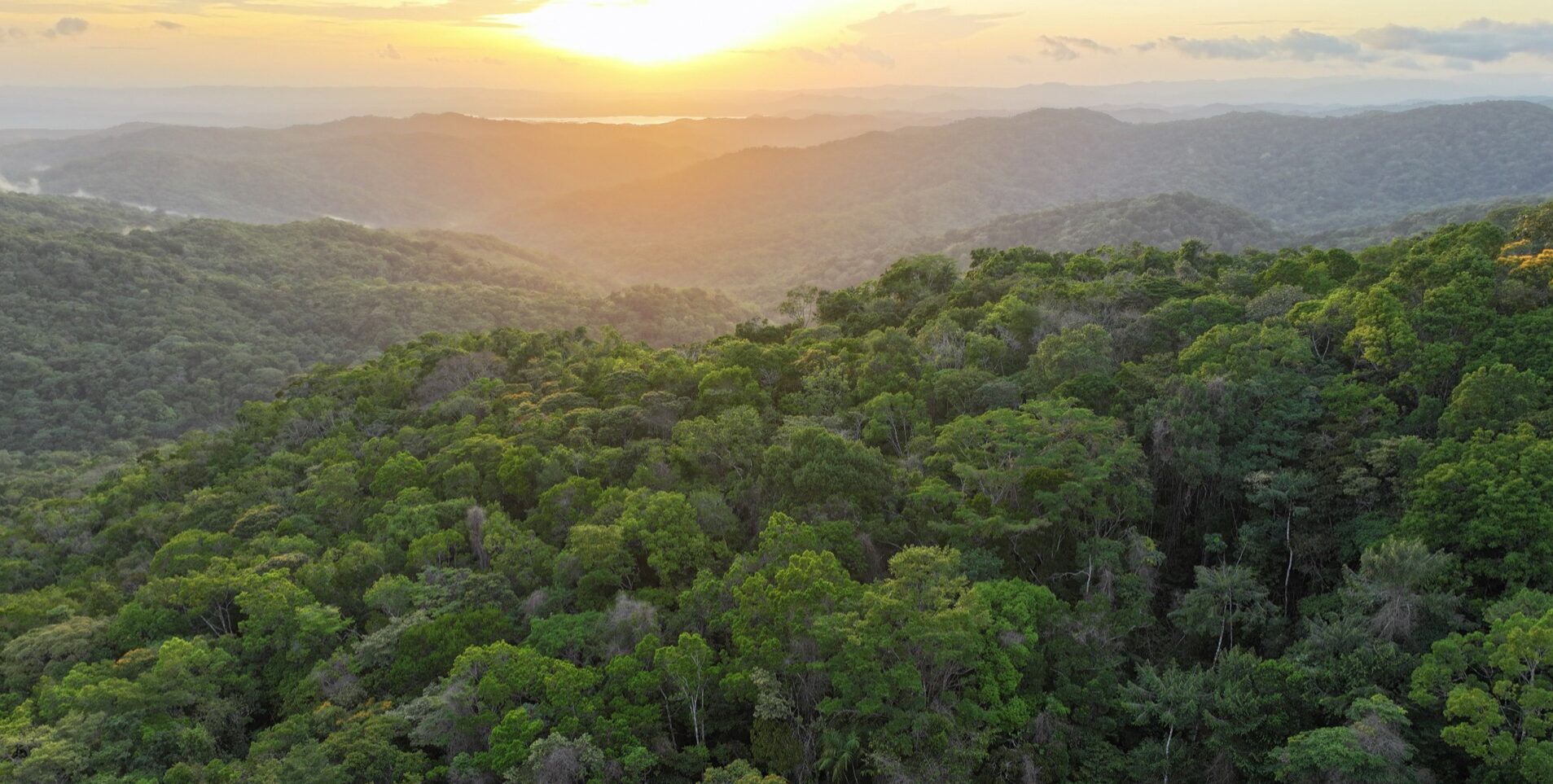
Banner image: Sunset over a Panamanian forest. Image by Rhett A. Butler/Mongabay.
FEEDBACK: Use this form to send a message to the author of this post. If you want to post a public comment, you can do that at the bottom of the page.

