


- Some former hunters on the Indonesian island of Java have abandoned catching birds for the songbird trade and have since become notable local conservation figures.
- The Menoreh Hills is a karst biosphere in Central Java province where sightings of songbirds have declined over several years due to hunting and land-use change.
- One local songbird, the Javan blue flycatcher, has become critically endangered due to hunting, with population assessments indicating the number of caged birds is at least an order of magnitude greater than the total population living freely in low- and mid-lying forests in Java.
PURWOREJO, Indonesia — As a young man, Parman hunted songbirds here in the Menoreh Hills, a landscape of karst valleys near the Indonesian city of Yogyakarta. The area is now a UNESCO Biosphere Reserve, but back then Parman would raid nests for rare birds, taking fledglings before they had learned to fly, then raising them himself until they were old enough to sell.
“Most buyers came from outside the area, especially Yogyakarta and Magelang,” Parman told Mongabay Indonesia in June, referring to the two nearest cities to his home in Donorejo village. “They’d ask local people to catch them, and we’d sell them — for a pretty good price.”
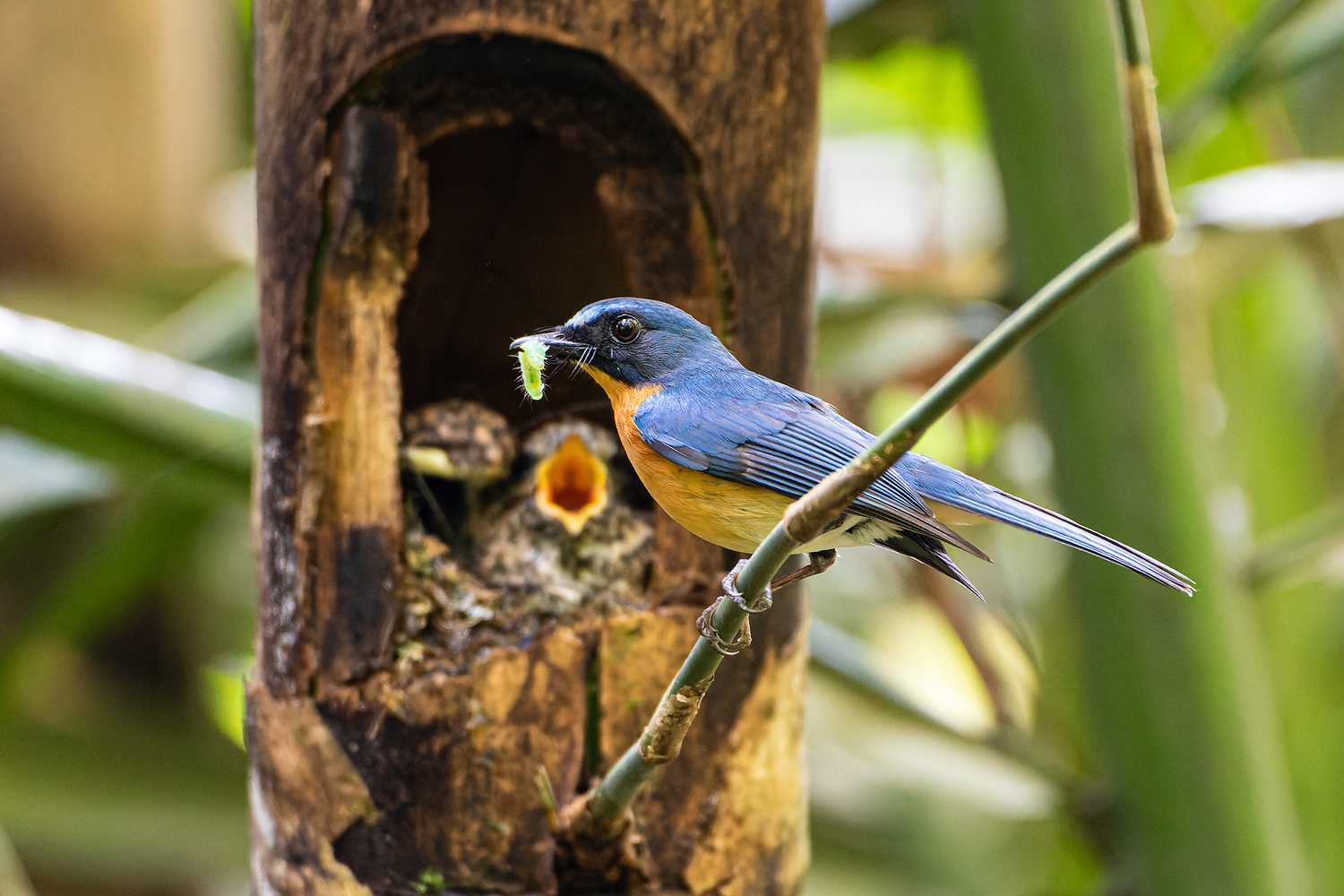
The colorful Javan blue flycatcher (Cyornis banyumas), for example, used to be a common sight and sound here in the Menoreh Hills.
But the species is now critically endangered, a sad reflection of the depth of Indonesia’s songbird trade. Today, many more of these birds are held in cages than live freely in forests.
“Remarkably, the population in captivity likely numbers in the tens of thousands, while the wild population is now suspected to number fewer than 1,000, and maybe much lower,” notes the most recent assessment of the Javan blue flycatcher, published in 2022 by the IUCN, the global wildlife conservation authority.
“It became really difficult to find birds here,” Parman said. “So that’s why we stopped, and chose to focus on raising goats instead.”
But after Parman and his peers stopped hunting for the songbird trade, they found outsiders soon filled the vacuum, which prompted him to see these hills differently.
Corridor of uncertainty
Across Java, the world’s most populous island, a small number of former bird hunters are making the switch to conservation.
For some, like Parman, this has meant preservation of the birds they once hunted by helping to bolster animal corridors in the landscape, the connective tissue between forests that prevents outright habitat fragmentation.
Last year Mongabay reported on two former hunters near Java’s Mount Slamet, including the environmental prizes won for the conservation work.
In Donorejo, village authorities enacted a ban on hunting songbirds in response to dwindling numbers. Anecdotal testimony suggests an increase in sightings of the Javan blue flycatcher may have occurred since the ban took effect around two years ago.
Some local residents have also planted fruit trees, nectar-rich flowers and crops like sorghum, which help sustain the local birdlife.
Adhita Virya Akmilius Lala, a young conservationist in neighboring Pandanrejo village, said local springs were habitats for a range of birds, but that hunting and environmental damage had put pressure on these water sources.
“We don’t have the authority, so all we can do is coordinate,” Adhita said. “We also ensure that trees containing nests are protected and monitored.”

Tegar Cahaya Putra, who founded a separate local conservation organization to support bird populations, said protecting the Menoreh Hills landscape had been integrated into local development planning.
“At least now there are efforts by residents to build bird corridors to maintain bird diversity and populations,” Tegar said.
Much of the local land here remains privately owned, but bird charity Kanopi Indonesia Foundation, which works in this area of Java, says community outreach could help to avert further declines.
“For example, the landowners of the upland there already know that their area is a nesting ground for Javan blue flycatchers, so they won’t clear-cut the hill,” said Arif Rudiyanto, program implementation associate from Kanopi.
Spring awakening
Across the ninth-century Borobudur temple complex, located just to the east of the Menoreh Hills, thousands of stone carvings depict birds from the Buddha’s past lives, alongside the Garuda, Indonesia’s national symbol.
Local legend contends the Menoreh Hills are the final resting place of Gunadharma, the mythical architect of Borobudur, a UNESCO World Heritage Site.
However, around five years ago, Parman noticed the Menoreh Hills appeared to go quiet as birds seemed to no longer nest here.
He said he hopes it’s not too late for the Javan blue flycatcher and other birds, which face an array of threats from climate change to hunting and land-use change.

Parman wanted to go further, and in concert with others in the village has coalesced a grassroots organization to record bird sightings and map their locations.
The data collected have shown an agglomeration of birds around local springs, five of which have been identified as being in critical state owing to low water levels.
“This data will be our material for rehabilitating the bird corridor here.” Parman said.
Banner image:The colorful Javan blue flycatcher (Cyornis banyumas) used to be a common sight and sound in the Menoreh Hills, but the species is now critically endangered. Image © boasemmanuel via iNaturalist (CC BY-NC 4.0).
This story was first published here in Indonesian on July 22, 2026.
Indonesia’s voracious songbird trade laps up rare and poisonous pitohuis
A one-time illegal logger grows back a forest for his people in Sumatra
On an Indonesian island, an ancient ritual evolves to protect an endangered cockatoo
Cite this article
Triyo Handoko (2026). In Java’s hills, former bird hunters are rebuilding a songbird haven. Mongabay Conservation news. DOI: https://doi.org/10.66709/news-327538

