


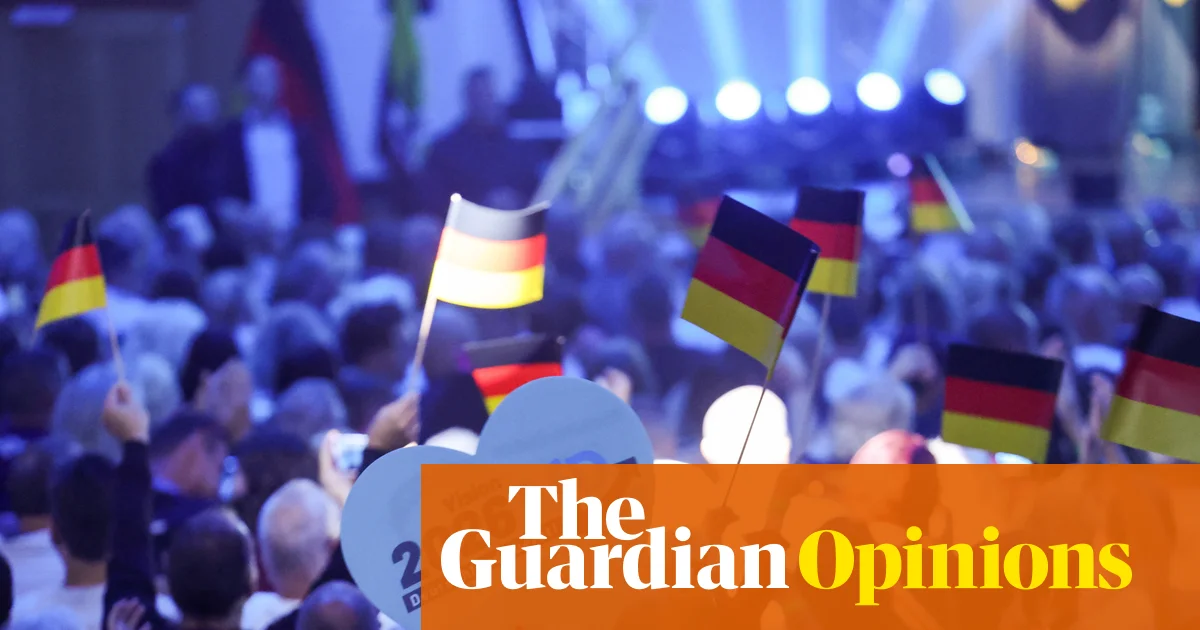
The fear that a fascist, far-right movement would rise to power again in Germany has been with me since my youth. On 6 September, the far-right, anti-immigrant, pro-Kremlin Alternative für Deutschland (AfD) won a landslide in Saxony-Anhalt, becoming the biggest party in the state parliament, with a shocking 44% of the vote, on a record turnout. If it finds a way to power it will be the first far-right party to govern a German state since the Nazi era.
The night before the vote, I sent a message to a friend, who, like myself, has an East German background. Was she as worried, scared even, about the vote as I was, I asked. I’d fallen into a loop for days, scrolling videos, reels, reports, interviews done on the ground. And I knew these AfD voters. They could have been relatives, friends of my parents, old teachers, former schoolmates. Why were they saying such incoherent stuff?
I did not grow up in Saxony-Anhalt, but in Saxony – a sibling eastern German state, not entirely the same but similar in many core aspects. When I went to high school in Leipzig in the late 1990s and early 2000s, the presence of rightwing extremists was part of my coming-of-age experience. Every Friday night, you felt the fear that neo-Nazis would be waiting outside the clubs, the bars, the tram stops, fists clenched or baseball bats in hand. Every 1 May was a flashpoint when neo-Nazis were allowed to march through the city-centre. And still, Saxony’s first prime minister after reunification, Kurt Biedenkopf – a West German Christian Democratic Union (CDU) politician and a close ally of Helmut Kohl – promised, stoically, throughout his 12 years in office: “Saxony is immune to rightwing extremism.”
By 2004, a year before I graduated, the far-right National Democratic party (NPD) had entered the Saxon state parliament for the first time, with 9.2% of the vote. In 2005, I left Saxony and moved to Berlin. One reason was the unbearable, dangerous presence of neo-Nazis and rightwing extremists. Many peers did the same, because it was clear that the blooming landscapes that Kohl, the German chancellor in charge of reunification, had confidently promised in 1990 weren’t going to materialise.
Instead, rightwing extremism has grown steadily in eastern Germany ever since. Only the names have changed – from NPD, to Pegida (the anti-migrant protest movement launched in 2014), to AfD. I am terrified, if not surprised. Because fascist structures, left unchecked, will always keep going.
But this result is also a function of the deeply troubled relationship between the former East and West Germany.
A couple of weeks ago, Magnus Brechtken, deputy director of the Institut für Zeitgeschichte in Munich – Germany’s leading institute for contemporary history – gave an interview to the FAZ newspaper. It went viral. The headline: “Many west Germans have had enough now.”
The interview was framed as a reminder to angry east Germans – meaning, specifically, those tempted to vote AfD out of spite towards the west – of some historical facts. Brechtken argued that the differences east Germans have been complaining about for 36 years are, by now, emotional rather than rational – the product, he suggested, of a lack of honest self-examination. He went further: the German west, he said, has spent the past 75 years proving it understands democracy and knows how to handle extremism, that it is better equipped to counter radical movements and prevent parties like the AfD from rising in the first place – while east Germans, he implied, have always had an inherited longing for authoritarian solutions.
You couldn’t help but wonder how much of it was history, and how much was personal opinion. But I do think Brechtken was right about one thing. This supposed east German anger, the AfD’s popularity, the result in Saxony-Anhalt and – in all likelihood – the party’s performance in two upcoming state elections on 20 September should be used as a reminder of some actual historical facts, and of follow-up questions Brechtken apparently decided not to ask.
The AfD was founded in west Germany. A large share of its leadership was born and raised in western states such as Rheinland-Pfalz and Nordrhein-Westfalen. The question shouldn’t only be what draws the east of Germany towards the AfD. It’s just as much: what draws a certain kind of west German towards building a party like this one, pushing it, and choosing the east as the place to make it grow?
I believe the west German states – which officially claimed to have carried out denazification after 1945, and prided themselves on the culture of remembrance, or “coming to terms” with the Nazi past – need to look, just as urgently as the east German states, at why this fascination with fascism keeps recurring. And why, by now, are there no working structures against the rise of right-extremist movements, parties and agendas – but somehow still a system that lets them flourish?
It’s also worth asking whether a party like the AfD went east only because east Germans are more susceptible – or because the visible inequalities there are excellent material to organise around.
In 1989, a lot of east Germans had hoped for something between socialism and capitalism. Reunification wasn’t necessarily the preferred option. What followed felt, to many, badly mishandled – too fast, laws and decisions imposed rather than negotiated. And then there was the Treuhand – the agency put in charge of privatising the former GDR’s entire state-owned economy. In the process of reunification, 94% of East German companies were taken over by West German or international investors. Six per cent stayed with the people of East Germany. Six per cent. Approximately 2m jobs were eliminated in the east.
In the autumn and winter of 1990-91, people took to the streets again – not against their own government’s repression this time, but against the perceived occupier: West Germany. They demanded new elections, a renegotiation of the agreements that had left millions empty-handed and jobless, as unemployment in the east skyrocketed. Detlev Karsten Rohwedder, head of the Treuhand and the key figure in overhauling the former East Germany, was asked in an interview back then by a TV host: “If it doesn’t get better, aren’t you afraid there might be another revolution in East Germany?”
In those years, the former East Germany was treated like a child that had to follow the laws and orders of its wiser western counterpart – a parent. Now, that child is all grown. But it remembers the experience – and quite possibly holds on to it too tightly. Ulrich Siegmund, the AfD’s man in Saxony-Anhalt, was born the same year as reunification.
after newsletter promotion
One of his main promises is to take back control. Maybe you could say that what happened in Saxony-Anhalt went beyond a question of control and was driven by the desire for a sort of revenge. The east, finally, daring to say to the overpowering west: enough. Or as Siegmund at his first victory press conference said, the result showed that the people of Saxony-Anhalt wouldn’t be “patronised” any longer. With this he was tapping into something almost visceral. The remark also clarified for me something about the motives of the countless potential AfD voters I had listened to over the past weeks and months. Most of them don’t actually read or know what’s in the AfD’s programme. And they don’t seem to care. What won people over was simpler: I hear you. I see you. Yes, you have every right to be unhappy.
Throughout the campaign, Siegmund travelled the entire state and threw parties: free sausages, free beer, dancing, music and maybe for some, it felt like the return of community. Villages and small towns that had been hollowed out, some of them ghostly and depopulated, were suddenly told again: you matter. Everyone else may have left you behind, but I, we, the AfD, care.
What many have not realised yet is that the AfD won’t improve life in east Germany. But that was never the point. It gave people attention in exchange for a vote.
And for now, that was what counted most.
Because the AfD is bigger than east versus west. It was built by west Germans, carried by east Germans, and now it strives for power across the country. Its programme runs on ideas Germany once needed a war and total defeat to bury: racism, the belief in superiority and a hierarchy of who really belongs, contempt for who doesn’t, a hunger for enemies dressed up as pride. That’s not a regional problem. It’s a national one, and it should frighten every single German citizen.
A vote for the AfD is a vote for that same set of beliefs. Whatever anger, disappointment, or legitimate demand to finally be seen or heard got bundled in alongside it.
In April 1932, the Nazi party became the strongest party in the state election in the region that now makes up Saxony-Anhalt, with 40.7% of the vote, and formed, with coalition partners, the first Nazi-led state government in Germany. Whatever happens next, it will be hard to say we didn’t know.
