


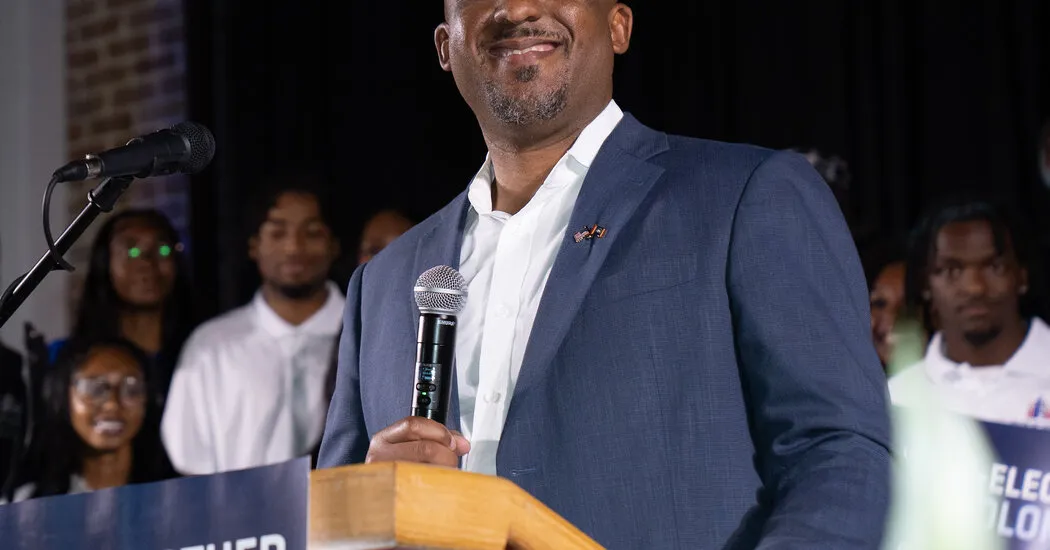
Barely more than a year ago, Scott Colom sat at the kitchen table at his parents’ house not far from his own home in northeastern Mississippi, using his lunch breaks from his job as district attorney to call potential donors.
Mississippi hadn’t had a Democratic senator since the 1980s. It hadn’t had a Black senator since the 1880s. But Mr. Colom made his pitch.
The response, in the recollection of his mother, Dorothy Colom, was typically a one-two beat:
You sound impressive.
You can’t win.
“It was just the two of us,” she said in an interview this week at her home in Columbus, Miss. “And my role was just to write down what the donors said.”
Now Mr. Colom, 43, is Mississippi’s senator-elect — and at the top of the list of Democrats whose unlikely wins in the midterm elections reordered the balance of power in Washington and scrambled longstanding preconceptions about who can win where.
A seventh-generation Mississippian descended from an enslaved woman, Mr. Colom (pronounced kuh-LOAM) defeated Cindy Hyde-Smith — the Republican incumbent who had single-handedly denied him a chance at a lifetime appointment as a federal judge three years before, blocking his nomination by President Joseph R. Biden Jr.
He wound up running for her seat, campaigning for more than a year before anybody but the most perceptive or optimistic Democrats believed he had a shot.
It frustrated Mr. Colom. But in the end, he said, it wasn’t all bad.
“It was good that it didn’t get attention too early,” he told The New York Times during the waning days of the campaign. “It made me earn it.”
“Throughout this campaign, there were many times where I had to have faith,” he said on Wednesday night in his victory speech at Tougaloo College, a historically Black school on the northern edge of Jackson, Miss., the state capital. “There were times that I couldn’t get donors to answer the phone. They did not believe a moment like this was possible. But I kept the faith.”
Before his win in the primary in March, before a viral ad that introduced him to the world and before the last-minute assistance of senators and former presidents, Mr. Colom just kept making calls and his mother just kept taking notes.
You don’t have a chance.
But send me your bio?
‘Our moment’
Mr. Colom and his twin brother, Andrew, were born in 1982 to a power couple of Columbus, a small, majority-Black city near the Alabama state line.
His father, Wilbur Colom, was a lawyer, an entrepreneur and a collector of stone sculptures from Zimbabwe. In the 1960s, he was a civil rights activist. In the ’70s and ’80s, he was a Republican — working on Ronald Reagan’s presidential transition team and the Senate campaigns of Haley Barbour and Thad Cochran. He ran for state treasurer in ’87 and said Black people should stop just giving their votes to Democrats. “I think Black Democrats should be ashamed of themselves,” he told the Clarion Ledger newspaper that year.
His mother, Dorothy Colom, always a Democrat, met her husband on a Saturday night in the library at the Antioch School of Law in Washington, D.C. She was a lawyer, too, before she ran for a seat on the bench, losing two races before winning her third. She was the district’s first Black chancery judge and retired in 2018 after almost a quarter century.
The twins licked campaign mailers for their mother and politicked at county fairs with their father. They hit back-to-back home runs in Little League and took violin lessons. They played pool at the Boys and Girls Club and went to vacation Bible school. They had summer reading, and their mother made them write reports.
“My dad was definitely the bad cop; my mom was definitely the good cop,” Andrew Colom said in an interview. “He’s the one saying, ‘You can do better.’ She’s the one saying, ‘I know how hard you try.’ And you need both of those.”
At Columbus High School, Scott Colom loved basketball and dreamed of being the next Michael Jordan. He was competitive and worked hard; he was also 5-foot-9. On a winning team, he was not one of the better players — but was, according to his coach, Sammy Smith, one of the most valuable. “He was a mental, emotional — if you will — spiritual leader,” said Adam Garner, a teammate and lifelong friend.
Mr. Colom attended Millsaps College, a small liberal arts school in Jackson. He played three seasons of basketball and double-majored in English and history. After graduation, he moved to Guyana, teaching English for a nonprofit called World Teach.
At the University of Wisconsin Law School, he interned with the Justice Department and with the chief prosecutor for the International Criminal Tribunal for Rwanda in Tanzania. He graduated cum laude in 2009 and was picked to be one of the student speakers at the ceremony.
He delivered a paean to his parents and a call to action to his generation.
“We enter a world with many problems, a world with great uncertainty,” he said. “But we are no longer observers of these problems. We are participants. For we have the tools to make a difference, the power to leave our mark on the world.
“I have no doubt that we are ready for our moment in history.”
Return to Mississippi
Mr. Colom turned down a lucrative job at a big-time law firm in Chicago, his mother said, and came home.
He would later talk to a friend about the “irreplaceability” of being close to family. He knew his father was keeping his firm open with the hope he would return. “He said he could make a difference here,” Ms. Colom said.
In the first few years of the 2010s, he was a lawyer at a nonprofit, the Mississippi Center for Justice, working to stop what he saw as the insidious spread of poverty predators like payday lenders.
He became the youngest and first Black judge in the Lowndes County justice court and then the first Black city prosecutor in Columbus.
And he wrote regular columns for the local newspaper.
In The Commercial Dispatch, he wrote about friends and mentors, local businesses and the importance of talking to one’s neighbors. He wrote about reality TV (“Nothing is in fact real”) and about race relations (“I believe our children will one day live in a fully integrated society”).
He started to write, too, about politics.
The Tea Party, he wrote in 2011, “should not be viewed as a singular moment in history but a part of a larger American tradition.”
He continued: “Civic and political engagement have been healthy for our democracy. Effective self-government takes effort and conviction.”
He noted with interest the “anti-establishment message” of a minor Republican candidate for governor, Ron Williams, who argued that the political status quo was dividing white and Black voters so the “working men and women of Mississippi won’t vote as Mississippians.”
Mr. Colom concurred: “The populist message probably won’t be enough to get Williams past the Republican primary, but I think Williams has identified an issue boiling below the surface,” he wrote.
And he remarked on a rock-bottom moment for Democrats in Mississippi. He charted the party’s decades-long decline — starting in 1964, when Barry Goldwater became the first Republican presidential candidate to win the state since Reconstruction, and accelerating in 1978, when Mr. Cochran became the first Republican elected statewide in more than a century.
By 2011, Republicans controlled nearly everything.
“A political party is made up of people, folks with different agendas, interests and goals,” Mr. Colom wrote. “Getting people organized enough to do anything is difficult. And, in many ways, the state Democratic Party has to be rebuilt from the ground up.
“Yet, the Democratic Party must find leaders willing to do this.”
The headline of the column: “The future of the MS Dem Party.”
‘David and Goliath’
Mr. Colom will be a senator because he is not a federal judge. And he is not a federal judge because of Ms. Hyde-Smith.
He had been elected district attorney in 2015 in a majority-white district, beating an incumbent who had been in office since 1989. “A David and Goliath situation,” said Cheikh Taylor, a Mississippi state representative and the chairman of the state Democratic Party.
He was a populist Democrat who was also a progressive prosecutor.
“If we send a young person to jail for drugs, it may seem like you’re tough,” he said in a campaign stop that summer, according to The Commercial Dispatch. “But five to six years later, they’ve got a felony and they can’t find a job.”
As D.A., Mr. Colom at times personally prosecuted the cases involving the most egregious offenses while also prioritizing leniency for first-time, nonviolent crimes. In his first re-election bid, in 2019, he ran unopposed.
During his second term, Mr. Colom was asked by the Biden administration if he would consider a lifetime appointment as a federal judge. “It wasn’t something I had been dreaming about,” Mr. Colom told The Times this fall. “But talking to my mom, and the stability it would have brought with my family, I decided to go for it.”
He labored to secure bipartisan backing, including from Representative Bennie Thompson of Mississippi, a mentor and powerful Black Democrat, as well as two former Republican governors.
But Senate tradition says the home-state senators of judicial nominees can block confirmation hearings for candidates they object to, and Ms. Hyde-Smith did so.
Mr. Colom’s interview with the senator, no more than 15 minutes on a video call, felt to him perfunctory. “The interview of somebody that got their mind made up,” he said in an interview.
In rejecting Mr. Colom, Ms. Hyde-Smith cited contributions he had received from the liberal megadonors George and Alex Soros and a statement he had signed with more than 70 other progressive prosecutors in 2021 saying they did not support the criminalization of medical professionals or parents who help a transgender child get gender-affirming care.
The snub did not make him want revenge, he said. It did, however, make him look more carefully at Ms. Hyde-Smith’s record.
She had, for instance, voted in 2021 against a bipartisan infrastructure law — the largest infusion of federal infrastructure money in more than a decade, helping to shore up projects across Mississippi and accelerate restoration of the Amtrak railroad line along the Gulf Coast. It was something the state’s other Republican senator, Roger Wicker, had helped pass.
She was also in lock step with Trump administration policies “causing pain to people,” he said.
“I said, ‘Listen, somebody’s got to fight back against this,’” Mr. Colom told The Times.
He announced his Senate candidacy in September 2025.
“As a Christian, I forgive Cindy Hyde-Smith. I truly do. I have to,” he said in his first interview, on the podcast of The Commercial Dispatch. “But as a Mississippian, I’m frustrated about the way she votes.”
‘Give them the belief’
Months into this campaign, though, after so many lukewarm responses to all the kitchen-table calls, Mr. Thompson got on a group video call with Mr. Colom. The message was stark: The cavalry was not coming to Mississippi.
“Congressman Thompson looked me in the face and he said, ‘You’ve got to touch as many people as you can — you’ve got to give them the belief that this is possible,’” Mr. Colom recounted on Wednesday in his speech.
He listened. Often with his wife, Nadia, and two young daughters in tow, he crisscrossed the state. The coastal communities, the Memphis suburbs in DeSoto County, the capital, Jackson — and, one year after announcing his campaign, Mr. Colom showed up in Mound Bayou, a town of fewer than 1,500 people founded by formerly enslaved people.
It was also the place where activism helped draw attention to the brutal murder and lynching of Emmett Till in 1955 and supported his family. Mr. Colom lingered more than usual on the state’s brutal history of suppressing voting rights.
“There was no way in the world that I was going to run for United States Senate in the great state of Mississippi and not visit and campaign in Mound Bayou,” he told a gathering of a couple dozen people.
“Part of winning an election is getting people to believe it’s possible,” Mr. Colom told The Times in Mound Bayou. “The final two months,” he added, “are going to be really special.”
In the end, it all crystallized in the final few weeks.
Mr. Thompson and Black leaders like Senator Raphael Warnock of Georgia kept hammering their colleagues in Washington to pay attention.
An ad skewering Ms. Hyde-Smith’s suggestion that there were alternatives to high-priced beef ricocheted across social media and became a rallying cry to “pick another senator” rather than pick another protein.
Former President Bill Clinton, former Vice President Kamala Harris, Representative James Clyburn of South Carolina, former Transportation Secretary Pete Buttigieg — they all came to Mississippi to campaign with Mr. Colom. Former President Barack Obama cut an ad supporting him. And to bolster the diverse, bipartisan coalition he needed to win, Mr. Colom even worked the line outside a rally President Trump held in Corinth for Ms. Hyde-Smith.
This past Sunday, as counties around Mississippi kept counting votes to see if he somehow had won, Mr. Colom went to church in West Point, a short drive from home, on his way back to Columbus.
He received a text message from a close friend, Jabari O. Edwards Sr.: “There are so many of our ancestors who have their blood in the ground around this state, who are now raining tears of joy down on you.”
