


When the campaign trail runs out, the concession call is a tradition that is excruciating for the loser and sweet for the victor.
If it happens at all.
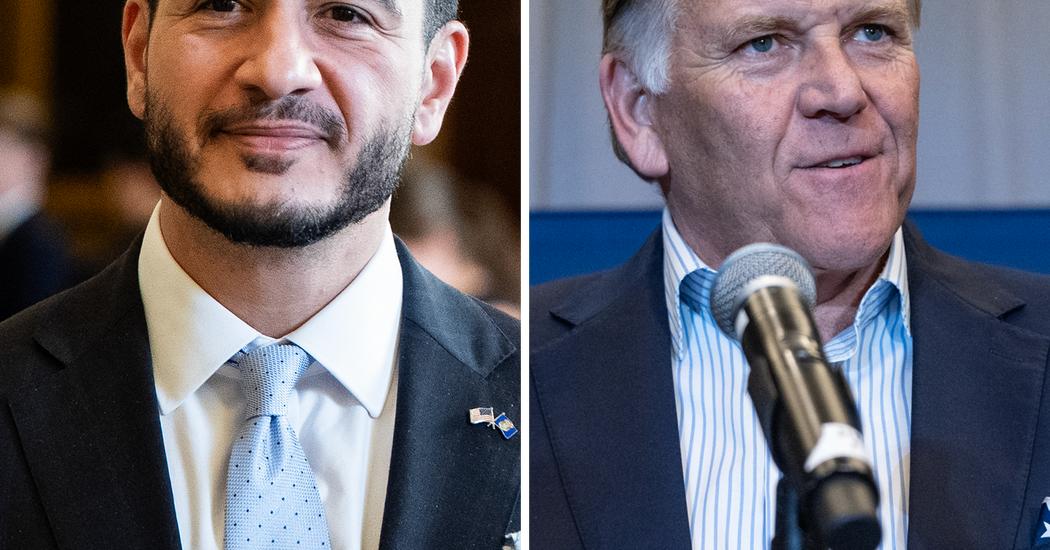
Last week, Abdul El-Sayed, the newly elected Democratic senator from Michigan, said that his Republican opponent, Mike Rogers, had never called.
“At the end of the day, it really doesn’t quite matter,” Mr. El-Sayed told reporters. “I’m sure he had a flight to catch to Florida,” a reference to Mr. Rogers’ owning a second home near Fort Myers. (A spokeswoman for Mr. Rogers did not reply to a request for comment.)
Amy Acton, who was elected Ohio’s governor, said she had refused to take a call from Vivek Ramaswamy, her vanquished Republican rival, who in the final weeks of the campaign featured Ms. Acton’s estranged mother calling her a liar in a TV commercial. Mr. Ramaswamy said in his concession speech that he had called Ms. Acton and left a message congratulating her.
“I have no intention of speaking to him,” Ms. Acton told “CBS Mornings” last week. “I do believe that leaders’ words matter.”
In a bygone era, such breaches of political protocol might have been unheard of. Yet as the 2026 midterm elections wind down, with several House races and a Senate race in Alaska too close to call, one might conclude that failing to concede defeat is more frequent than ever, the latest norm of polite politics to become a casualty of a less civil age.
Historically, concessions in American politics have come in two prongs: a personal communication between candidates, as well as a public speech. And some candidates still appear to embrace those customs.
On Wednesday, Representative Mike Lawler, Republican of New York, posted a picture on X with Cait Conley, the Democrat who had just unseated him, in spite of the acrimony of their campaign. “We had a great conversation about the district, the work ahead and our mutual respect for each other,” Mr. Lawler wrote. “I wish Cait well as she takes up the mantle.”
And when Scott Colom’s upset victory in Mississippi was announced Wednesday evening, it was met by well wishes in a concession video from Senator Cindy Hyde-Smith, a Republican.
A message of concession is “the single most important thing that happens in an election,” said Scott Farris, who wrote the book “Almost President: The Men Who Lost the Race but Changed the Nation.” In Mr. Farris’s own unsuccessful 1998 run for Congress in Wyoming, he did not make a concession call. He quickly regretted it — and later agreed to appear at a joint luncheon with his winning opponent, Barbara Cubin.
“We have this metaphor of politics as a war. And so when the war is over, people want it to be over. They don’t want it to keep having guerrilla warfare,” Mr. Farris said. “So they want a definitive surrender, but then they want the victor to also be gracious.”
A laying down of arms was on display in 1948 when Thomas E. Dewey, the New York governor, lost to President Harry S. Truman.
“My heartiest congratulations on your election and every good wish for a successful administration,” Dewey wrote to Truman in a telegram. “I urge all Americans to unite behind you in support of every effort to keep our nation strong and free and to establish peace in the world.”
Dewey did not show the same spirit of reconciliation when he lost the 1944 campaign to President Franklin D. Roosevelt. He was the only presidential loser between 1896 and 1980 not to send a congratulatory telegram to the winner.
Telegrams — first used in the 1896 presidential race — gave way to the telephone in 1980 when President Jimmy Carter called Ronald Reagan. Mr. Carter told supporters in the concession speech that followed that he had congratulated Mr. Reagan “for a fine victory” and promised an orderly transition.
Even after the fierce 2016 election, President-elect Donald J. Trump received a call from Hillary Clinton, which she described in her memoir as “without a doubt one of the strangest moments of my life.”
“I congratulated Trump and offered to do anything I could to make sure the transition was smooth,” she wrote. “It was all perfectly nice and weirdly ordinary, like calling a neighbor to say you can’t make it to his barbecue. It was mercifully brief.”
By 2020, that neighborly spirit had faded when Mr. Trump lost the popular vote and the Electoral College to Joseph R. Biden Jr.
Mr. Trump never admitted that he lost, becoming the first U.S. presidential candidate to refuse to concede in the modern political era. That decision played a part in the Jan. 6, 2021, attack on the Capitol and ushered in a new era of election denialism. (A stark contrast with the conciliatory note Mr. Trump left for Mr. Biden in the Oval Office, according to Mr. Biden’s new book.)
In races further down the ticket and in nonpresidential elections, the tradition of burying the hatchet has usually been kept.
Howard Dean, the former governor of Vermont who sought the Democratic presidential nomination in 2004, never made a concession call in his political career. But he received several concessions he remembered in an interview as “cordial” and “pro forma.”
“‘You ran a great race. Thanks very much,’” Mr. Dean said. “I’m, of course, hopefully equally gracious and saying, ‘I really appreciated all your ideas and so forth and so on.’ Hopefully it’s two people being as gracious as they can to be.”
Mitt Romney, who lost the 2012 election to President Barack Obama, wrote in a text message that his concession to Mr. Obama was “not a hard call at all.”
“I had long ago learned that that’s the nature of politics, business, sport, and life,” Mr. Romney said. “I congratulated him: He had run an effective campaign.”
Mr. Romney used a tennis analogy.
“If you’re playing in the U.S. Open and your opponent serves an ace, you congratulate him,” he said.
Not all calls go smoothly. Political history’s most famous concession call — or calls — occurred during the 2000 election. At first, then-Vice President Al Gore conceded to Gov. George W. Bush of Texas. But as Florida’s narrowing margins brought the results into question, Mr. Gore called to take it back.
“You mean to tell me, Mr. Vice President, you’re retracting your concession?” a stunned Mr. Bush said.
Mr. Gore responded: “You don’t have to be snippy about it.”
Eventually, Mr. Gore would concede again.
But he did it in a speech, and quipped that he wouldn’t be calling Mr. Bush for a third time.
Losing feels terrible, especially after a rough campaign. When Jaime Harrison failed in 2020 in South Carolina to unseat Senator Lindsey Graham, he said in an interview, he “felt like crap.” That didn’t stop him from aiming for magnanimity in his concession.
“Leaders have to lead,” Mr. Harrison said. “And even in times when they’re frustrated or times in which they’re upset, and times when they hurt.”
