


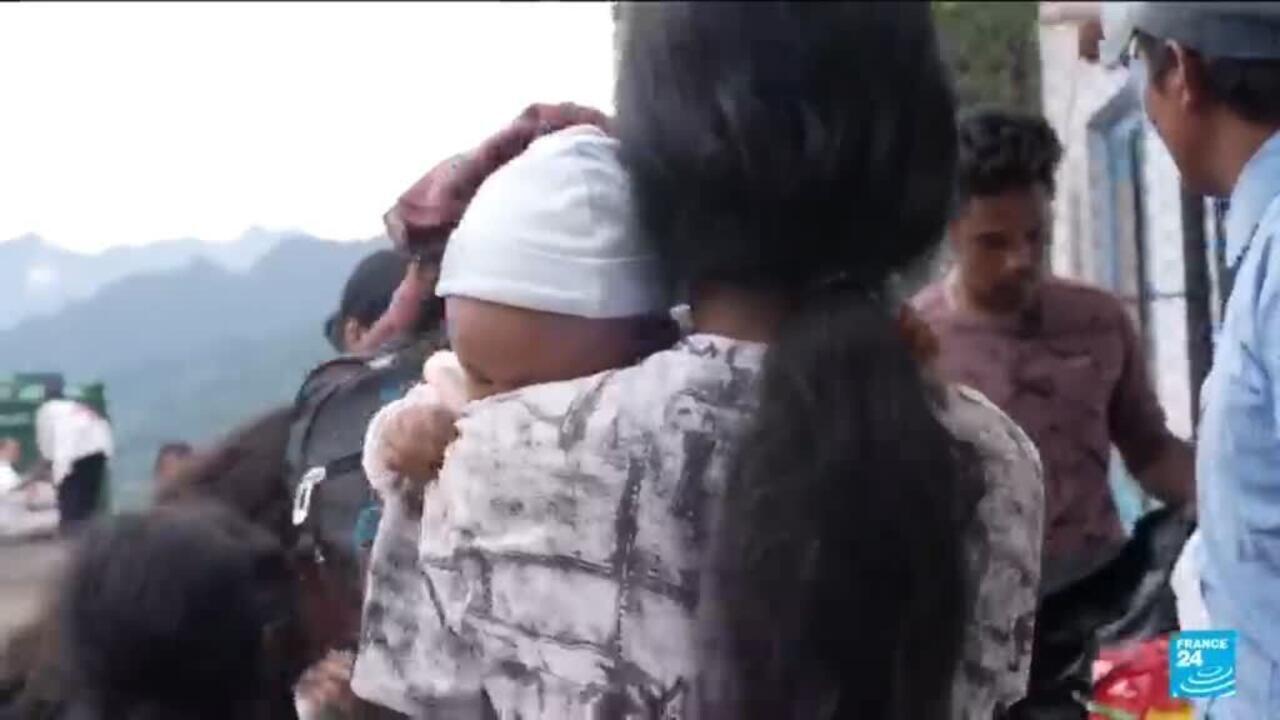
Thirty kilometres from the Nepal–China border, a school in the remote Himalayan region has opened its doors to around 200 people driven from their homes by the catastrophic flash flood last week that left their village largely buried beneath the mud.
Aid workers bringing badly needed supplies can travel up to nine hours along a winding dirt road to reach Rasuwa district near the disaster’s epicentre.
“Food is scarce, so I’m bringing rice, lentils and oil,” said Madhav Neupane, a Human Development and Community Services employee. “There is no electricity, so we’re also bringing solar power banks. Since people are homeless, we’ve also got tents with us.”
Read moreWhy early warning signs of glacier collapse in Nepal were difficult to detect
Many of the people now crammed into the school are still waiting for news of their loved ones.
“I don’t know if I’m dreaming or if it’s real. I’ve lost 11 members of my family,” said flood survivor Ranjina Tamang. “Some are missing, others may be dead – I don’t know.”
Elsewhere, the frantic search for survivors continues. A Chinese national was pulled alive from a hydropower tunnel in Nepal on Saturday, authorities said. Two Nepalese workers were rescued from another mud-choked tunnel on Friday. More than 5,600 people are still missing.
For those who fled the catastrophe, living conditions remain difficult in the overcrowded camps that have sprung up in the flood’s wake.
Watch FRANCE 24’s on-the-ground reporting by clicking on the player above.
