


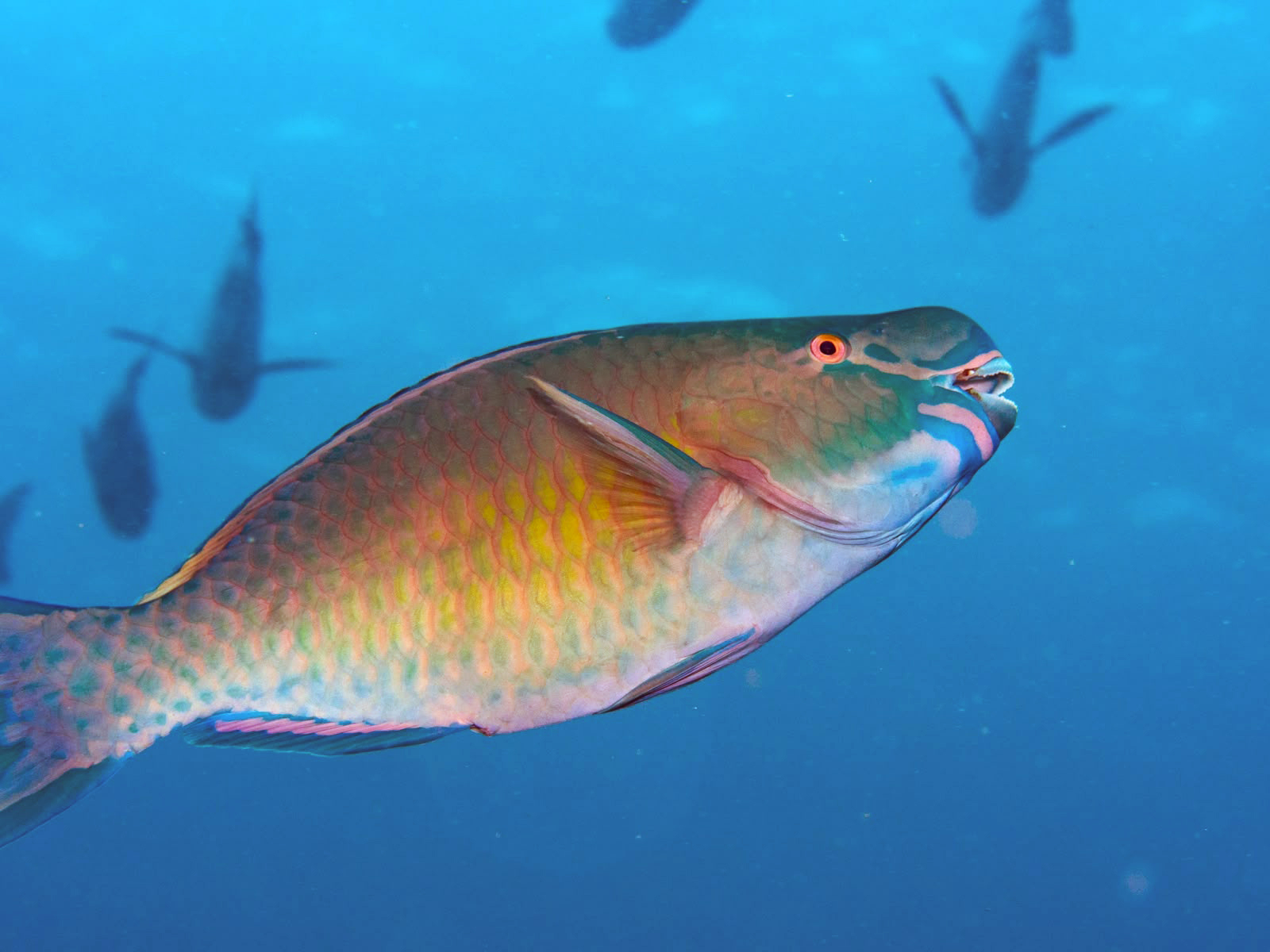
- Parrotfish play a vital role in reef ecosystems by producing sand from consumed coral and maintaining healthy reefs by grazing algae; in doing so they support the sediment accretion processes that help low-lying atolls naturally grow and adapt to rising sea levels.
- A grassroots social media campaign in the Maldives raised awareness about the ecological importance of parrotfish, helping build widespread public support for their conservation after the species began proliferating in local fish markets during the COVID-19 pandemic.
- Public backing from the #FishForTomorrow campaign led the Maldivian government to ban the catch of all parrotfish species in 2020, making the Maldives one of the first countries to enact national protections based largely on community advocacy.
- Building on this success, the NGO Maldives Resilient Reefs is expanding conservation efforts through sustainable fishing partnerships, seagrass protection and a nationwide initiative to protect 30% of the country’s marine habitats by 2030.
It started six years ago when Shaha Hashim began seeing posts across social media: Vulnerable and protected species were being fished throughout the atoll islands of the Maldives, and some were even turning up in fish markets.
This included animals like the giant clam (genus Tridacna), Napoleon wrasse (Cheilinus undulatus), and even species of parrotfish (subfamily Scarinae).
These species weren’t historically targeted by Maldivian fishers, but were rising in popularity over the last decade. This came to a head in the midst of the COVID-19 pandemic, as tourism workers were being let go from their jobs at resorts, and fishing became more popular recreationally, as well as a means of earning money and providing food.
“This was the only way for them to earn an income at that time,” Hashim told Mongabay by video call. Today, she’s the co-founder and executive director of Maldives Resilient Reefs (MRR).
Hashim said the parrotfish were particularly concerning. At the time, they weren’t a protected species, though they played a key role in recycling sediment and generating new habitat for coral reefs. Protecting them means safeguarding accretion: An important sedimentary process that is intertwined with the resiliency and natural management of atolls.
“Accretion really is the deposition of sediment above the water level,” said Paul Kench, a coastal scientist and the pro vice-chancellor of Te Wānanga Pūtaiao Division of STEM at the University of Waikato in New Zealand. He told Mongabay by video call that accretion allows atolls to naturally combat climate change by rising with the sea level and growing horizontally.
Parrotfish help in multiple ways
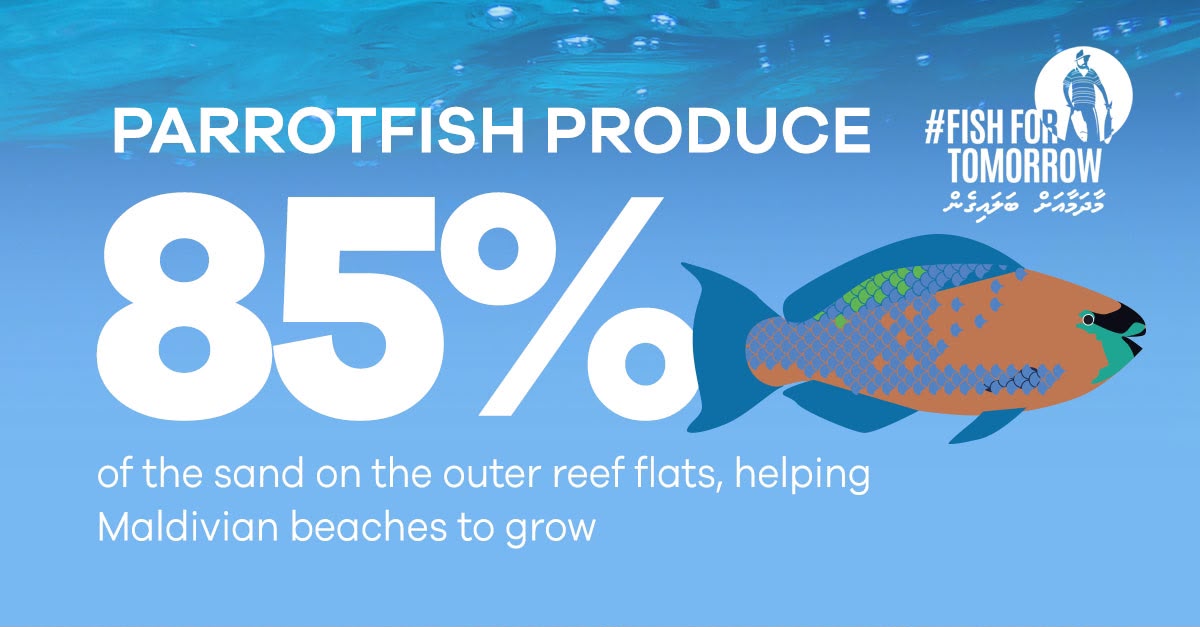
In 2015, Kench co-authored a paper that found parrotfish responsible for generating upwards of 85% of the new sand-grade sediment produced in outer reefs surrounding reef islands.
They use their beak-like teeth to grind through coral exoskeletons to get to the algae — or sometimes the soft, living coral polyps — inside. They then excrete any ingested coral chunks as fine sand It’s one of many ways sediment can be generated and make its way to islands, in order for accretion to take place.
A study published in the journal Geology in 2015 found that parrotfish were responsible for producing upwards of 85% of sand in the outer reefs surrounding the islands of the Maldives. Beyond generating sediment, parrotfish contribute to reef expansion by eating algae off of prime surfaces where baby coral called planulas can anchor and grow.
Coral reefs are ultimately sediment factories, said Sebastian Steibl, a postdoctoral researcher at the University of Auckland and the Naturalis Biodiversity Center in the Netherlands. He has studied Maldivian coastal ecosystems for the last decade. He told Mongabay by video call that when it comes to these ecosystems, protecting biodiversity and sedimentary processes are intertwined. “It comes in a package,” Steibl said.

#FishForTomorrow campaign is a success
With the Blue Marine Foundation, MRR launched an educational campaign over social media: #FishForTomorrow. Their goal was to broadcast information about the important ecological roles of the different species that were starting to show up in markets. They posted facts about parrotfish life spans, the amount of sediment they produce, and how they help make room for baby coral.
The community campaign went viral on social media, Hashim told Mongabay. Community members began posting videos with the hashtag of them releasing parrotfish that accidentally ended up on their lines; local scientists spoke out in support of the campaign; fishers began reaching out to Hashim’s NGO to thank them for their work. An online poll from MRR garnered 27,000 responses in the final days of the four-week campaign: Around 70% of responders supported the legal protection of parrotfish.
“It was really exciting to see that other people were appreciating what we were trying to do, and they were willing to join for free, voluntarily,” Hashim said.
The onslaught of positive local support for the campaign drove the Ministry of Fisheries, Agriculture and Ocean Resources to pass a new law in 2020, banning the “taking, catching, harvesting and killing” off all species of parrotfish within Maldivian waters. It had been years since the last fishing ban was passed in 1995, for the Napoleon wrasse (Crassilabrus undulatus).
Hashim said the ban put a stop to a worrying trend, preventing a commercial market from gaining traction in the local economy. Beyond that, she said the ban represented a rare success in species conservation.
“If you want to protect a place, or to include a species on a protected list, usually a lot of science is needed,” Hashim said. “But this was a special case because we managed to showcase the popular support for conservation, and policymakers react to popular support.”
Hashim said she sees success in how quickly this measure was pushed through. The community engagement resulted in a preemptive ban, protecting parrotfish before their numbers reached a tipping point. She said that in the years since, there’s been an observed decrease in landed parrotfish being posted on social media and sold in local markets.
Kench said to his knowledge, the Maldives was the only country that used the figures from his research to enact policy.
“Raising awareness in that way, I think, probably nationally, has had a big impact on people’s understanding of the importance of looking after reefs,” Kench said.
Continuing to build reef resilience
However, Kench noted that banning parrotfish hunting is only one step in building reef island resilience. Accretion is a sedimentary process with many pathways, and at many atolls, natural systems such as currents, waves and storms are just as key. Furthermore, he said banning parrotfish hunting doesn’t undo the urban development and anthropogenic change that has already shaped the Maldivian ecosystem.
In the time since the ban, Maldives Resilient Reefs has been involved in several other projects that support ecosystems and sedimentary processes within the Maldives.
The social media campaign #FishForTomorrow morphed into a MRR-facilitated, ongoing, outreach initiative between community fishers and resort properties. The idea is that in return for top market prices for their catches, local fishers would adhere to catch limits and avoid catching vulnerable or banned species, while collecting data on their catches to report to both MRR and the Ministry of Fisheries, Agriculture and Ocean Resources.

Hashim said that after piloting the model at two popular resorts, they’re preparing to roll out the program on a nationwide scale. Furthermore, MRR is negotiating with resorts to preserve sea grass fields within their marine properties, which provide food and habitat for many marine species and in some cases can help combat island erosion.
On top of that, MRR is conducting fieldwork, gathering data to facilitate the protection of 30% of the nation’s oceans by 2030. This includes “30% of the coral reef areas, as well as other interconnected habitats like mangroves and sea grasses, as well as managing reef fish at a sustainable level, so that they can help in the recovery of reefs as reefs change and adapt to the changing climate,” Hashim said.
“Being small islands, the reefs are our first line of defense. And if they are damaged, we wouldn’t be able to survive on the islands,” she said.
Coupled with conducting community and ecological surveys, as well as presenting management plans to the Maldivian government, she said MRR will publicly promote the plan — called 30×30 — over social media later this summer, similar to what they did for the protection of parrotfish.
Kench said it’s worth combining targeted strategies to preserve different routes of sediment generation, even if the different methods aren’t easily quantified. By mitigating harm or restoring reef ecosystems, “you’re giving the island the best chance to remain resilient,” he said.
Today, parrotfish represent a community-driven conservation success to Hashim. “They always bring a smile to my face,” she wrote to Mongabay. “It’s incredible the services these pretty fishes are providing to us free of charge.”
Banner image: A 2015 paper found that parrotfish were responsible for generating upwards of 85% of the new sand-grade sediment in the outer reefs surrounding the islands of the Maldives. Image by Shaha Hashim.
FEEDBACK: Use this form to send a message to the editor of this post. If you want to post a public comment, you can do that at the bottom of the page.
Coral reef experts press on, with climate looming over international conference
Citations:
East, H. K., Johnson, J. A., Perry, C. T., Finlay, G., Musthag, A., Zahir, H., … Floyd, M. (2023). Seagrass meadows are important sources of reef island-building sediment. Communications Earth & Environment, 4(1), 33. doi:10.1038/s43247-023-00675-y
Perry, C. T., Kench, P. S., O’Leary, M. J., Morgan, K. M., … Januchowski-Hartley, F. (2015). Linking reef ecology to island building: Parrotfish identified as major producers of island-building sediment in the Maldives. Geology, 43(6), 503–506. doi:10.1130/G36623.1

