


- The recent disaster that sent a wall of water and debris roaring down rivers of the Tibetan Plateau serves as a warning for future hydropower development on Nepal’s rivers, especially the Karnali, the nation’s last undammed watershed.
- Two proposals have targeted the Karnali — which is home to Indigenous communities and provides habitat for endangered fish and reptiles — seeking to bore tunnels through its mountains, drain miles of riverbed, and turn whitewater into megawatts.
- “A free-flowing Karnali River is an insurance policy — ecological, cultural, and now, unmistakably, physical — against the very disaster that just killed hundreds of people and buried hundreds more alive in hydropower tunnels. Nepal does not need to dam its last wild river; it needs to save it,” a new op-ed argues.
- This article is a commentary. The views expressed are those of the authors, not necessarily of Mongabay.
Recently, a glacial collapse on the Tibetan Plateau sent a wall of water and debris roaring across the Nepal-China border. As of this publication, more than 1,000 people are confirmed dead and over 4,000 remain missing in Nepal and China combined. Rescue crews are still digging through mud to find hundreds of workers believed trapped inside the tunnels of hydropower projects on the Trishuli River — tunnels large enough to drive trucks through, now choked with silt.
This is not simply a natural disaster. It is a preview of what climate change has in store for the Himalaya, and a wakeup call for Nepal’s headlong rush to dam nearly every river in the country.
One of us has spent three decades running rivers and building river-conservation movements from a basecamp in Kathmandu. The other has spent an equal number of years fighting to protect rivers in the American West and around the world. We come from different countries and different rivers, but we have arrived at the same conclusion: Nepal’s flood catastrophe is a warning that must change how the country — and the international financiers underwriting its hydropower boom — think about all of our rivers, but especially the Karnali River, the last major river in Nepal that has never been dammed.
Disaster written in the mountains
The floods that just devastated the Rasuwa and Nuwakot districts didn’t come from nowhere. Climate scientists have been documenting the warning signs for years: Glaciers across the Hindu Kush Himalaya are thinning at an accelerating pace, permafrost is degrading, slopes are destabilizing, and glacial lakes are swelling and bursting with increasing frequency. The Kathmandu-based International Centre for Integrated Mountain Development has tracked these trends for a decade. Nepal’s disaster agencies knew the risks were rising, but the government and the hydropower industry built anyway.
That is the cruel irony at the center of this tragedy. Nepal now generates nearly all of its electricity from hydropower, much of its “run-of-river” facilities squeezed into the same steep, narrow river corridors where floods, landslides, and debris flows are most likely to strike. When the recent flood hit, it damaged 11 operating hydropower plants and knocked out roughly a 10th of the nation’s total generating capacity — enough that Nepal, ordinarily an electricity exporter to India, has now had to halt those exports and start buying power from India instead. Fifteen more plants under construction were also damaged.
Importantly, environmental researchers who study dam-building across South Asia warn that these projects don’t just sit passively in the path of disaster — their massive concrete structures, tunnels, and altered river channels can act as ‘force multipliers,’ turning a bad flood into a catastrophic one when they fail or are overtopped.
And still, the hydropower expansion plans keep coming. International financiers and companies have pledged support for more than tripling Nepal’s hydropower capacity over the next decade, largely to feed India’s power-hungry grid. Nepal has roughly 6,000 rivers and streams. Every one of them has already been dammed or is slated to be, except one.

What’s left to lose
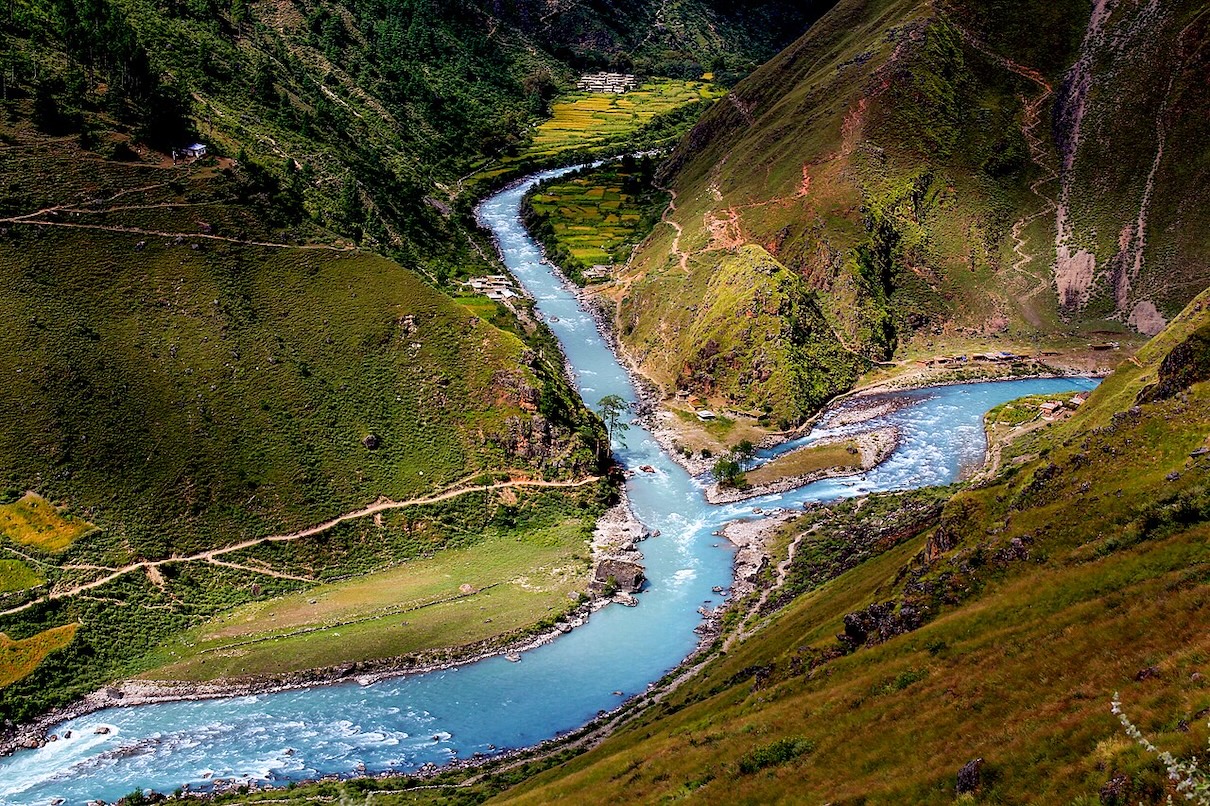
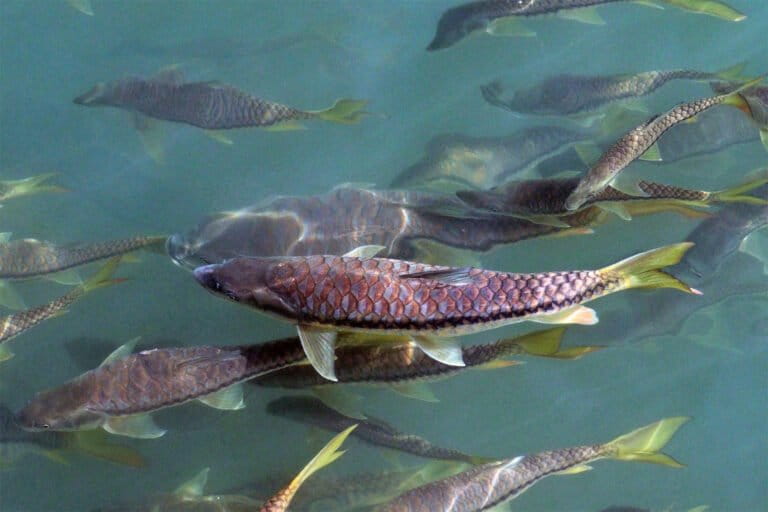
That one river is the Karnali, which begins near Mount Kailash on the Tibetan border and rages, glacier-fed and free, through the canyons of western Nepal before spilling onto the plains toward India where it merges with the Ganges. It is Nepal’s last wild river, and the last place where indigenous communities, including the country’s few remaining nomadic Raute people, still live along an undammed watershed. The Karnali is the last home to the giant migratory mahseer (Tor putitora), an endangered predator sometimes called the ‘tiger of the river’ and a species of giant catfish (Bagarius yarrelli) listed as vulnerable by the IUCN.The Karnali is also the last stretch of whitewater capable of sustaining a growing ecotourism economy that provides Nepali communities a sustainable alternative to resource extraction.
It is also, once again, in the crosshairs. Competing proposals — one backed by an Indian engineering firm, another by the Nepali government itself — have circled the Karnali for two decades; each seeking to bore tunnels through its mountains, drain miles of riverbed dry, and turn its whitewater into megawatts. These plans have been stalled by politics, financing gaps, and sustained public opposition. They have never gone away.
After what just happened on the Bhotekoshi and Trishuli rivers, they should.
Preserve, don’t dam, the Karnali
We are not arguing that Nepal should abandon renewable energy — far from it. We are arguing that the flood has proven, in the most devastating way possible, that piling ever more concrete and tunnel infrastructure into unstable Himalayan river corridors is a gamble the country cannot keep making in the face of climate change. Nepal’s own energy officials are now scrambling to assess how long it will take to rebuild what the flood destroyed. Before rebuilding what was lost, Nepal should ask a harder question: What should never be built at all?
The Karnali is the answer to that question. Conservationists, rafting guides, Indigenous leaders, and river advocates in Nepal have spent years building a campaign to permanently protect the river — modeled in spirit on the United States’ Wild and Scenic Rivers Act — and to seek international recognition of the Karnali’s outstanding natural and cultural value, including through UNESCO World Heritage designation. That campaign, and a pending petition before Nepal’s Supreme Court challenging the proposed dam on the Karnali, deserve the full support of Nepal’s government, international conservation funders, and the global community that is watching Himalayan rivers destabilize in real time.
The Karnali River is far more than a natural waterway. In South Asia, people worship landscapes and rivers, and their waters give birth to human spirits, cultures and lives. We seek designation as a UNESCO World Heritage River in part because the Karnali connects three major civilizational landscapes:
1) The Kailash Civilization of Tibet and China,
2) the Khas Civilization of western Nepal, and
3) the Ganga Civilization of India.
Taken together, the river is a faith and spiritual home to nearly two billion people connecting these three civilizations.

The ecological importance of the Karnali has been further escalated because the Phoenix Species Project, recently funded by Leonardo DiCaprio and Jeff Bezos, has identified an endangered species of crocodile called the gharial (Gavialis gangeticus) that lives in the lower stretches of the Karnali in Bardiya National Park as one of the species it will try to save. If the dam were built on the Karnali and a glacial collapse were to occur upstream, the impact in Bardiya National Park could be devastating.
A free-flowing Karnali is not a rejection of Nepal’s development. We understand and appreciate that Nepal needs development including economic development, infrastructure development, and energy development. But Nepal has dammed — or has proposed to dam — every river in the country, while other alternatives are not considered.
And amidst all the discussion and chaos around Nepal’s rivers, people forget that Nepal has about 300 sunny days in a year for solar energy, and thousands of blustery mountain passes and deep river gorges for wind energy.
A free-flowing Karnali River is an insurance policy — ecological, cultural, and now, unmistakably, physical — against the very disaster that just killed hundreds of people and buried hundreds more alive in hydropower tunnels.
Nepal does not need to dam its last wild river; it needs to save it.
Gary Wockner, Ph.D., is executive director of Save The World’s Rivers and a longtime river conservation advocate. Megh Ale is Karnali River Waterkeeper, an Ashoka Fellow and the founding president of the Nepal River Conservation Trust. The pair has rafted the Karnali together.
Banner image: Confluence of the Chuwa River (at right) into the Karnali River (left). Image courtesy of Sherparinji via Wikimedia Commons / Creative Commons Attribution-Share Alike 3.0.
See related coverage:
Nepal’s high-altitude wildernesses & wildlife are increasingly under threat (commentary)
A blueprint for effective activism 10 years after defeating a dam in Borneo (analysis)
Kathmandu Resolution calls for Asia-wide leadership on conservation (commentary)
Cite this article
Gary Wockner, Megh Ale (2026). For wild rivers like the Karnali, Nepal’s disaster is a warning and an answer (commentary). Mongabay Conservation news. DOI: https://doi.org/10.66709/news-330371

