


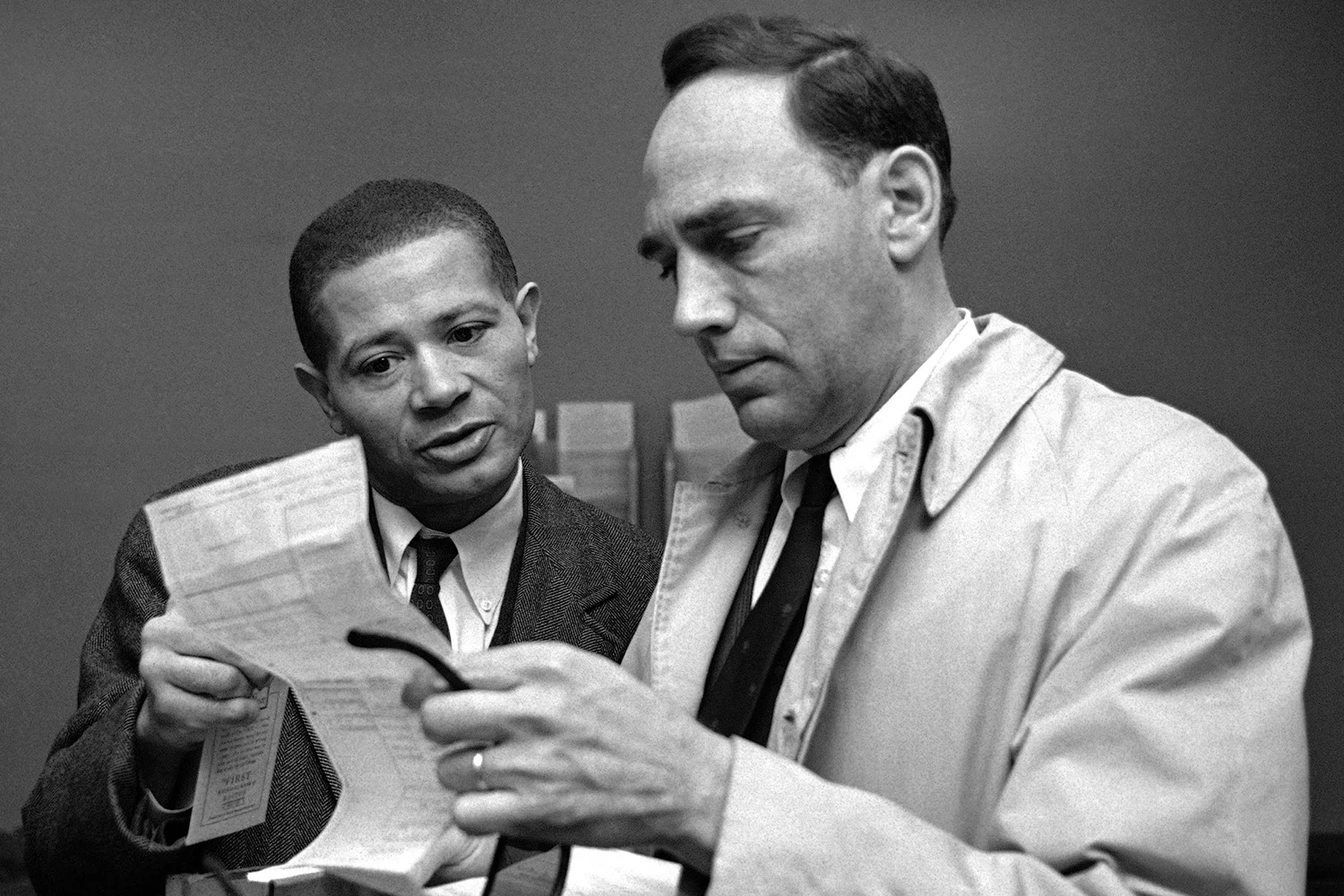
The Justice Department once prosecuted a U.S. journalist for coming home without a passport after a reporting trip to Cuba. He was charged with violating an obscure requirement in the Immigration and Nationality Act. As the journalist pointed out, dozens of white Americans had reentered the United States without passports for various reasons since the law’s enactment, but only he—a Black reporter with a penchant for muckraking—had been punished for doing so.
This happened in 1962, under President John F. Kennedy, and the target was William Worthy, one of the nation’s most distinguished international correspondents. A recipient of Nieman and Ford Foundation fellowships, Worthy had circled the world twice on reporting assignments—from Indonesia to South Africa to Czechoslovakia—and had been the first U.S. reporter to broadcast news from Moscow since the start of the Cold War. He had lacked a passport since 1957, when he visited China despite a U.S. ban on travel to the country.
This happened in 1962, under President John F. Kennedy, and the target was William Worthy, one of the nation’s most distinguished international correspondents. A recipient of Nieman and Ford Foundation fellowships, Worthy had circled the world twice on reporting assignments—from Indonesia to South Africa to Czechoslovakia—and had been the first U.S. reporter to broadcast news from Moscow since the start of the Cold War. He had lacked a passport since 1957, when he visited China despite a U.S. ban on travel to the country.
Throughout his career, Worthy’s reporting highlighted parallels between anti-colonial and civil rights struggles worldwide. He skewered the ruling elites who claimed such movements were fueled by foreign powers rather than discontent with the status quo: From Alabama to French Algeria, “they cannot conceive of the people becoming spontaneously aroused and deciding on their own to be free,” he wrote in 1956.
Before the Cuba trip that precipitated his prosecution, Worthy had visited the island three times since Fidel Castro toppled a U.S.-allied dictatorship and had reentered the United States each time without a hitch. Months after his fourth trip, however, pressure was building on Kennedy to show strength against Castro. A Justice Department official noted in a memo that Worthy had touted Cuba as a model for “other nations wishing to eliminate dictatorship” and had blamed the U.S. embargo for deaths on the island. Worthy was indicted four days later.
Today, Worthy is unknown to most Americans. But 64 years after the court case that briefly made him a household name, his legacy is more relevant than ever. His story shows how precedent set by Kennedy helped pave the way for future administrations, including Donald Trump’s, to suppress speech and foreign influences that challenge U.S. geopolitical interests. Today, the Immigration and Nationality Act is again fulfilling the intention of the senator who sponsored it in 1952—screening out “subversives, the criminals and the undesirables”—albeit through a subsequently added provision that Secretary of State Marco Rubio has used to revoke the visas and green cards of pro-Palestine scholars. And much of the current administration’s rhetoric about the threat of transnational left-wing radicalism is rooted in the same accusations as those leveled against Worthy decades ago.
Worthy lands at Peking Airport in 1957 for interviews with Chinese leaders. The Boston Globe via Getty Images
Worthy’s passport troubles began on Christmas Eve in 1956. Clad in a borrowed coat of possum fur that enveloped his short, stocky frame, he walked across a narrow bridge from Hong Kong into China, becoming the first U.S. journalist to enter the country in seven years. The passport in his pocket was stamped “not valid for travel” to China and several other communist-led countries, just like all U.S. passports issued to regular citizens in the previous four years.
Over the course of his 41-day visit, Worthy delivered three television broadcasts from China—the first any American had made since 1949—and scored interviews with Chinese Premier Zhou Enlai and one of the hundreds of U.S. political prisoners who had been detained there since the Korean War. He applied for a new passport two weeks after coming home, shortly before his expired. After a month of silence from the passport office, Worthy testified at a U.S. Senate hearing on “The Right to Travel,” where he chastised the State Department for behaving like the authoritarian governments of the very countries it banned Americans from visiting.
“We are familiar with the dreary, turgid, and dishonest newspapers in the Communist countries where reporters are told by the government what to write, which stories to cover, and where to travel,” he said in his Boston drawl, large brown eyes earnestly fixed on the senators. “Neither as a newsman nor as a citizen do I want to see even the seeds of such controls planted in this country.” A few hours later, the State Department notified Worthy that his passport application had been “tentatively” rejected.
Over the next year, U.S. officials threatened to prosecute Worthy under the Trading with the Enemy Act, a Woodrow Wilson-era law empowering presidents to restrict trade between the United States and its enemies. When that failed to materialize, they offered him a new passport if he would sign an oath vowing not to return to China. “Even the most savory carrot cannot make a free man trot,” Worthy retorted.
In March 1958, his passport application was formally rejected. Worthy, backed by the American Civil Liberties Union (ACLU), took the secretary of state to court. His first loss came that autumn, in a federal district court in Washington, D.C. The following summer, an appeals court upheld the decision to deny him a passport, ruling that “a blustering inquisitor avowing his own freedom to go and do as he pleases can throw the whole international neighborhood into turmoil.” Worthy appealed again, but in December 1959, the Supreme Court announced it would not review the case.
Worthy was down but not out. For two years, the tireless reporter only visited countries that did not require Americans to show a passport. His dispatches from Cuba became a particular headache for Kennedy’s administration. Months before U.S.-backed paramilitary units landed at Cuba’s Bay of Pigs in April 1961, Worthy reported in the Afro American newspaper that “Washington winks at the presence of military training camps for 500 mercenaries and soldiers of fortune in remote areas of Florida.” Days after the botched invasion, he urged Black Americans to oppose the U.S. campaign to overthrow Castro, warning that the “wicked colonial war” would set back civil rights in the United States if successful. Later that year, he spent three months in Cuba covering stories such as U.S. civil rights activist Robert F. Williams’ secret journey there to claim asylum and how drug shortages from the U.S. embargo were causing needless infant deaths on the island.

U.S. President John F. Kennedy speaks at a news conference on Nov. 2, 1962, announcing evidence that Soviet missile bases in Cuba were being dismantled. Kennedy cautioned that the United States would still insist on inspection. Bettmann Archive/Getty Images
Worthy was indicted six months after that last trip for reentering the U.S. without a passport. He immediately surrendered to the U.S. marshal in Manhattan. In a statement, Worthy posited that the case against him was motivated by the administration’s grievances with his reporting, such as a recent series he had written about the FBI’s failure to protect Black Americans in North Carolina from mob violence, which angered J. Edgar Hoover.
His trial in Miami federal court was set to begin in August 1962. Meanwhile, Worthy and his ACLU lawyers began drumming up public support for his defense. Worthy’s sister Myrtle began a hunger strike in early July. A star-studded coalition of prominent Black civil rights advocates, progressive politicians, and union activists rallied support from their respective communities. Many—including Malcolm X and Martin Luther King Jr.—were already friends of Worthy’s.
“It will be one of the tragic ironies of modern history if the nation that talks eloquently about freedom ends up convicting a man just for coming home,” King wrote in a letter to the Miami judge assigned to the case. Longtime Socialist Party presidential candidate Norman Thomas, whom Worthy had known since college, urged Attorney General Robert F. Kennedy to drop Worthy’s case or move it out of the South, noting that “he is a Negro, which will not be in his favor.” Radical Catholic activist Dorothy Day led 150 people in a picket line outside the U.S. Mission to the United Nations to protest Worthy’s plight. The eminent British philosopher Bertrand Russell cabled the attorney general that the Worthy indictment was “EVIDENCE DISAPPEARANCE OF YOUR CIVIL LIBERTIES AND DISGRACE AMERICA IN THE EYES OF REASONABLE MEN.”
After a brief trial without a jury, a Miami federal judge convicted Worthy in August 1962. He was sentenced to three months in jail and nine months on probation. “I am proud of having established a record for going where the news breaks and for surmounting man-made handicaps to get first-hand reporting,” Worthy said in a statement he sent the Afro American hours after his conviction. “Travel control is thought control and intellectual control.”
While Worthy appealed the ruling to a higher court, his supporters again took to the streets and airwaves. Eight days after his conviction, the Committee for the Freedom of William Worthy was formed in the office of A. Philip Randolph, organizer of the Brotherhood of Sleeping Car Porters, the first successful African American-led labor union. “Free William Worthy” rallies were held around the country. James Baldwin defended Worthy in an interview with talk-radio personality Barry Gray, warning that his conviction would set a dangerous precedent: “If it happens to Bill Worthy, it can happen to me.” Folksinger Phil Ochs chronicled the case in a sardonic ballad, ridiculing the U.S. government’s patronizing attitude toward Americans who sought to visit “these evil lands.”

Worthy testifies before Congress on the State Department’s silence on his application for a renewed passport in Washington on March 29, 1957.Bill Allen/AP
In February 1964, the appeals court finally overturned Worthy’s conviction, declaring unconstitutional the section of the Immigration and Nationality Act that barred Americans without passports from entering the United States. Worthy was soon back overseas—and his reporting on U.S. foreign and national security policies remained prescient. In April 1967, he slammed the CIA for spying on U.S. citizens in “trouble spots” and bribing overseas correspondents, especially Black ones, to publish articles furthering U.S. policy. Four months later, the agency quietly launched Operation CHAOS: a vast surveillance effort targeting students and “Negro expatriates” abroad.
The operation was intended to uncover foreign conspiracies behind protest movements within the United States. But its reports on subjects such as the “U.S. peace movement,” “restless youth,” and “internal security threats” kept failing to turn up any evidence of subversion from abroad. A Senate select committee that probed the operation found in 1976 that every CHAOS report had concluded the same thing: foreign powers were not a significant driver of dissident movements in the United States. Yet to this day, Washington continues to malign its critics by casting them as dupes of international forces.
The Trump administration’s mistrust of “radical” foreign influences, exemplified by the State Department’s July 2026 report on Cuba’s “campaign of subversion,” is a case in point. Arguing that Cuba is one of the “most sophisticated and dangerous vectors for hostile foreign influence,” the report echoed sources like a 1961 Senate committee that blamed pro-Cuba advocacy by Worthy and other Black activists on international communists “utilizing their powerful resources in an effort to subvert the American Negro against his own Government.” Black Americans who see solidarity between their civil rights struggle and Cuba’s fight against U.S. domination, the 2026 report claimed, are pawns of a Cuban plot to “cultivate a fifth column of American black extremists.”
Worthy never shied from debunking such canards, even when doing so put him in his government’s crosshairs. At a time when astute and fearless reporters are needed more than ever, it behooves the nation to remember this American’s battle for the right to travel and report freely, and the genuine solidarity he sought with oppressed classes everywhere.
