


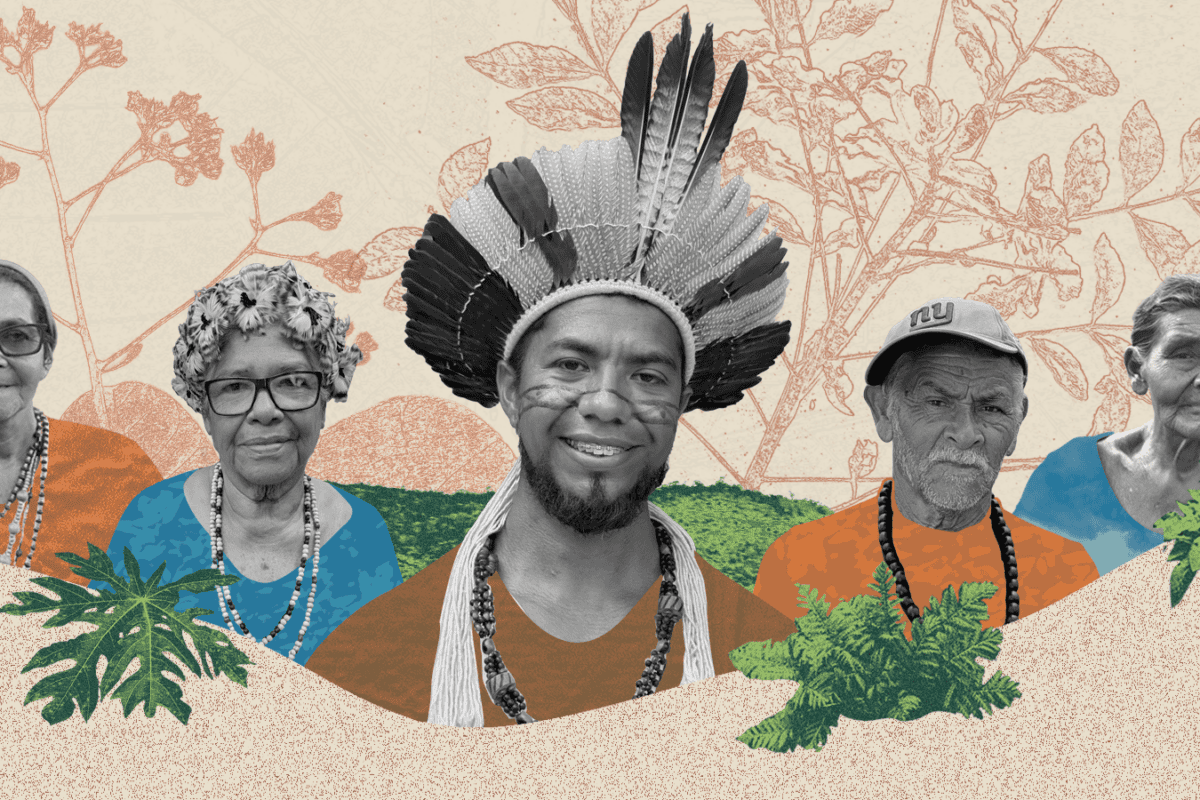
- In an unprecedented participatory ethnobotany approach, Hemerson Dantas dos Santos Pataxó HãHãHãi, a Brazilian Indigenous ethnobotanist, documented alongside his people their traditional medicinal practices: cataloging 175 medicinal plants, many of which had their use reaffirmed in scientific literature.
- Mongabay visited Hemerson and spoke with several Indigenous elders who survived violent land conflicts about their medicinal knowledge and their efforts to protect it in the Caramuru/Paraguassu Indigenous Territory, a land illegally occupied by cattle farmers for decades in Brazil’s Bahia state.
- Samples of plants collected by Hemerson are being kept at an internationally registered herbarium, and he’s finalizing a book in the hope of keeping the knowledge of the species and ancestral healing practices alive for his people’s future generations.
- The work carried out with his people was essential to make “immortal” the knowledge of the elders, Hemerson said, describing them as “living libraries” and “Guardians of Memories.”
CARAMURU/PARAGUASSU INDIGENOUS TERRITORY, Brazil — Looking at the landscape of dry and cleared mountains around her house, Marta Xavier de Oliveira remembered when it was a forest.
“When we got sick, that’s where we got our medicine from,” Oliveira, known as Dona Marta, 87, told Mongabay. An Indigenous elder of the Kariri-Sapuyá people, she stands amid her ancestral land in Brazil’s northeastern Bahia state and her vegetable garden where she’s kept several medicinal plants going.
Beside her is an embaúba tree (Cecropia pachystachya), used to treat diabetes and prostate issues, in the backyard of her house in the village of Caramuru. “It was all over there. They knocked everything down. Everything was cleared and they destroyed the forest.”
Some native species, including embaúba, were planted here 44 years ago. Others, however, disappeared from the territory over the past decades, when outsiders invaded the area and cleared the forests for cattle pastures, Dona Marta said. She cited a specific plant: puaia, used to treat snake bites, plague — an illness elders said includes fever, headaches, and leaves the body all twisted — and various other diseases. “It was there in the woods,” she said, pointing to the cleared mountains. “It’s gone.”
On Dec. 27, 2025, Dona Marta passed away.
Her knowledge, however, is alive today in a study published in the Journal of Ethnobiology and Ethomedicine, which cited her. The paper is authored by Indigenous ethnobotanist Hemerson Dantas dos Santos Pataxó HãHãHãi and Eliana Rodrigues, a professor and coordinator of ethnobotanical and ethnopharmacological studies at the Federal University of São Paulo (Unifesp).

“Hemerson is the first [published] Indigenous ethnobotanist in the world. There is no other — look for it, there isn’t!” Rodrigues told Mongabay in a video call, a fact also acknowledged by the journal. “We couldn’t find anyone, a person who lived in a village, who was Indigenous, and recorded their own people’s knowledge.”
Through a participatory ethnobotany approach, Hemerson carried out a collective work with his people for his Ph.D. thesis and study, from outlining the objectives to fieldwork. Dona Marta was one of the 19 Indigenous people, including elders and healing practitioners, who worked with him to catalog 175 medicinal plants and their ancestral healing practices in the Caramuru/Paraguassu Indigenous Territory. Of this total, 87 plants could be identified down to the species level.
Hemerson called Dona Marta and all the elders a “living library.”
“We have a duty to strengthen our culture and honor the memory of our elders by taking a little of our precious time to listen to them and learn from them all the things they can to teach us,” Hemerson told Mongabay while showing medicinal plants at his house in Caramuru village.
When she was alive, Dona Marta served for decades as a midwife in Caramuru/Paraguassu. “There was no doctor to care for women,” she told Mongabay back in October 2025, adding that there wasn’t really any Western medical care for anyone here. She said she treated many residents with plants from the territory, using traditional medical practices she learned from her ancestors.
“Back then, the Indigenous people worshiped nature, the sun, the moon, the stars, which they believed to be the force of the spirit [of the forest],” Maura Rosa Titiah Vieira, known as Dona Maura, 74, told Mongabay when we visited her house in the village of Água Vermelha. “They had their prayers, their incense burners, their chants, the leaves they knew they could use that day.”

For Hemerson, the collective work was also “an encounter with my own history,” referring especially to his grandfather Edísio Pataxó, a prominent Indigenous leader who died while he was still very young.
“I never got to meet my grandfather, but I knew he was a chief and that everyone admired him,” Hemerson said. “During the interviews, everyone shared with me a little of their memories of my grandfather.”
When he decided to do a Ph.D., Hemerson said he wanted to pursue a project that could benefit his community and leave a legacy for his people. It was only after consulting with his people, he said, that they collectively decided to focus on medicinal plants used in the territory.
He said they decided to initially target the plants used for treatment of the most common complaints in the territory: diabetes, worms, and hypertension. Of the total plants recovered and recorded, 43 species were indicated for those complaints, and 79% of them had their use supported in the scientific literature, the study found.
The data also pointed out that exotic or naturalized species accounted for 67% of plants used by the Pataxó HãHãHãi people in their daily lives, primarily due to their displacement from their land decades ago — and the destruction of native forest. According to the study, this fact “not only forced many people to learn how to use plants from outside their villages but also fragmented their cultural knowledge, led to the loss of native plants, and even resulted in the loss of indigenous lives.”
This was reflected in the composition of Dona Marta’s garden when Mongabay visited last year.
At her vegetable garden, she showed Mongabay a wide variety of plants. She pointed to lemongrass (Cymbopogon citratus) used to treat various types of pain, like stomachaches and headaches; Mexican mint (Coleus amboinicus) and lemon balm (Melissa officinalis) used to treat high blood pressure; and artimijo (Artemisia vulgaris) used to treat neurological problems like seizures — and also one of the pleasantly scented leaves from the forest used in a ritual bath and prayers asking for protection before land reclamations.


Guardians of herbs and memory
Spanning over about 54,000 hectares (about 133,000 acres) — an area equivalent to the island of Guam — the Caramuru/Paraguassu Indigenous Territory was demarcated in 1926 by the Indian Protection Service (SPI), the country’s first federal agency dedicated to Indigenous affairs (active until 1967, when it was replaced by the National Indigenous Peoples Foundation, Funai). However, throughout the 1940s the state government of Bahia issued leasehold titles to farmers, who occupied the territory and displaced the majority of Indigenous residents, triggering countless violent land conflicts and killings in the area, Hemerson noted in his thesis.
In 1982, the Pataxó HãHãHãi people carried out their first land reclamation process, in the Caramuru Indigenous land, he added. And in 2012, Brazil’s Supreme Federal Court nullified the leasehold titles and awarded the land ownership to the Pataxó HãHãHãi people, who comprise diverse ethnic peoples with subtly distinct cultures, including the Baenã, Pataxó, Hãhãhãi, Kamakã, Tupinambá, Kariri-Sapuyá, and Gueren peoples. Currently, there are approximately 3,600 individuals spread across 10 villages in the territory.
When they came back to the territory, the elders said, most of it was destroyed. They said they had to start from scratch, from planting their vegetable garden for subsistence and replanting medicinal plants. Decades of occupation by cattle ranching drastically changed the territory’s Atlantic Forest vegetation and its soil, elders interviewed in the territory told Mongabay.
Nevertheless, this physical destruction didn’t erase the Pataxó HãHãHãi’s history of the territory and their ancestral medicinal knowledge, which is alive in the memory of the elders, Hemerson said. He called them “Guardians of Ancestral Medicine,” “Guardians of the Herbs,” and “Guardians of Memories.”
He said their expertise was key not only to cataloguing all the medicinal plants used by his people — including those not even found in the territory anymore — but also to rescue information about what the territory was like before much of it was taken by farmers.
Many of the elders Mongabay interviewed in the territory said taking Western medicine wasn’t effective and traditional practices were the only healing method that worked.
How did they know which plants to use? Beyond learning with their ancestors, the guardians said they received guidance through prayers (influenced by some aspects of Catholicism), dreams, and spirits of light, the so-called Encantados (enchanted).
“Sometimes I remember: ‘Oh, that plant that mom used to make our tea; grandma used to give me that medicine.’ And other times that understanding of a plant comes in a dream … It always happens to me,” said Dona Maura from the Baenã people at her house while birds like the guaxe (Cacicus haemorrhous) chirped in the background.
“I keep thinking: ‘I have this, my son is feeling this, what do I do? Only You [God] can give me strength.’ I have that thought in my prayers, and when it’s night I dream and see the plant. The next day I make the medicine and everything works out fine.”
Prayers and faith in healing are traditionally present in the entire process of ancestral medicinal practices with plants, from harvesting the plants to making a tea, a syrup, a lotion or a bath with them, said Maria Creuza Fernandes Rodrigues Kariri-Sapuyá, 70, known as Dona Creuza.

“When it’s time to harvest, we harvest and say: ‘My God, I’m going to harvest these medicines so that God will bless us and cure that illness,’” Dona Creuza told Mongabay at the garden at her home in Caramuru village where she cultivates several dozen species of medicinal plants.
When she didn’t know which plant to use, she said, the revelation came in a dream. “I dreamed of my grandmother, who passed away a long time ago. I dreamed about her talking to me: ‘Make this medicine like this, it’s good.’ Then I would wake up early in the morning and the first thing I would do was to go and make it. And it worked.”
For Hemerson, faith “provides conditions that certainly contribute to the healing process, combined with the chemical composition of the plant itself in many recipes,” while religion “helps to understand a little more about faith in this process.”
Older women in the territory, Dona Maura said, have “a spiritual strength from nature” that allows them to carry out medicinal healing practices. However, not everything can be revealed, she added, because many who revealed things about their ancestors died, many were persecuted, many were massacred.
“There are many things I didn’t learn because my mother didn’t teach us; she was afraid that if we learned to do things in the forest, we would be repressed like they did to her.”
Hemerson noted that prayers have been always present in healing rituals, although in a different way after Catholic influence. However, today, few Indigenous people use prayers as part of the procedure for a treatment, and these practices are more common among elders, according to his thesis.

Gardens for free treatment, research and sharing
Even the most serious illnesses — severe fever, respiratory conditions, snake bites, and cancer — are treated with plants in the Caramuru/Paraguassu territory using ancestral healing practices.
Dona Marta’s brother, Aniraldo Xavier Kariri-Sapuyá, 73, known as Seu Aniraldo, said he used graviola (Annona muricata) leaves to make a juice and heal a snake bite suffered by his son-in-law. He said he also added a dose of a medicinal activated charcoal powder to counteract the snake venom.
“When he arrived here, he already had a big cut on his leg, he was in pain, and his head was aching,” Seu Aniraldo told Mongabay, surrounded by several dozen plants in a medicinal garden nursery in his backyard in Caramuru village. “He had a headache, dizziness, and his vision was getting blurry. As soon as he took it, all the symptoms went away. He didn’t even need to see a doctor. Thank God nature heals — second only to God.”
Called “Horta Medicinal,” the medicinal garden sits in the south of the territory, amid bushes and a few trees in Caramuru village. It’s a reference nursery set up in the village in June 2023 by the Brazilian federal government’s Secretariat for Indigenous Health (SESAI), a unit of the Ministry of Health, in response to the community’s requests.

The nursery is tended by Seu Aniraldo, who survived land conflicts, including two bullets in his left lung. He has already cultivated more than 150 plants. This played a key role in the use of medicinal plants for the research project, Hemerson said. The pioneering work, he added, makes seedlings available to the Indigenous community and has also been presented by Seu Aniraldo to students at nearby universities.
The medicinal garden at Dona Creuza’s house is also available for those who need the plants, she said.
“It’s not for sale, it’s for us to use,” she told Mongabay. “The community can use whatever they need.” Although her medicinal garden has several dozen plant species, she said she wants to plant even more and dreams of having plants that she can’t find in the territory anymore.
Hemerson said one of his dreams is to expand the medicinal garden and have Indigenous medical practices incorporated within Brazil’s federal health system’s (SUS) traditional medical protocols.
“More than 70% of the medicine in a drugstore either come from plants or are plant-based. Through the SUS you can legally use certain plants for treatment,” he told Mongabay. “However, Anvisa [the country’s health surveillance agency] has only authorized [the use of] 68 medicinal plants” — a fraction of the 150 plants “just in our own backyard,” he pointed out.
To disseminate the knowledge of his 80-page Ph.D. thesis within his people, Hemerson is finalizing a book.
“People are not going to pick up the thesis to read it — it’s unlikely,” he said. “But the book will have lots of images of the plants, photographs, and recipes. Many people already know the plants and these recipes, so it will be a way of spreading the knowledge, as well as bringing these plants closer to people in some way.”
Hemerson said he’ll distribute copies not only to the interviewees and his community overall, but also to “strategic sectors,” especially schools, aiming to help disseminate among young people the history of his people, keeping it alive through future generations.
Hemerson said he’s also considering the possibility of publishing a book for a broader audience, but this must be a collective decision of his people.


Ethical documentation of Indigenous knowledge
On Jan. 28, 2026, Hemerson finally got his Ph.D. degree from Unifesp.
“Today, Brazil gains much more than a new Indigenous Ph.D. It gains the first [published] Brazilian Indigenous ethnobotanist, who possesses a unique ability to move between two worlds: the ‘academic’ and the ‘forest,’” said Rodrigues, his doctoral adviser. “Hemerson’s defense of ‘his’ work, which is also the work of the Pataxó Hãhãhãi people, will certainly inspire many other Indigenous people to record their own traditional knowledge.”
The doctoral committee, she added, highlighted the amount of knowledge recorded, the book produced, the nursery to make seedlings available in the territory, “and his brilliance in navigating the fields of chemistry, pharmacology, and now, anthropology and botany.”
The unprecedented participatory ethnobotany approach used by Hemerson was created by Rodrigues. Academic researchers “train” researchers from traditional communities to allow them to be “the actor recording their knowledge themselves,”giving them autonomy and exclusivity over what to do with their traditional knowledge, she said.
“The approach stems from [an issue that causes] a lump in my throat, because I was unfairly accused of biopiracy in my country,” she said, referring to a controversial case involving the Indigenous Krahô people of Tocantins state, where Rodrigues had been conducting research with Unifesp in 1999 to collect and identify 400 plants and berries used by the Krahô. “I thought: ‘Now, instead, we are going to create a method, an approach where Indigenous people will not depend on anyone.’”
Rodrigues narrated the controversial case in the book Invisible Psychoactives: An ethnographic journey through the ancestral knowledge of Indigenous peoples and Quilombolas.
Published in 2025, the book’s foreword is signed by Hemerson, who is also cited in the last chapter.
“Tomorrow, he will surely write a book telling us whether or not this approach can be transformative for traditional peoples,” Rodrigues wrote. “Meanwhile, I find myself wondering if we are in this dimension to learn, and perhaps to sow good seeds. When I am gone, I hope to have left at least one!”
The participatory ethnobotany approach used in the research ensured the Pataxó HãHãHãi leadership were involved in recording their medicinal knowledge, Hemerson told Mongabay, calling the defense of his doctoral thesis “memorable.”
For him, Dona Marta’s death before the completion of his work and the doctoral thesis presentation was “very painful.” But she was there, he said, in a video he streamed during the presentation, where she talked about her memories and how much she missed the forest.
“It was so emotional that I couldn’t even make the comment I intended to make. Then I just left the video playing because I couldn’t do it.”
When Mongabay interviewed Dona Marta in October 2025, she said she “felt sad” for no longer having puaia, one of many plants lost to the community, and that she missed it and dreamed of having it back in her ancestral land someday.
The samples of plants collected by Hemerson are kept at the herbarium of the State University of Santa Cruz (UESC), which is registered internationally and considered by Brazil’s Ministry of Environment and Climate Change to be a faithful depository, said Luiz Alberto Mattos Silva, a professor and former curator of UESC’s herbarium at the time.
“It was the first time we incorporated the work of an Indigenous researcher here,” Silva told Mongabay at the herbarium, located in the city of Ilhéus in Bahia.

Hemerson collected three samples of each plant: one is stored in the herbarium and the other two are made available to anyone in the world he wants to send it to, Silva said. Since the data for the samples of his research were entered into the herbarium system, he added, anyone anywhere in the world can consult it.
Hemerson said he dreamed of his work helping to bring these species back and honor Dona Marta’s memory and all Pataxó HãHãHãi elders. Despite not being aware of scientific names for puaia and other plants lost from the territory, Hemerson said he’s hopeful the herbarium can “help a lot in their rescue process.”
“I believe that herbaria are an important link for these plant encounters, because if the herbarium has any exsiccatae [dried samples], it also has the location of the collection, which could allow finding more individuals of the lost species.”
For Hemerson, the work carried out with his people was essential to make “immortal” not only Dona Marta’s knowledge, but that of all the elders and interviewees who made this collective work with him and available for future generations.
“To me, the medicinal garden represents life and self-sufficiency. My mother had always looked after our health using medicinal plants,” Seu Aniraldo said. “My dream is to one day see my community free from relying so heavily on chemical medications, which only worsen our health and destroy our body’s protective cells.”


This piece was translated in Portuguese and published on Mongabay Brasil. Read here.
Karla Mendes is a staff investigative and feature reporter for Mongabay in Brazil and the first Brazilian to win the John B. Oakes Award for Distinguished Environmental Journalism. A member of the Pulitzer Center’s Rainforest Investigations Network, she is also the first Brazilian and Latin American ever elected to the board of the Society of Environmental Journalists (SEJ); she was also nominated Diversity, Equity and Inclusion (DEI) Co-chair. Read her stories published on Mongabay here. Find her on LinkedIn, Instagram, Threads, Bluesky, and 𝕏.
The vanishing pharmacy: How climate change is reshaping traditional medicine
Citation:
Pataxó Hãhãhãi, H. D., & Rodrigues, E. (2025). Participatory ethnobotany in Indigenous health: Study conducted by a Pataxó Hãhãhãi ethnobotanist among his people, Brazil. Journal of Ethnobiology and Ethnomedicine, 21(34). doi:10.1186/s13002-025-00782-4
FEEDBACK: Use this form to send a message to the author of this post. If you want to post a public comment, you can do that at the bottom of the page.
Cite this article
Karla Mendes (2026). How a Brazilian Indigenous ethnobotanist & elders recorded their people’s medicinal knowledge. Mongabay Conservation news. DOI: https://doi.org/10.66709/news-322177

