


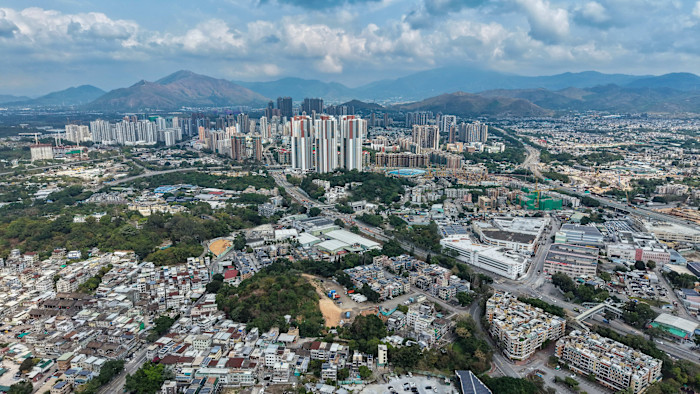
From Hong Kong’s rural northern reaches, the towers of tech hub Shenzhen loom on the horizon, marking the border with mainland China.
Soon, an ambitious project will bring the two sides much closer together.
A huge infrastructure initiative aims to transform a swath of Hong Kong’s New Territories — a ramble of fish farms, towns and brownfield sites — into an industrial and technology belt that will revive the Asian financial hub.
Authorities hope the project, termed the Northern Metropolis, will breathe new life into Hong Kong’s economy, which was dented by anti-government protests in 2019 and Covid restrictions that led to an outflow of people and foreign investment.
They also envision it as a way to bind the territory closer to China, shifting the centre of commercial gravity northwards towards the border and deepening integration with mainland cities.
For longtime residents such as Kwok, 66, however, the plan means something more immediate: eviction. His village is among the first set to be cleared in the coming weeks.
“It will be hard to part with it. The rent is just several thousand dollars a month,” he said outside the makeshift shelter of corrugated iron and wooden boards where he has lived since 1998, a year after the British territory was handed back to China. “But now there’s nothing for it — they want to build.”
The scheme, first unveiled in 2021, will transform underutilised parts of the New Territories into four economic hubs focused on commerce, professional services, technology and eco-tourism spanning 30,000 hectares, one-third of Hong Kong’s landmass.
With a slew of new residential developments, the projects will also eventually house 2.5mn people, the government says, a third of the city’s population, helping to ease a decades-long housing crisis.
That includes the 1.1mn currently residing in the project area as well as luring new arrivals from Hong Kong’s dense urban districts, China and overseas with job opportunities and access to mainland markets.
For authorities, the Northern Metropolis forms a critical part of what Beijing calls the Greater Bay Area, a network of 11 cities of the Pearl River Delta envisioned as a mega-metropolis to rival Silicon Valley or Tokyo.
“The Hong Kong government is attaching great importance to the development of the Northern Metropolis,” said Sonny Lo, a professor at the University of Hong Kong.
“The idea is to integrate the northern part of Hong Kong economically, logistically and socially with the Greater Bay Area, especially Shenzhen, at a much faster pace.”

Analysts said the development reflected more emboldened policymaking in Hong Kong in recent years. Since the 2019 protests, authorities have dismantled civil society, stifled dissent and overhauled the legislative system to disqualify the political opposition.
“In the past . . . a strong civil society opposing the government [and] legal action by stakeholders could delay the process,” said Lo. “But now we can see that . . . the roadblocks . . . have already been cleared.”
It also emulates China’s model of spurring growth with infrastructure mega-projects focused on priority sectors such as technology.
In October, Hong Kong’s leader John Lee highlighted the Northern Metropolis as a pillar of the city’s five-year plan, its first ever, mirroring China’s trademark economic development road maps.
Xia Baolong, Beijing’s top official for Hong Kong, has also urged the city to accelerate the project, telling officials on a two-day tour of the territory in June to make the most of a “precious window of opportunity” to speed up development, according to a local official.

For proponents, Beijing’s backing is a blessing. The Northern Metropolis could help diversify Hong Kong’s economy beyond its traditional pillars of finance and trade and tap into the tech boom that has powered neighbouring Guangdong province.
“Before, some people just didn’t want to touch the mainland,” said Jeffrey Lam, a former legislator and newly appointed chair of the company responsible for developing Hung Shui Kiu, one of the project’s first industrial parks.
“We are part of the People’s Republic of China,” he added. “They have been showing helping hands when Hong Kong is in need.”
Lam said he hoped the park could eventually have a borderless arrangement with Qianhai, a special economic zone across Shenzhen Bay.
Analysts at S&P Global Ratings have estimated the project will cost more than HK$360bn (US$46bn) over the next five to six years — higher than the government’s estimate of HK$224bn. About HK$140bn of that cost is set to be borne by government-related entities, S&P said.
It also marks a new precedent for Hong Kong towards mainland-style development, where the government uses a combination of debt and equity funding and private partnerships to fund developments. In the past, Hong Kong paid for large-scale infrastructure projects via its large fiscal surpluses, the rating agency said.
The first land tender for Northern Metropolis, related to the Hung Shui Kiu park, last month drew just two bids, one from Hong Kong developer Henderson Land and another from a consortium of Chinese developers and ecommerce group JD.com.
In response to a request for comment, Hong Kong’s Development Bureau said the Northern Metropolis “provides a strategic connection point to the Greater Bay Area” that would “integrate technology, education, talent and industry, deepening our collaboration with GBA cities”.
It added: “There has been clear support within society that we should speed up [Northern Metropolis] development to strengthen Hong Kong’s relevance in the area, provide more quality jobs for our next generations and create a more liveable environment.”


Gary Ng, senior economist at French investment bank Natixis, said that Hong Kong could leverage its strengths in research and development in fields such as biotechnology but could struggle to compete with lower-cost hubs in Shenzhen and Guangdong.
“The Hong Kong government has been trying to boost innovation over the past 30 years,” he said. “Not all projects have really lived up to expectations.”
One previous mega-project was Lantau Tomorrow Vision, a HK$580bn land reclamation plan that would host a new business district and housing for as many as 1.1mn people on a series of artificial islands. It was shelved indefinitely in 2024.
Such ambitions seem similarly far-fetched in the New Territories village of Yick Yuen Tsuen, where overgrown banyan tree roots twist around the shape of an already demolished home. But large red-ink banners demanding greater compensation from the government point to changes to come.
“We villagers actually don’t want to leave,” said Wong Chiu, a construction worker who has lived in the village since 2010. “But if the government insists on doing this, we have no choice.”
Cartography by Cleve Jones
