

Close Menu
NCIJ Network NCIJ Network
    What's Hot

    US House votes to hold billionaire Epstein associate Leon Black in contempt of Congress

    September 16, 2026

    Greens just four points behind Labour in urban areas, poll reveals | Green party

    September 16, 2026

    Planning permission for new Scottish AI datacentres suspended for up to a year | Datacentres – UK

    September 16, 2026
    Facebook X (Twitter) Instagram
    Trending
    • US House votes to hold billionaire Epstein associate Leon Black in contempt of Congress
    • Greens just four points behind Labour in urban areas, poll reveals | Green party
    • Planning permission for new Scottish AI datacentres suspended for up to a year | Datacentres – UK
    • Anthropic merges Claude chat and Cowork into one
    • Windows 11 KB5124008 update breaks domain trust for some users
    • Circle (CRCL) debuts Arc blockchain in biggest bet yet beyond $74B USDC stablecoin
    • Scientists find an immune “false alarm” that may drive rapid aging
    • Trump, God, and the Struggle for the Chin State
    • About
      • Our Team
      • Editorial Policy
      • Editorial Independence
      • International Support
    • Trust & Standards
      • AI Usage Policy
      • Conflict of Interest Policy
      • Corrections Policy
      • Ethics Policy
      • Fact-Checking Policy
      • Source Protection
    • Get Involved
      • Guide for Sources
      • Support Independent Journalism
    • Legal
      • Cookie Policy
      • Privacy Policy
      • Terms of Use
    Facebook X (Twitter) Instagram
    NCIJ Network NCIJ Network
    Wednesday, September 16
    • Home
    • World
    • Ai
    • Business
    • Politics
    • Health
    • Crypto
    • Science
    • Technology
    • Cybersecurity
    • Defense & Security
    • Economy
    • Energy
    • Europe
    • More
      • Fact Check
      • Investigations
      • Opinion & Analysis
      • Environment
    NCIJ Network NCIJ Network
    Home»Science

    Hidden magnetism inside atoms may explain mysterious gamma rays

    NCIJ NETWNCIJ NETWORKBy NCIJ NETWNCIJ NETWORKAugust 22, 2026 Science No Comments3 Mins Read
    Share
    Facebook Twitter LinkedIn Pinterest Email

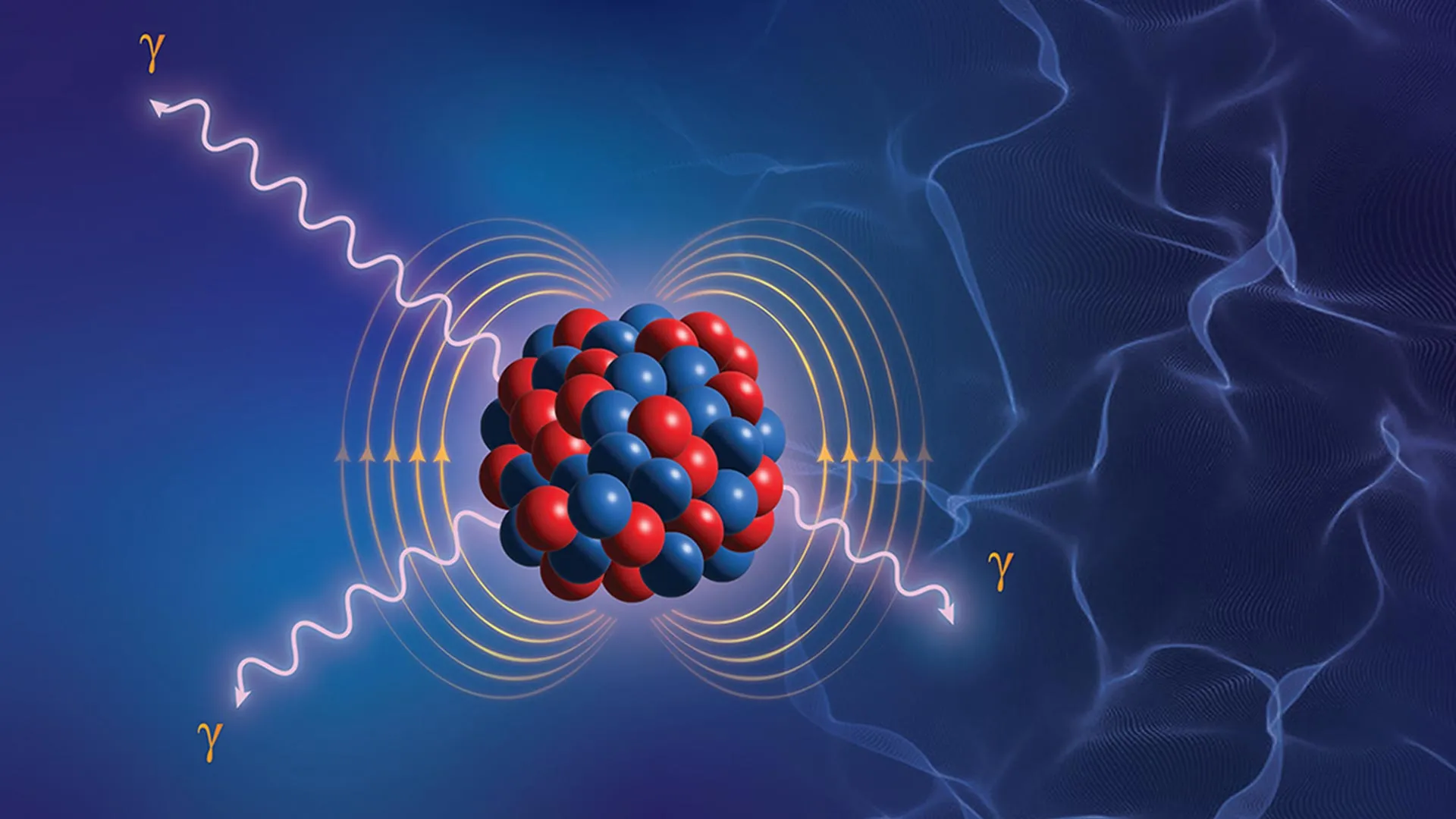
    A decades-old puzzle in nuclear physics has centered on a strange question: why do some atomic nuclei release more low-energy gamma rays than scientists expect?

    A new study led by the Facility for Rare Isotope Beams (FRIB), with researchers from Lawrence Livermore National Laboratory (LLNL), may provide the answer. Published in Nature, the findings offer new insight into the structure of atomic nuclei and could have important implications for astrophysics, nuclear energy, national security, and nuclear forensics.

    Gamma rays are a form of electromagnetic radiation, just like visible light and radio waves. They are released when excited atomic nuclei lose energy and move into lower, more stable states during radioactive decay.

    A Longstanding Gamma Ray Mystery

    For decades, scientists have noticed that some nuclei emit an unexpectedly large number of low-energy gamma rays. This effect, known as “low-energy enhancement,” has been difficult to explain. It does not appear in every nucleus, and researchers have not been able to reliably predict where it will occur.

    “This low-energy enhancement wasn’t predicted by theory, so it was kind of a shock to the community when it was first observed,” said Eleanor Ronning, lead author of the study and former FRIB graduate student. “It is difficult to predict where [low-energy enhancement] occurs — we don’t know which nuclei will exhibit it.”

    The new results provide strong evidence that magnetic transitions within the nucleus are responsible for the effect.

    “This is a key step forward,” said Andrea Richard, co-lead of the study, former postdoctoral researcher at LLNL and current assistant professor at Ohio University. “We now have a consistent explanation that connects experimental observations with theory.”

    Separating Electric and Magnetic Nuclear Decay

    To investigate the mystery, the researchers measured gamma rays produced as a radioactive copper isotope decayed into zinc. FRIB’s specialized instruments and capabilities allowed the team to separate two distinct decay states and examine them individually.

    In one state, the decay involved an electric transition. As the copper transformed, protons inside the nucleus shifted their positions.

    The second state involved a magnetic transition. In this case, the neutrons and protons in the nucleus essentially flipped their internal magnets.

    Only the magnetic transition produced the low-energy enhancement in gamma rays. That result showed that the phenomenon is magnetic in nature.

    Ronning and Richard jointly proposed the experiment. Along with Richard’s work as a postdoctoral researcher, other LLNL scientists contributed their expertise and helped monitor the experiment continuously during the weeklong, 24/7 run.

    Implications for Nuclear Science and Security

    Although the study focused on just one nucleus, the researchers say the findings could improve nuclear models across a much wider range of elements and reactions.

    “We can improve the knowledge of our stockpile performance and interpretation of past test program results using the improved theory based on these discoveries,” said author and LLNL scientist Darren Bleuel. “In addition, we can improve nuclear forensics — our ability to determine if a nuclear event has occurred and identify the most likely source.”

    The findings could also help scientists better model nuclear reactions in stars, supernovae and neutron star mergers — including the reactions responsible for creating heavy elements — while improving understanding of processes relevant to nuclear energy.

    Atoms explain gamma hidden magnetism mysterious rays
    NCIJ NETWNCIJ NETWORK
    • Website

    Keep Reading

    Scientists find an immune “false alarm” that may drive rapid aging

    These mice have human (nerve cells) on the brain

    NASA Watches Earth’s Weight, Finds Center of Mass

    NASA Celebrates Restoration of Guam Station Damaged by Typhoon Mawar  – NASA

    Part-human part-mouse brain developed in science breakthrough

    Scientists turn seawater into fresh water without harmful brine

    Add A Comment
    Leave A Reply Cancel Reply

    Editors Picks

    US House votes to hold billionaire Epstein associate Leon Black in contempt of Congress

    September 16, 2026

    Greens just four points behind Labour in urban areas, poll reveals | Green party

    September 16, 2026

    Planning permission for new Scottish AI datacentres suspended for up to a year | Datacentres – UK

    September 16, 2026

    Anthropic merges Claude chat and Cowork into one

    September 16, 2026
    Latest Posts

    What is Trump Media’s Truth API and why is it controversial?

    August 4, 2026

    How ProPublica Tested Hundreds of Omaha Homes for Lead — ProPublica

    August 4, 2026

    Golar LNG raises $600 million loan with FLNG business expansion in mind

    August 4, 2026

    Subscribe to News

    Get the latest sports news from NewsSite about world, sports and politics.

    NCIJ Network is an independent digital news platform delivering trusted investigative journalism, European and global news, in-depth analysis, and fact-based reporting with accuracy, transparency, and integrity.

    Facebook X (Twitter) Instagram Pinterest YouTube

    US House votes to hold billionaire Epstein associate Leon Black in contempt of Congress

    September 16, 2026

    Greens just four points behind Labour in urban areas, poll reveals | Green party

    September 16, 2026

    Planning permission for new Scottish AI datacentres suspended for up to a year | Datacentres – UK

    September 16, 2026

    Subscribe to Updates

    Get the latest creative news from FooBar about art, design and business.

    Type above and press Enter to search. Press Esc to cancel.