


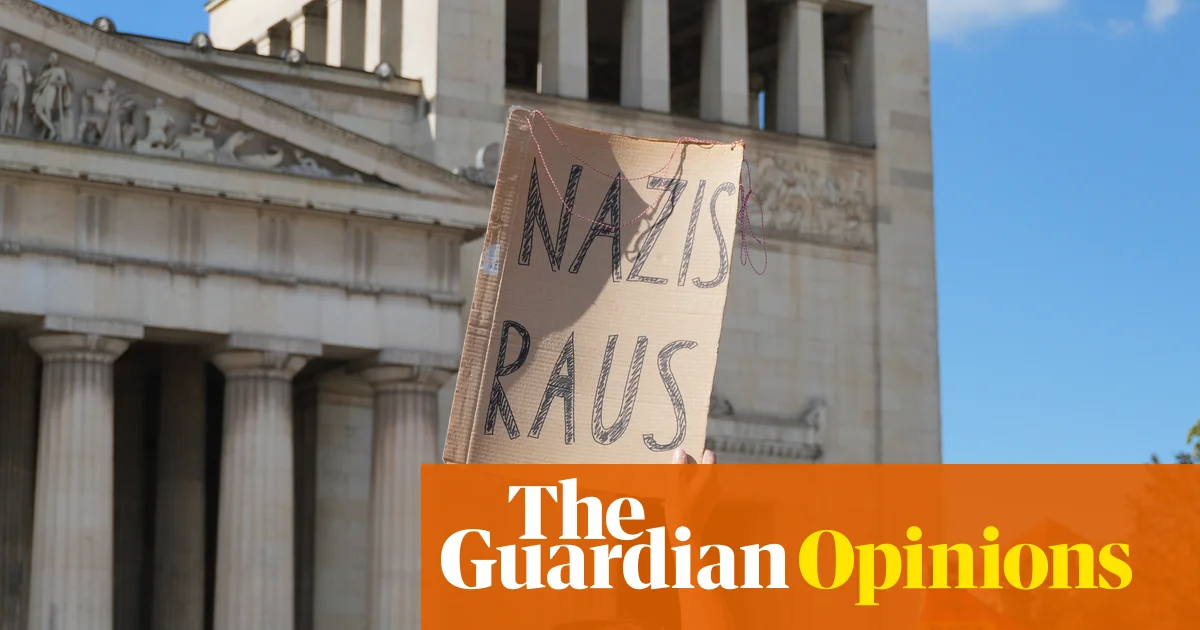
Far-right nationalist populist parties are making the running everywhere from Washington to Warsaw. So why be so alarmed about a little regional electoral victory for one such party, the Alternative für Deutschland (AfD), in one federal state, Saxony-Anhalt? “Because it’s Germany!” is the almost instinctive answer in many heads around the world.
But that “because it’s Germany” needs to be taken apart, like the segments of an orange. Yes, because of Adolf Hitler, two dictatorships (Nazi Germany until 1945, communist-ruled East Germany until 1989) and two world wars. And yes, some of the language used by the AfD will give anyone familiar with Nazi rhetoric a cold shudder down the spine.
Then there’s the fact that Germany is Europe’s central power. The AfD’s national co-leader Alice Weidel says that when her party gets into government after the federal election scheduled for 2029, Germany will abandon the euro and leave the Schengen border-free travel area. What would be left of the EU then?
The great German liberal social and political thinker Ralf Dahrendorf, who died in 2009, told me more than once that he would only feel really confident of the resilience of German democracy when it had withstood the test of a big economic crisis. Well, the country is close to that now.
The final segment of “because it’s Germany!” is perhaps the most interesting. The federal republic’s entire constitutional, political and educational system is designed to prevent anything like the collapse of the Weimar republic into Hitler’s dictatorship in 1933. The federal republic should be a wehrhafte Demokratie – a democracy capable of defending itself.
So how Germany will defend its democracy is a question not just of European but of global significance. Looking at all the answers being frenetically canvassed in Berlin, I think the most convincing formula is: neither ban the AfD nor embrace it, but instead constrain it legally and fight it politically.
The German constitution provides for political parties that are “hostile” to its basic liberal democratic principles to be banned. Senior German politicians have called for an application to be made to the constitutional court to ban the AfD, or at least its most extreme parts, on those grounds. But it’s too late for that. The AfD has been a major force in the Bundestag since its success (off the back of the migration crisis) in the 2017 general election and, like Reform UK in Britain, has led nationwide in opinion polls. To suddenly tell so many citizens “you’re not allowed to vote for the party you support!” would itself be an assault on democracy.
But this is not democracy as the tyranny of the majority: the people have spoken, off with your head! It’s liberal democracy, meaning the outcome of any popular vote is constrained by the rule of law, human and minority rights, and pluralist, anti-majoritarian institutions. The real threats to German democracy today are less like Weimar in 1933 than Budapest in 2010 (when Viktor Orbán took over) and Washington DC in 2025. The mini-Donald Trumps of the AfD have reportedly been quietly exploring Trump-like executive and administrative devices they might use to consolidate their control. The Federal Republic of Germany has the right, the power and the duty to stop them.
Article 37 of the constitution, which allows federal authorities to overrule anti-constitutional behaviour by the states, has never been used in the 77-year history of the republic. Assuming, as now seems likely, the AfD forms the state government in Saxony-Anhalt, all federal powers, up to and including article 37, should be used wherever necessary. For example, they should prevent sensitive intelligence about Russia’s increasing aggression being shared with a Saxony-Anhalt branch of the domestic security service controlled by the pro-Russian AfD; secure the independence of courts and prosecutors, as well as the neutrality of police and civil service; and, I would add, stop any extreme politicisation of education and public service broadcasting. Of course, AfD politicians will cry “foul!”; tough. If, as they say, they want “another republic”, they can go and live in Russia.
Yet even more important than these legal and administrative constraints is the political response. At the opposite end from those calling for the party to be banned are Christian Democrats calling for the “firewall” to be abandoned and AfD politicians to be embraced as part of the normal political process. Letting them take responsibility in a state government will, it’s argued, expose their incoherence, incompetence and lack of real policy answers.
Talking and working with them will end up moderating them, as apparently happened with Giorgia Meloni’s Brothers of Italy. I’ve been tempted by these arguments myself. But evidence collected by political scientists suggests that a strategy of inclusion is just as likely to put more wind in the nationalists’ sails. And AfD activists are themselves warning against the danger of Melonisierung (Melonisation).
So Christian Democrats should not be tempted to get half into bed with the AfD, like a middle-aged man nervously edging into an extramarital affair. Instead, starting already this weekend with elections in Mecklenburg-Vorpommern and Berlin, they should more effectively combat it politically. Rather than defining Christian Democracy by what it’s against (the AfD and the far-left Linke), they should say what it’s for. To renew Germany’s social market economy, they should implement all the labour market, pension, tax and other reforms agreed this summer with their Social Democrat coalition partners – and more. Faced with huge external challenges, from Russian aggression to US and Chinese AI, the Christian Democrats – historically the party of Europe – should boldly advocate the European-scale answers which alone will give any European country the strength to stand up to giants.
after newsletter promotion
But besides AI, Germany’s mainstream parties badly need EI (emotional intelligence). The key to the success of the AfD’s Ulrich Siegmund in Saxony-Anhalt, as with Trump and Britain’s Nigel Farage, is a kind of emotional communication. I’m here with you; I hear you and see you; I share your anger. With me, you can say what you really think and be yourself, because – whether or not I’m a millionaire – deep down I’m a normal bloke like you. So let’s all have a beer and march forward to an imagined past.
It’s fascinating to re-read the exiled German political scientist Karl Loewenstein’s influential 1937 article on “militant democracy” and find him insisting that democracy cannot “devise emotional formulas capable of competing with the fascist Pied Pipers”. Hence the emphasis on constitutional constraints. But in our transformed information environment, with its premium on attention, drama and passion, democracy can’t be defended simply by legal constraints and rational policies. Democrats everywhere need to compete with today’s Pied Pipers on the emotional plane, too. Constant presence on social media and physical presence on the ground are both essential.
Hungary’s new prime minister, Péter Magyar, and to some extent the UK’s, Andy Burnham, have shown how it can be done. So much will now depend on German democrats, and especially Christian Democrats, proving they can do the same.
-
Timothy Garton Ash is a historian, political writer and Guardian columnist. His new book, Europe in 7 1/2 Chapters, is published in October
-
Do you have an opinion on the issues raised in this article? If you would like to submit a response of up to 300 words by email to be considered for publication in our letters section, please click here.
