


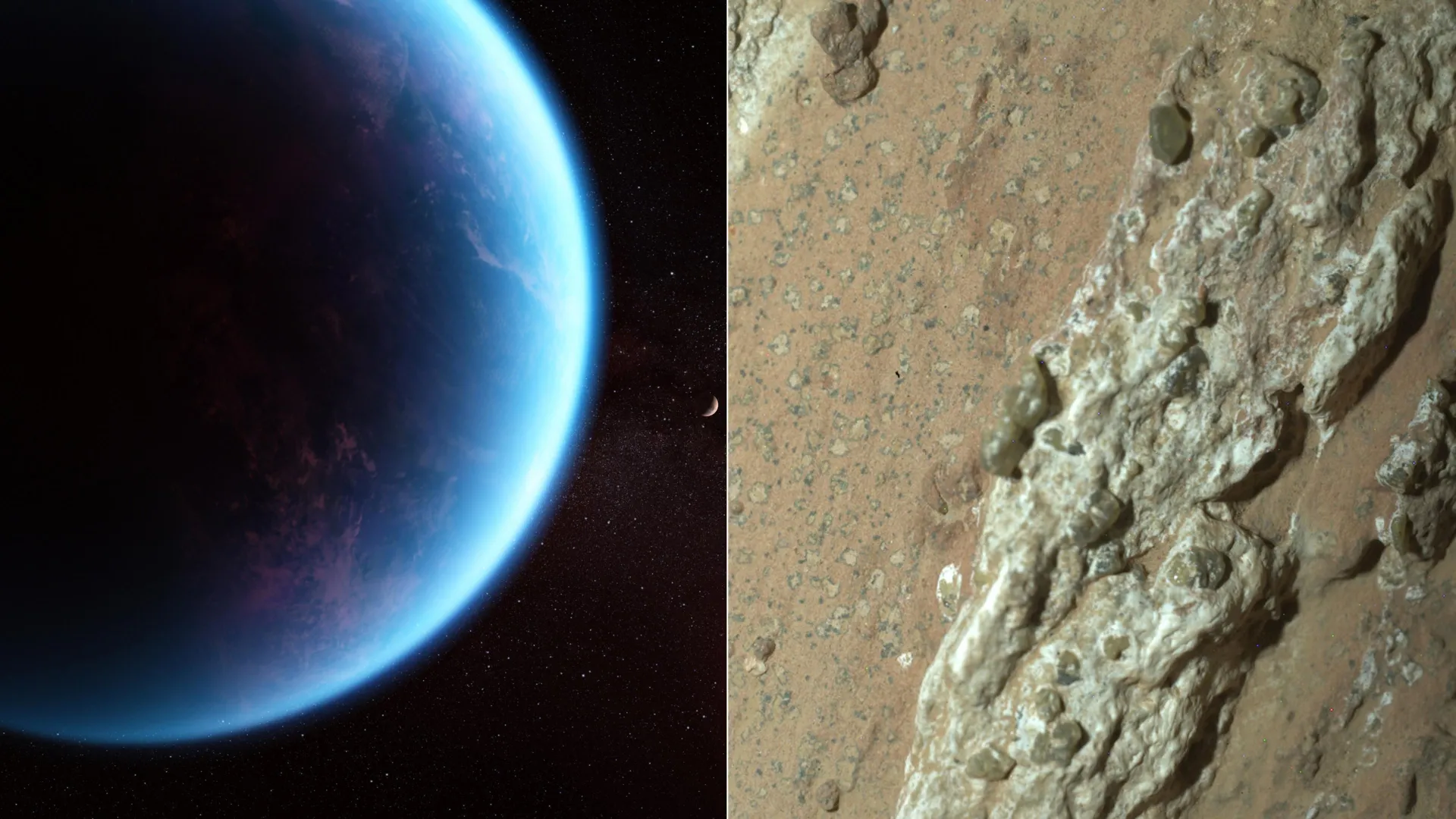
It may seem like we are on the verge of discovering alien life. In 2025, a press release stated that we have the “strongest hints yet” of extraterrestrial life on the exoplanet K2-18b. And when talking about a collected sample from a rock named “Cheyava Falls” on Mars, NASA Administrator Sean Duffy said this was the “closest we have ever come” to discovering life on the red planet.
Such moments capture the imagination. But they also raise an important question: what do the majority of scientists actually think?
Surprisingly, we usually don’t know. When a scientific controversy or breakthrough dominates headlines, press officers and journalists often quote a handful of experts. These views may be insightful, but they rarely tell us what the wider scientific community thinks. And yet public discussions frequently rely on phrases such as “the science says” or “scientists believe”, as if there were a clear and measurable answer.
In reality, systematic evidence about scientific opinion is often missing. My colleagues and I recently tried to change that in the domain of astrobiology. Shortly after the two major announcements of possible extraterrestrial life in 2025, we surveyed astrobiologists to understand how expert judgment was distributed across the field.
The first case concerned the exoplanet K2-18b. In April 2025, researchers reported possible traces of molecules called dimethyl sulfide and/or dimethyl disulfide. On Earth, these are associated with biological activity. Media coverage was extensive, with many reports framing the finding as an extraordinary advance in the search for alien life.
The second case came in September, when NASA announced that Cheyava Falls appeared to preserve a potential biosignature – so-called “leopard spots” which are mineral rings that on Earth are often formed by microbial activity. Again, headlines, and NASA officials themselves, suggested something momentous.
What scientists actually thought
We surveyed hundreds of astrobiologists from across the global research community, within days of each announcement. We asked a simple question: did scientists think extraterrestrial life had probably been found?
The results revealed a rather cautious picture. For K2-18b, only 6.6% of surveyed astrobiologists agreed that scientists had probably found extraterrestrial life. Nearly two-thirds disagreed, while 28.0% remained neutral. For the Mars case, confidence was higher but still cautious: 15.1% agreed, disagreement fell to 44.6% and neutrality rose to 40.3%.
Looking only at agreement and disagreement, however, misses an important part of the story. The proportion of astrobiologists who strongly disagreed fell dramatically, from 35.1% in the K2-18b case to just 11.1% for Mars. Much of the movement was therefore not from rejection to endorsement, but from strong rejection towards more tentative positions.
In other words, expert opinion moved in structured ways. The shift from K2-18b to Mars was not a simple movement from “no” to “yes”. Instead, the community became more open to the possibility without embracing it outright.
One possible reason is that the two cases involved different kinds of evidence. The K2-18b claim relied on possible atmospheric signatures detected from across interstellar distances, whereas the Martian case concerned a rock that could be studied directly and in much greater detail. At the same time, astrobiologists have long been aware that apparently lifelike features can sometimes arise through non-biological processes. Often, the challenge is not imagining how life could produce a signal, but understanding all the ways nature might produce something similar without life.
Scientific opinion is rarely binary. Public discussion often treats science as though communities either agree or disagree. But the distribution of opinion matters too. Strong agreement, agreement, neutrality, disagreement and strong disagreement can each tell us something different about how a scientific community is responding to a claim.
A large neutral response can indicate several things. Scientists may judge the evidence genuinely inconclusive. They may hold an intermediate level of confidence. Or they may regard a claim as too speculative to endorse or reject decisively. Likewise, movement from strong disagreement towards ordinary disagreement may signal a softening of attitudes even when overall disagreement remains high. Treating scientific opinion as simply “for” or “against” risks flattening these important distinctions.
Beyond extraterrestrial life
The broader lesson extends well beyond extraterrestrial life. In areas such as climate science, pandemics, artificial intelligence or medical research, public conversations frequently invoke scientific consensus.
Sometimes strong agreement genuinely exists. Sometimes it does not. But we often lack systematic ways of measuring what scientists actually think, especially where evidence is emerging or uncertainty remains substantial. Instead, discussions rely heavily on selective quotation, vocal individuals or assumptions about community views.
Efforts to do this more systematically are beginning to emerge. At Durham University, our research group, C-Scope (the Centre for Scientific Community Opinion Polling and Evaluation), studies how expert opinion is distributed and how it changes over time. We are not trying to replace evidence with polling, nor to treat majority opinion as truth. Our aim is to better understand how scientific communities respond to uncertainty.
Scientific knowledge advances through uncertainty, disagreement and gradual revision. If public discussion, and perhaps political will, increasingly turns on claims about what scientists think, we should make more effort to find out.
