


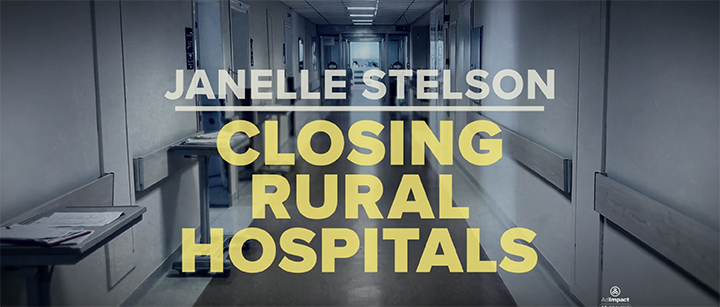
As Democrats release a flurry of midterm ads portraying GOP cuts to Medicaid as a threat to rural healthcare, Republicans have countered with ads claiming Democratic candidates in Texas and Pennsylvania would put dozens of rural hospitals out of business by creating a public health insurance option. But the ads cite an industry-backed study whose assumptions don’t apply to all public option proposals.
In Texas, according to ad-tracking service AdImpact, President Donald Trump’s political operation has spent more than $6.9 million on an ad claiming James Talarico, the Democratic candidate for Senate, “supports a radical healthcare plan” that “could close 30 hospitals.”
And in central Pennsylvania’s 10th Congressional District, which includes the state capital of Harrisburg, an ad from a group backed by House Republican leadership claims Democrat Janelle Stelson supports “a plan to close up to 25 Pennsylvania rural hospitals” and accuses her of “closing the hospitals your family depends on.”
Talarico, a state legislator, is running against state Attorney General Ken Paxton in the closely watched Texas matchup. Stelson, a former local news anchor, is challenging incumbent Republican Rep. Scott Perry. Both races are rated toss-ups by the Cook Political Report.
The GOP ads in Texas and Pennsylvania don’t tell viewers exactly what Democrats’ “radical healthcare plan” is. But both of them cite a 2019 report from the consulting firm Navigant about the potential impact of creating a public option — a form of government-backed health insurance that people could buy into at a lower cost than private insurance.
That analysis was commissioned by the Partnership for America’s Health Care Future, a coalition of groups opposed to policies like a public option and Medicare for All. The coalition’s members include groups representing hospitals, insurers and other healthcare and business interests.
The Navigant report estimates that anywhere from 28% to 55% of rural hospitals nationwide would be at “high risk” of closing if a public option were implemented, depending on how many people switch from private insurance. That includes 11 to 30 rural hospitals in Texas and 15 to 25 in Pennsylvania. By comparison, an earlier analysis from the same firm estimated that 21% of rural hospitals were already at high risk of closing without a public option, including 12 in Texas and 9 in Pennsylvania.
But those estimates are based on a major assumption — that a public option would pay hospitals the same rates as Medicare. And that’s not true of every proposal.
Most recent Democratic public-option proposals we reviewed would pay either rural hospitals or hospitals in general somewhat more than Medicare does. Talarico has said he wants to raise payment rates as part of his healthcare plan, in which case the Navigant study’s assumptions wouldn’t apply. Stelson’s campaign told us she hasn’t committed to a specific public option proposal, but generally supports more funding for rural hospitals.
“I think it would be reasonable to look at this [analysis] with some skepticism,” Christine Monahan, an associate research professor at Georgetown University’s Center on Health Insurance Reforms, told us, noting that its estimates of at-risk hospitals are based on a “theoretical proposal” that doesn’t line up with what most advocates are actually proposing.
Lydia Hall, a spokeswoman for the Congressional Leadership Fund, the group behind the Pennsylvania ad, told us Stelson “knows supporting a public option is unpopular and is now desperately trying to reframe her stance on a position she’s championed for a long time,” but did not answer specific questions about the ad. MAGA Inc., Trump’s super PAC, did not respond to our questions about the Texas ad.
Proposals for a public option have circulated for years, including during debates over the 2010 Affordable Care Act and during the 2020 Democratic presidential primary. Eventual winner Joe Biden was among the candidates championing a public option as a more moderate alternative to proposals like Medicare for All, which would largely or entirely replace private insurance with a government-run single-payer system.
The idea hasn’t gotten as much attention recently, with Democrats’ messaging ahead of the midterms focused largely on reversing Trump’s changes to Medicaid and restoring more generous Affordable Care Act subsidies that Republicans let expire at the end of last year. But some Democrats have said a public option could be on the table if the party retakes power in 2028, and candidates like Talarico and Josh Turek, the Democrat running for Senate in Iowa, have made it a part of their campaign platforms. Others, including Senate candidates Troy Jackson in Maine and Abdul El-Sayed in Michigan, have endorsed more sweeping Medicare for All proposals.
The basic premise of a public option is that the government would create a health insurance plan that people could opt into, with lower premiums than private plans. (Some versions would allow people to buy into Medicare at any age, rather than creating a whole new program.) Proponents hope that would expand coverage to more people and lower overall premiums by forcing private insurers to compete.
The savings that make it possible for a public option to offer lower premiums would come from the government using its leverage to set or negotiate payment rates that are lower than what hospitals typically get from private insurance. So there would likely be some impact on hospitals’ bottom lines.
But what that impact looks like “really depends on how the policy is designed,” including where payment rates are set, said John Holahan, an institute fellow at the Urban Institute who has studied such policies.
The Navigant study cited in the ads assumes that a public option would reimburse healthcare providers at the same rates as Medicare. Because private insurers tend to pay hospitals about 2.5 times what Medicare does for the same services, that “would be a big cut for a lot of hospitals,” Holahan said.
But, he said, most public option proposals don’t go that far. For instance, some aim for rates that are 60% to 100% above what Medicare pays, which he said would be enough to produce some savings without huge impacts on most hospitals’ finances.
Monahan also noted that the effects would play out differently for different hospitals. Part of the rationale for a public option, she said, is to curb costs at hospitals that can charge excessive prices because they effectively have a monopoly in their area. But some independent hospitals or practices that don’t have the same negotiating leverage with major insurers might benefit from certain public-option pricing systems. Hospitals are also required to provide emergency care regardless of insurance status or ability to pay, so some could see their uncompensated care costs go down if more people have insurance.
Democrats in Congress have proposed several different versions of a public option since 2019, according to comparisons compiled by health policy organizations KFF and The Commonwealth Fund. Some use Medicare rates as a baseline but allow for certain adjustments, such as paying rural hospitals up to 25% or 50% more. Others direct the government to negotiate rates with providers using Medicare rates as a floor, which would presumably result in rates that are somewhat higher.
The Navigant report itself says that depending on how many people switch to a public option, rates that are 40% to 60% above Medicare’s would be enough to “hold rural hospitals harmless.”
We asked the Talarico and Stelson campaigns about how they would set payment rates under a public option, but neither gave us specifics.
Talarico has talked about a proposal he’s calling “Medicare for Y’all,” which would allow Americans of all ages to buy into Medicare as an alternative to private insurance. (Note that this is different from “Medicare for All” proposals, which generally aim to replace private insurance entirely.) His campaign website also says he would “improve Medicaid and Medicare reimbursement rates,” though a campaign spokesperson, JT Ennis, did not answer our questions about whether Talarico has specific targets in mind.
Stelson’s campaign told us she broadly supports the concept of a public option, but has not committed to a specific proposal. A spokesperson also pointed us to a policy document the campaign has released that says Stelson would “fight for increased funding and staff for our rural hospitals.”
Without more details, it’s hard to assess the impacts those policies would have. But neither candidate appears to have proposed the specific policy contemplated by the Navigant report — a public option paying current Medicare reimbursement rates — and Talarico has explicitly said he wants reimbursement rates to be higher. So it’s inaccurate to claim, as the ads do, that the candidates support a plan that’s been estimated to risk putting as many as 55 hospitals across Texas and Pennsylvania out of business.
Editor’s note: FactCheck.org does not accept advertising. We rely on grants and individual donations from people like you. Please consider a donation. Credit card donations may be made through our “Donate” page. If you prefer to give by check, send to: FactCheck.org, Annenberg Public Policy Center, P.O. Box 58100, Philadelphia, PA 19102.
