


- Gabon passed a decree this year requiring benefit sharing for commercial uses of the medicinal plant iboga, its derivatives, and associated traditional knowledge, but the mechanisms for distributing those benefits are still being built.
- A community association in Ogooué-Ivindo province earned the equivalent of about $50,000 from three legal iboga shipments since 2023, yet its promised share of value created further downstream has still not arrived.
- The decree is unusually broad, attempting to cover ibogaine, analogs, and compounds made through synthetic or alternative sources, although how Gabon could enforce those claims abroad remains unresolved.
- In September, Gabon moved to halt exports of iboga and all derivatives while it develops a new national framework, freezing even the legal community-based trade the country had previously encouraged.
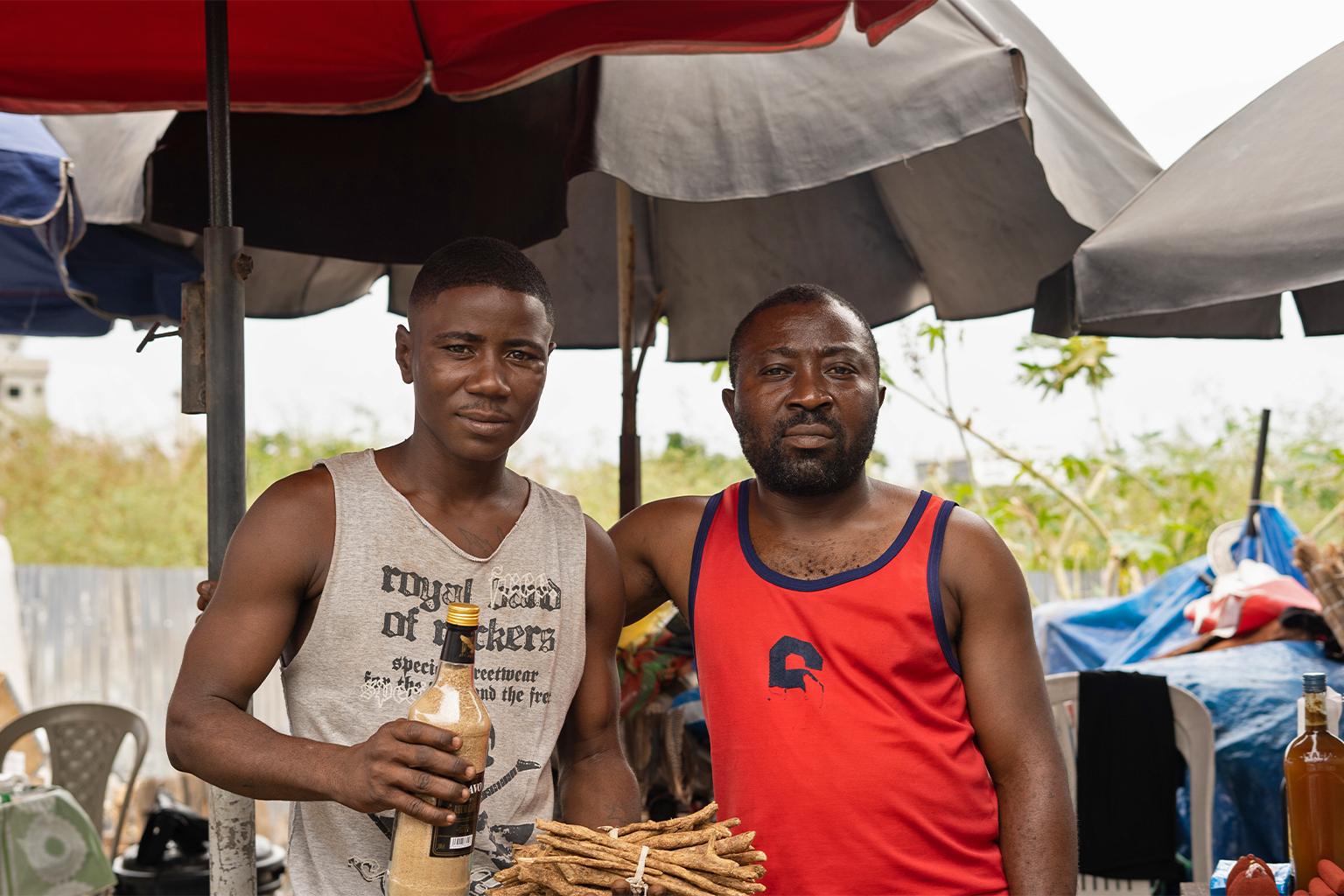
LIBREVILLE — In the traditional-medicine corner of La Peyrie Market in Libreville, iboga comes in a repurposed clear rum bottle packed to the neck with pale bark powder, set among tinctures in old plastic bottles. Two men appeared within a minute, and once they heard they were talking to a journalist, went half-giddy. They were happy to say where the root goes: overseas, to clinics, some of it ground into capsules.
“Do the buyers pay well?”
“They pay well,” one said. And all of it, he insisted, was legal.
Iboga, Tabernanthe iboga, is a plant native to the wet forests of West-Central Africa. And here in Gabon, its root bark plays a central role in several Bwiti (or Bwété) traditions. It is also the original source of ibogaine, an alkaloid extracted from the root, now drawing intense interest as an experimental treatment for addiction and other mental-health conditions.
The sellers at the market called the money good. But, further down the value chain, ibogaine treatment can cost thousands of dollars per patient. That gap, Gabonese practitioners and officials say, is at the heart of the dispute: the plant and the knowledge are theirs — and are threatened with overexploitation — while a lot of the money is made abroad. A 2023 Interpol analysis also found much of the trade was illicit, identifying that online resellers nearly quadrupled between 2021 and 2023.
And the market for the plant may only get bigger, officials speculate.
Interest in ibogaine is accelerating in the United States. A 2024 Stanford University observational study of 30 special-operations veterans reported sharp reductions in PTSD symptoms a month after a treatment with ibogaine plus magnesium. The state of Texas has allocated $50 million toward ibogaine research, and an April 2026 executive order directed federal agencies to accelerate research and establish access pathways for psychedelic drugs, explicitly including ibogaine compounds.
Ibogaine remains a Schedule I drug in the U.S., the government’s most restrictive category for drugs it deems to have no accepted medical use and a high potential for abuse, placing it in the same category as heroin. And because ibogaine is illegal in the U.S., the commercial treatment market is largely offshore. It’s banned in much of the rest of the world too, though Aotearoa New Zealand, Brazil, and South Africa allow it by prescription under medical supervision. Ambio Life Sciences, a Canadian company with clinics in Mexico, where it’s unregulated, and Malta, lists programs ranging in price from $7,350 to $30,000.
As more money accumulates around ibogaine, the question in Gabon is how much of it flows back down the chain to the people whose plant and knowledge sit at its beginning.
In theory, international law and new national decrees already have an answer.


Owed, and unpaid
Gabon is a party to the Nagoya Protocol agreement, in force since 2014, which requires participating countries to establish rules for access to genetic resources and the fair sharing of benefits arising from their use. The United States is not.
Iboga entered European laboratories around 1900 and was sold in France as a tonic long before U.S. patents covered methods of using ibogaine to interrupt drug dependence. No comparable benefit-sharing system existed back then to share that downstream value with Gabonese source communities. The pattern has precedent: Indigenous Amazonian knowledge of curare helped produce drugs fundamental to modern anesthesia, with little of the resulting value returning to the communities that held that knowledge.
This time, Gabon wants something different, though what benefit sharing should actually look like is still unsettled, and different players want different things. Until mid-September 2026, communities were paid for the iboga they grew and sold overseas. But this has faced a block after the government tightened an existing 2019 ban on exports — until a new plan for the plant is implemented, sources say.
Gabon also wants a cut of the money made further down the chain, from clinic treatments to patents, and even from synthetic ibogaine made abroad. Under another decree, signed in May this year, that money would flow into a national fund and be split between the state and the communities. Practitioners want it redistributed to the people who have kept the plant, which the government frames as a way of building an industry at home.
“The revenues from the exploitation of iboga must be redistributed,” Maître Moubeyi Bouale told Mongabay. “That is all we are asking.”

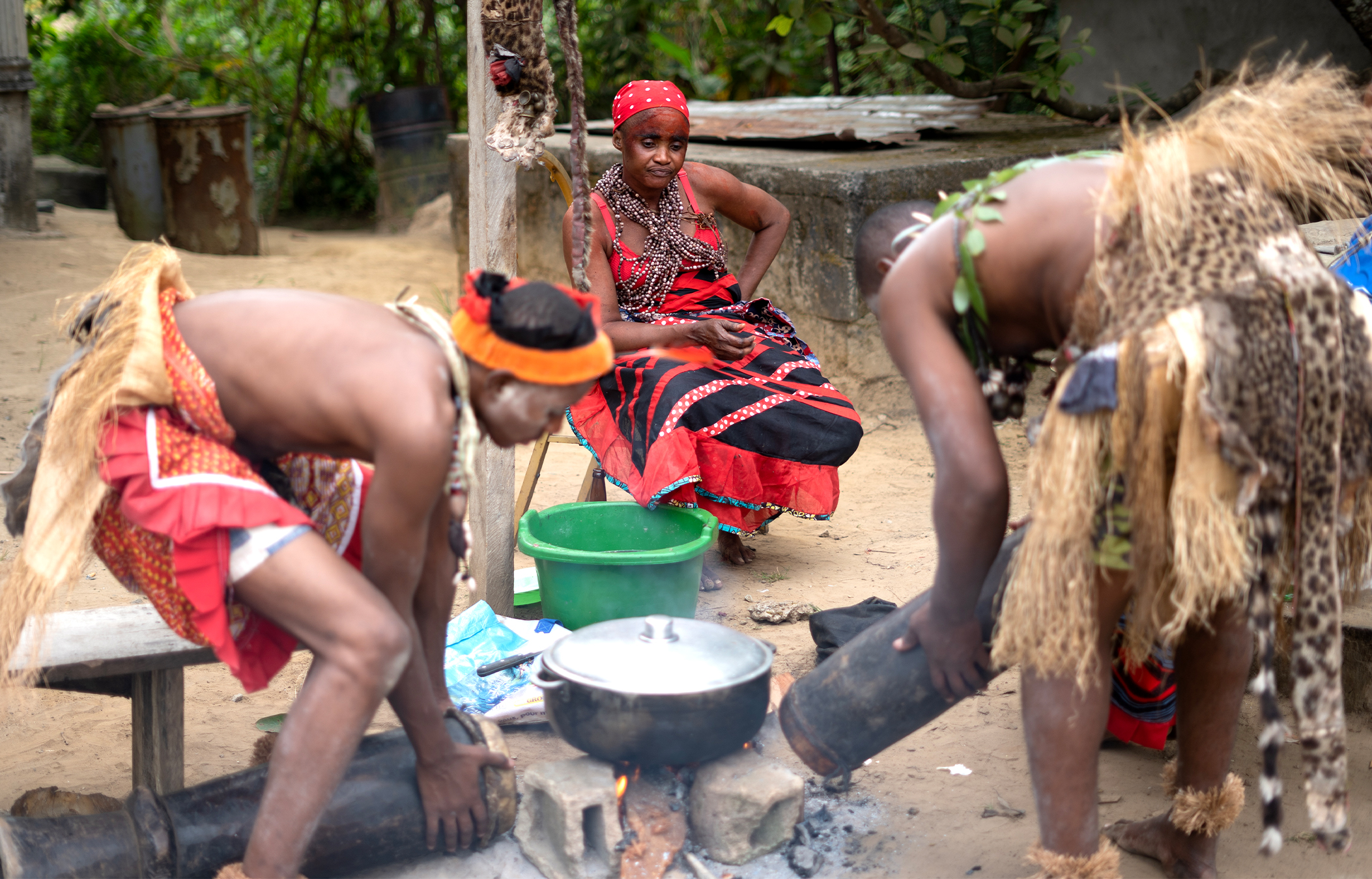
Moubeyi is national director of the Association Nationale Maghanga Ma Nzambé, which has spent this year registering temples nationwide for the Bwété Missoko rite, one of the branches of Gabon’s iboga-centered Bwiti traditions.
The demand is not to keep the world out, but to be let into the deal, he said. He described the boom as a maize field with wild boars tied along the fence. Let them loose, he said, and they flatten the whole crop.
One community in particular has set out to prove that growers can keep a share, not just sell the bark and vanish. A2E, an association of villages in Ogooué-Ivindo province, chose to farm iboga rather than rely on wild stocks. They put the sale to the whole community for a consensus vote, then shipped three legal orders to Terragnosis, a Canadian company: 41 kilograms (90 pounds) from 2023 to early 2025, for more than 32 million CFA francs, about $50,000, or roughly $1,200 a kilogram ($560/lb) — a small fraction of what a single ibogaine treatment sells for.
“Everything was paid,” A2E’s president, Elie Nloh, told Mongabay. Then, his voice dropped. Asked whether A2E had seen a franc of what the plant earns once the bark becomes an extract or a clinic treatment, he said, “That is the problem.”
The contracts indeed provided for a share of that later value. By the time Mongabay reported this, it had not reached A2E. Jonathan Dickinson, who runs Ambio and founded Terragnosis, does not dispute that. The money, he said, is being held in trust while the parties await guidance from the Gabonese government on its distribution. Paying a village for raw bark was the easy part, he said, while sharing the value created after it leaves the village has not happened.
None of this is entirely new. Stéphanie Moussounda, known as Maman Djédjé, a traditional practitioner initiated across several Gabonese rites, told Mongabay that a laboratory in the French city of Marseille once offered her $500/kg ($227/lb) for bark she used in her practice. She refused and asked instead: “Make me a patent.” Instead, she said, they took her for a fool, and the relationship fell apart.
Djédjé is also not asking the world to stay away. Iboga is like cassava to us, she said: we grow it, we eat it, we know it, and the law should chase traffickers, not healers.
She said she will share what she knows because it was given to her freely and she is bound to pass it on. Her condition is that it “be respected and valued,” adding that she can tell those who come to learn from those who come “to steal the molecules.”

A plant under pressure
The economic question is tied to a conservation one, practitioners say.
Yann Guignon, president of Blessings of the Forest Gabon, an NGO that has spent years working on community cultivation, conservation, and benefit sharing, said growing commercial demand is putting pressure on wild stocks and turning iboga into “a commercial product for private interests.”
That pressure comes not from the small, cultivated trade like A2E’s, but from the much larger illegal harvest of wild plants feeding the same demand. There are no reliable figures for how much iboga leaves the country, but much of the trade is illicit and underreported, a 2023 Interpol analysis suggests.
“The same poachers that traffic ivory or leopard skins are now known to traffic iboga, felling large areas of the bush in protected forests,” the analysis says. They export to Asia, Europe, and the United States, either directly from Gabon or via neighboring Cameroon.
The oldest trees go first, Guignon said, making iboga harder to find across parts of its range and heavily poached near the Cameroon border. For Guignon, building a legal trade means more than moving bark through the right paperwork: it means protecting the plant while keeping the communities that have maintained it inside the value chain.

Gabon’s answer came on May 22 this year, when President Brice Oligui Nguema signed Decree 0239, asserting sovereignty over iboga, its derivatives, and associated traditional knowledge, and seeking to reach some applications involving compounds made abroad. The decree requires authorization and benefit-sharing agreements for commercial use. Most uniquely, it creates a sovereign fund, a state-run account meant to collect royalties and benefit-sharing payments and direct them to the iboga sector, national research, and the source communities.
Guy-Bertrand Mapangou, president of Gabon’s Economic, Social, Environmental and Cultural Council, put its logic plainly: “It would not be coherent for our country to provide the resource and the knowledge while the research, the patents and the economic benefits are developed mainly elsewhere.” Gabon, he said, must move “from exporting resources to creating value at home.”
The law is sweeping, but its implementation framework is still being built. On Sept. 29, Guignon said implementation arrangements were under discussion within an intersectoral committee and that a draft law, expected to supersede parts of the May decree, was being finalized. He said the sovereign fund had still not been established and that, apart from a new export prohibition, “no specific provisions of the decree had yet been implemented.”
That prohibition came in the form of a Sept. 18 Council of Ministers decision adopting a draft decree barring the export of iboga and all its derivatives, in any form, backed by criminal, forestry and customs penalties. The government said the measure was intended to protect the plant and the traditional knowledge associated with it.
Guignon describes the export prohibition as a stopgap — provisional rather than permanent, pending new export procedures and further consultation with stakeholders before a longer-term law is brought to the National Assembly.
Until then, nothing leaves the country legally, not even the careful, consent-based channel A2E built.
As of Mongabay’s reporting, Nloh said his community had not yet been consulted: “No one has come to us.”
Even U.S. advocates for ibogaine say Gabon should be part of the bargain. Bryan Hubbard, CEO of Americans for Ibogaine, told Mongabay he “100% completely” supports treating Gabon as a partner. However, he emphasized scientific and agricultural exchange as forms of benefit sharing rather than specifying a royalty arrangement.
A2E has proved a community can grow iboga and be paid for the bark. Whether it shares in what the bark becomes — an extract, a treatment, or a patent with another name on it — is the question the new decree was written to answer. For now, it remains unanswered.
Nloh called his community the guardians of the resource “since the dawn of time.” All he wants, he said, is that they “not be cheated of the resource we have kept for so long.”
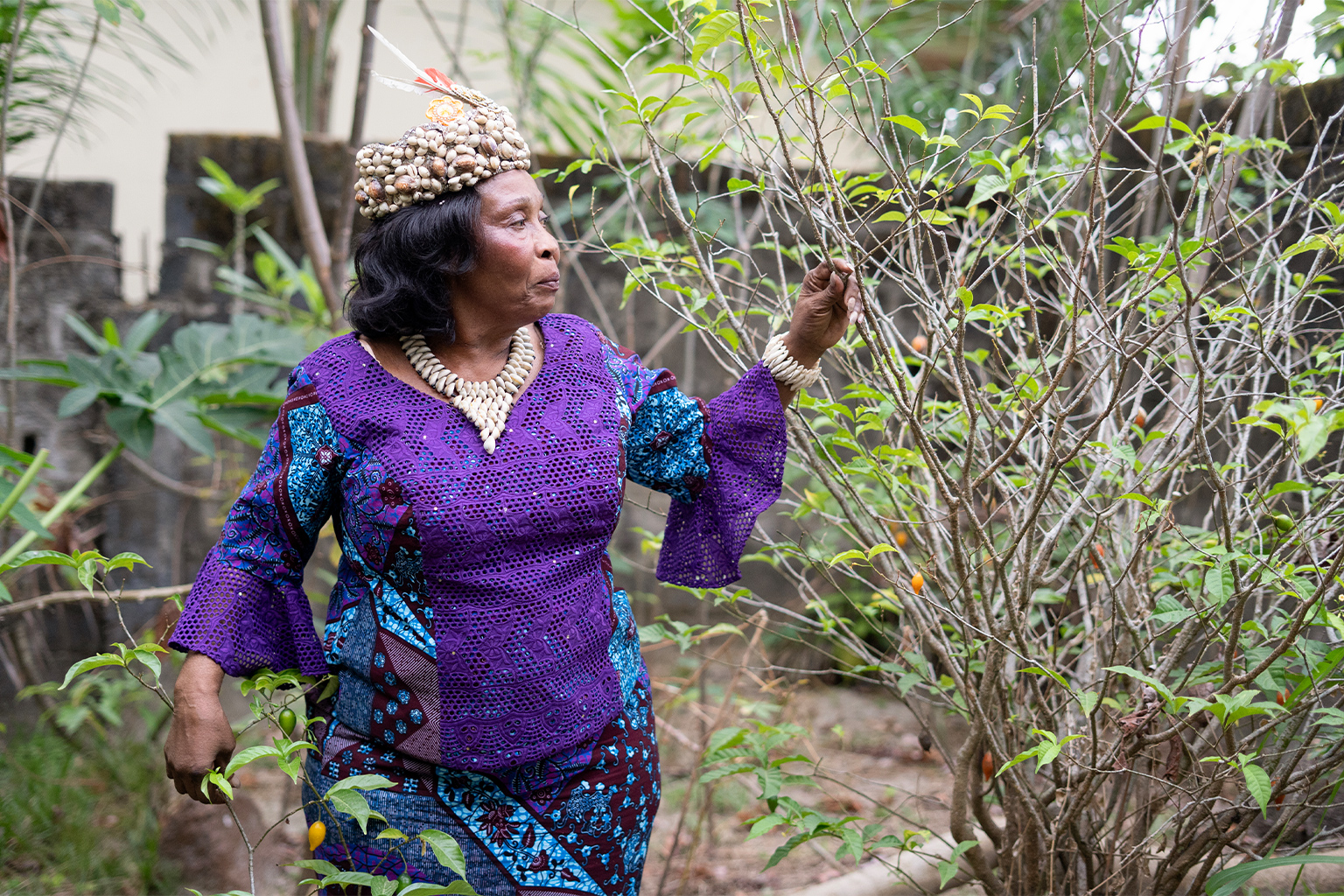
Banner image: Stéphanie Moussounda, known as Maman Djédjé, a Gabonese traditional practitioner and initiatory mother, president of the Fédération nationale des traditionalistes gabonais (FENATRAG) and second vice-president of COARITRAG, at her temple in Gabon. Image by Molly Helfend for Mongabay.
Reporting for this story was supported by a Rainforest Reporting Grant from the Pulitzer Center.
How a Brazilian Indigenous ethnobotanist & elders recorded their people’s medicinal knowledge
Secret Amazon species may be new source of ibogaine for addiction treatment
Citations:
Esperança, M. P., Gomes, N. G. M., & Campos, M. G. (2026). Ibogaine: Therapeutic potential, cardiac safety, and translational perspectives in the treatment of substance use disorders — A scoping review. Molecules, 31(3), 545. doi:10.3390/molecules31030545
Cherian, K. N., Keynan, J. N., Anker, L., Faerman, A., Brown, R. E., Shamma, A., … Williams, N. R. (2024). Magnesium–ibogaine therapy in veterans with traumatic brain injuries. Nature Medicine, 30(2), 373-381. doi:10.1038/s41591-023-02705-w
Ortiz-Prado, E. (2026). Channeling ancestral knowledge into production: From Ecuadorian curare to a shared-benefit model that breaks Indigenous poverty. Frontiers in Public Health, 14. doi:10.3389/fpubh.2026.1860471
Cite this article
Molly Helfend (2026). Gabon, home to the medicinal plant behind ibogaine, wants a fairer share of its global boom. Mongabay Conservation news. DOI: https://doi.org/10.66709/news-331394

