


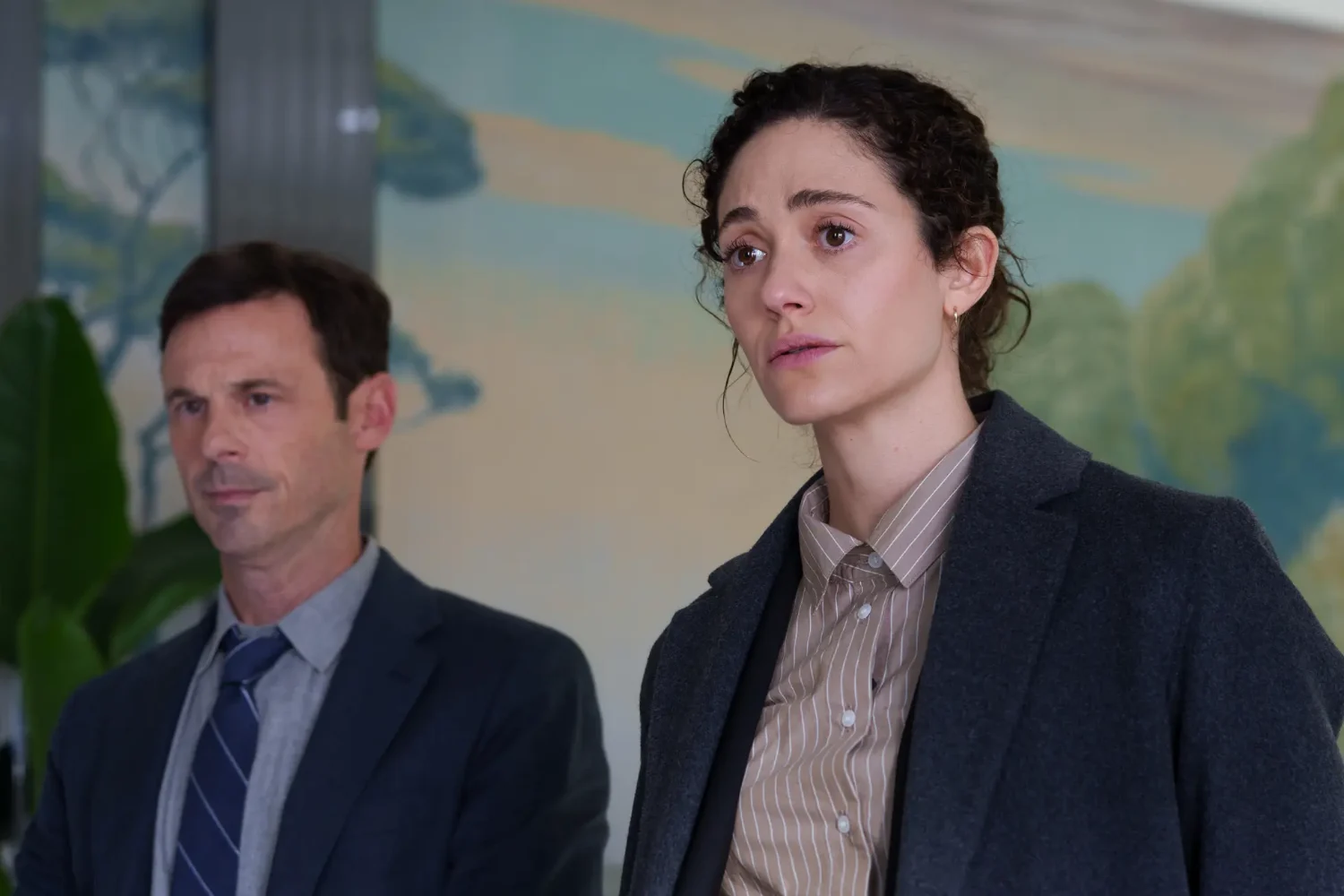
Furious, the first season of which finished on Hulu in late August, made me pay close attention to its characters’ eyes. They may not be a window into the soul, but they offer a glimpse into the incandescent anger that propels most of the main characters. On several occasions, the camera lingers on a close-up of FBI agent Alice Black (Emmy Rossum) as she contemplates whether, this time, she can face getting in the shower—the place where, for years, beatings from her former boyfriend and fellow cop (Jake Lacy) often began. In episode four of eight, it cuts to Sex Crimes Unit head Nora Washington (Quincy Tyler Bernstine) staring straight ahead in stony silence as she listens to her boss and betrayer Ed George (Danny McCarthy) lecturing about self-care and mental health. And in episode two, to Catherine Grace (Lola Petticrew) as she whispers a semi-ironic thank-you in the ear of a man she’s about to kill, for having given her a glass of water after he sexually assaulted her when she was a trafficked teen over a decade earlier.
This triptych of women with their buried emotions and choked rage anchor the show, created by Elizabeth Meriwether (who also created New Girl and The Dropout) as an exploration of and fictional catharsis for all the ways in which misogyny runs rampant in real-life society. The daily horrors of living through the second Trump administration are a cruel reminder that, outside of television, justice is a pipe dream, bad men are rarely punished, that anyone who isn’t a cisgender, heterosexual white man has no place in society—and even that place requires relentless adherence to an aggressive, dominating, meat-eating, steroid-enhanced ideal of supposed masculinity.
Furious, the first season of which finished on Hulu in late August, made me pay close attention to its characters’ eyes. They may not be a window into the soul, but they offer a glimpse into the incandescent anger that propels most of the main characters. On several occasions, the camera lingers on a close-up of FBI agent Alice Black (Emmy Rossum) as she contemplates whether, this time, she can face getting in the shower—the place where, for years, beatings from her former boyfriend and fellow cop (Jake Lacy) often began. In episode four of eight, it cuts to Sex Crimes Unit head Nora Washington (Quincy Tyler Bernstine) staring straight ahead in stony silence as she listens to her boss and betrayer Ed George (Danny McCarthy) lecturing about self-care and mental health. And in episode two, to Catherine Grace (Lola Petticrew) as she whispers a semi-ironic thank-you in the ear of a man she’s about to kill, for having given her a glass of water after he sexually assaulted her when she was a trafficked teen over a decade earlier.
This triptych of women with their buried emotions and choked rage anchor the show, created by Elizabeth Meriwether (who also created New Girl and The Dropout) as an exploration of and fictional catharsis for all the ways in which misogyny runs rampant in real-life society. The daily horrors of living through the second Trump administration are a cruel reminder that, outside of television, justice is a pipe dream, bad men are rarely punished, that anyone who isn’t a cisgender, heterosexual white man has no place in society—and even that place requires relentless adherence to an aggressive, dominating, meat-eating, steroid-enhanced ideal of supposed masculinity.
When the women abused by Jeffrey Epstein and, allegedly, his friends can’t get real redress and are further traumatized by the haphazard release of millions of documents, when an adjudicated sexual abuser runs the country and appoints another man accused of sexual assault to a cabinet position, and when the gains of the #MeToo movement are mere embers, that well of anger has to go somewhere. The gift of Furious is that it looks at every angle of being a victim and perpetrator, of gendered and state violence, and how many lines have to be blurred before anything resembling justice is found.
Just as important as the eyes are the masks. The viewers’ first introduction to Catherine is at an outdoor neighborhood Halloween parade where she is bedecked in a red wig and animal mask, laughing at her misguided attempt to give out unwrapped treats to children—while inside the house behind her, a drugged man drags himself into the hall, thinking he can escape the fentanyl-laced needle that will doom him.
Over the course of the series, Catherine dons many masks. Literal ones, like the surgical masks she puts on to evade ubiquitous surveillance cameras and for her job as a home health aide to Alden (Steve Way), disabled by muscular dystrophy. But also figurative, channeling her clear trauma into roles as a domestic abuse survivor, a cater waiter, and a flirtatious submissive to get what she thinks she wants—justice against her tormentors—or what she actually wants, which is revenge.
Petticrew’s performance tips one way, then the other, across a gossamer-thin line between sanity and madness. Taking on the role of the mythical Furies, invoked many times throughout the series, Catherine transforms her victimhood into vengeance, willing to risk the cost of dying, because for her, the price of living has been too great.
Alice, as Rossum’s depiction makes clear throughout Furious, is not quite an antagonist, nor is she fully on the same wavelength as Catherine. We learn early that Alice left the New York Police Department after reporting her ex for abusing her—only for most of the department, save for Danny Kelly (Scoot McNairy), who carries a torch for her, to disbelieve her and turn their backs. At the FBI, she’s supposed to stick to taking calls from conspiracy-obsessed cranks, but she desperately wants to work on sex crimes cases in the dingy basement of the Bureau’s Manhattan office where Nora presides over a grim daily routine of brutalized informants and child sexual abuse material.
Danny enlists Alice to work the murder of the drugged man in the brownstone. He’s Caleb, son of Jay Easton (Peter McRobbie), a deliberately initialed billionaire whose proclivities have long been whispered about but never fully proven. Once Alice realizes the crime resembles an earlier murder of a local sex trafficker, she becomes at one with the maelstrom. All of her efforts go into catching Catherine, but traumas recent and long-past refuse to stay compartmentalized. Alice’s scary competence as an investigator and her penchant for consensually engaging in violent sexual encounters are also a carapace, meant to cover her own howling, bewildering hurt—and finally unleashed desire for revenge.
Lola Petticrew as Catherine in Furious.Sarah Shatz/Disney
In lesser hands this would have devolved into tawdry melodrama, but Furious sidesteps the pitfalls, particularly in the standout sixth episode, when Alice’s attempts to arrest Catherine result in several earned jaw-dropping twists, and in the seventh, when Nora’s own suppressed fury finds an outlet at a karaoke bar, shrieking Meat Loaf’s “I’d Do Anything For Love (But I Won’t Do That).”
Furious also subverts the television procedural by rooting its narrative and visuals firmly in the lingua franca of a certain type of 1980s and 1990s story. The show is loosely based upon the 1987 neo-noir film Black Widow, written by Ronald Bass (who gets an executive producer credit on the show) and directed by Bob Rafelson, which features Debra Winger as a Department of Justice data analyst who suspects one young woman (Theresa Russell), nimble with disguises and name changes, in the deaths of at least three husbands.
Many of the plot points in Furious emerge from the bones of Black Widow (as does, perhaps, Killing Eve) but there is a stark difference between the unabashedly male gaze of Rafelson’s direction, preoccupied with erotic tension between Winger and Russell, and Meriwether’s vision, which focuses more on trauma kinship between her main leads.
Black Widow isn’t the only throwback influence I detected in Furious. Every time Petticrew appeared on screen as Catherine, I was struck by the resemblance to Mena Suvari in American Beauty, the 1999 film ostensibly about the midlife crisis of a suburban man (Kevin Spacey) and the teenage object of his obsession. And every time Rossum, as Alice, loosens her hair to reveal tight, glossy, black curls, she resembles both Winger in Black Widow and Julia Roberts in Sleeping With the Enemy (1991), another film written by Bass, this one a taut thriller about intimate partner violence and how one woman tries to get free of it.
With the recent news that Furious has been picked up for a second season, I can’t help wondering which real-life horrors will provide further storytelling inspiration. This summer, Philadelphia police detectives announced that they had uncovered over 1 million images and videos from a decrepit house in the neighborhood of Olney, where the infamous pornographer R.C. Horsch and his 44-year-old son, Eugene, lived. The latter was arrested and the house searched, producing evidence linked to at least seven missing women, and the revelation that Horsch, who died in 2025, may have strangled a woman to death on camera.
Epstein and R.C. Horsch may have evaded accountability in life, but thanks to television dramas like Furious and the work of journalists like Julie K. Brown, we now know them for who they really were. We also know the toll exacted on the psyches and souls of the countless women and girls harmed by them and by other terrible men. Catharsis isn’t a solution, and television isn’t life, but after watching the series, I felt my own rage channeled into action rather than despair. That is the sign of a series that can justifiably be called art.
