


Stay informed with free updates
Simply sign up to the EU energy myFT Digest — delivered directly to your inbox.
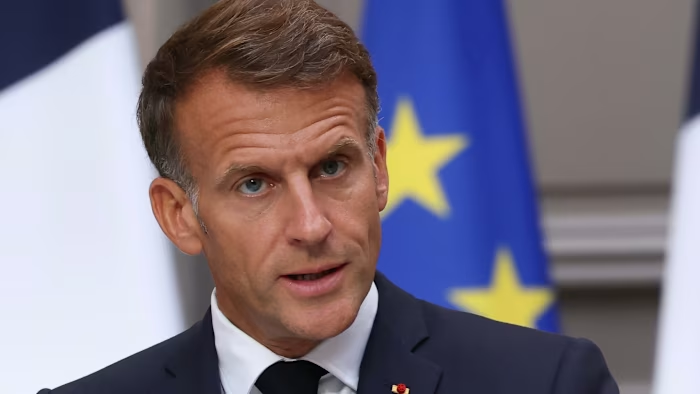
French President Emmanuel Macron has called on Brussels to take immediate action to lower energy prices, including by delaying a law on methane emissions.
In a letter to European Commission president Ursula von der Leyen, Macron called on the bloc to bring forward measures to tame energy prices.
European gas prices have risen from €27 to €80 per megawatt hour this year due to the crisis in the Middle East, while oil futures recently traded above $100 a barrel.
The letter, first reported by Les Echos and details of which were confirmed by the Élysée, asks the Commission president to delay an incoming law that critics warn could restrict the availability of oil and gas imports into Europe.
France is also making new demands on Brussels to boost the production of jet fuel and diesel by temporarily easing technical rules on refiners, in a bid to boost refineries’ production by up to 20 per cent.
It also wants to enable the use of more biofuels and to extend joint EU purchasing of gas-to-liquid products such as jet fuel and diesel.
Macron’s request to delay the methane rules by one year adds to growing pressure on the Commission to relax the environmental regulation.
It imposes strict requirements for importers of oil and gas to monitor and restrict methane emissions, including measures to detect leaks and reduce flaring, or risk fines of up to 20 per cent of their annual turnover.
It has been heavily lobbied against by exporters such as the US and Qatar, which have warned that the rules are too tricky to comply with and that it would jeopardise the supply of their products.
More than a dozen member states have called for a delay to the implementation of methane rules but Macron’s intervention is the first time France has opposed it publicly.
The Commission has responded to the pressure by delaying the impact of the regulation’s sanctions regime for three years but importers have warned that this does not remove the difficulty of complying with the legislation from January 2027.
Meanwhile, Brussels has responded to high energy prices by relaxing its rules on state aid, allowing member states to spend more money on supporting consumers and businesses who are affected.
It has also advanced plans to electrify the EU’s economy faster and reduce reliance on imported fossil fuels by setting a target to double the EU’s rate of electrification by 2040.
France’s ability to introduce new measures to shield people from higher prices is particularly constrained as the government struggles to contain one of the EU’s highest deficits, at over 5 per cent of GDP.
It has shied away from the wide-ranging protections afforded to households during the energy crisis that followed Russia’s full-scale invasion of Ukraine that sent electricity bills soaring.
But it has been rolling out more targeted help to people who use their cars for work purposes to help ease the pain of rising petrol prices, and new measures are expected to be announced on Tuesday.
