


Elizabeth Goldman is a co-director of Global Nature Watch, previously known as Global Forest Watch, a database measuring forest loss that’s frequently cited in Mongabay reporting. She joins this week’s podcast to detail GNW’s updated 25-year analysis of global forest fire trends. The picture is stark: Forest fires burn twice as much forest today as they did 20 years ago, and historic fire seasons are the “new normal,” she says.
“Catastrophic, large-scale fires are becoming more of a normal. The last three years are the worst three years in the record-keeping in our data set,” Goldman says. “Fires now burn twice as much forest as they did earlier in the time series from our data.”
2025, considered a drop from 2024, still saw 11 million hectares (27 million acres) of forest, an area roughly the size of Guatemala, burn. Rhett Butler, founder and CEO of Mongabay, published an analysis of the dip in 2025, cautioning readers against reading too much into what appeared to be a reprieve. He noted that large-scale commodity agriculture and climate change, the causes of this forest loss, remain. Goldman agrees.
In the absence of “serious action” internationally to combat it, and commodity-driven agriculture that continues contributing to these fires, Goldman says there are things governments can do to mitigate their risk locally.
“There are ways to sustainably manage a forest, like through thinning and prescribed burns, fire breaks, those sorts of things that don’t involve clear-cutting an entire forest, but leave the tree standing, leave the healthy ecosystem there, but are still kind of managing the fuel load,” she says.
Sustainable management and strengthening Indigenous rights and resources is another cited need, Goldman says, a point raised in a previous Newscast conversation with Erica Gies, who reported on the work of forestry scientist Suzanne Simard.
“Results show that 60% coverage really does maintain a lot of the complexity of the forest and those forest relationships and a healthy hydrology, keeping the land from drying … in some ecosystems it seems like 30% might be enough, but definitely clear-cutting seems to not be sustainable,” Gies said in that conversation.
Mike DiGirolamo is the host & producer for the Mongabay Newscast based in Sydney. Find him on LinkedIn and Bluesky.
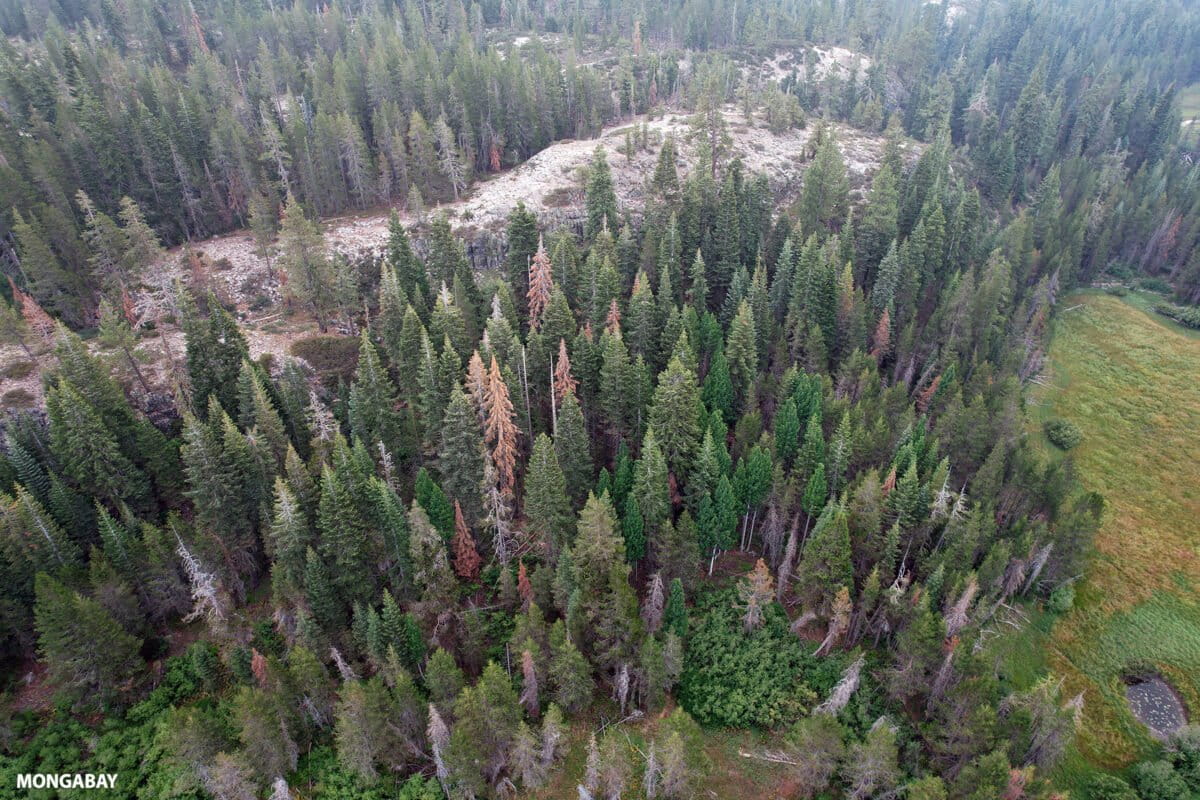
Banner image: Pine forest and granite in the Sierra Nevada. Image by Rhett A. Butler/Mongabay.
Listen to a previous podcast conversation on sustainable forest management with Erica Gies:
Notice: Transcripts are machine and human generated and lightly edited for accuracy. They may contain errors.
We are ‘not on track’ to solve this problem
Liz: So 11 million hectares of tree cover was lost in 2025 due to fire. This is the third worst year since 2001, which is when our record keeping begins. And when we say 11 million hectares, that’s roughly the size of Guatemala, so this is a, a substantial area that was lost to fire. One place where it was particularly notable is Canada.
Half of the global fire-driven tree cover loss in 2025 occurred in Canada, and that was the second worst fire season there since 2001, behind only 2023. We just see that there’s kind of more record-breaking. Fire is becoming kind of a normal now, and it’s one of the reasons why forest loss remains stubbornly high, is it’s becoming an increasingly important driver.
It’s not just agriculture that’s having a big impact anymore.
Mike: Welcome to the Mongabay Newscast. I’m your host, Mike DiGirolamo, bringing you weekly conversations with experts, authors, scientists, and activists working on the front lines of conservation, shining a light on some of the most pressing issues facing our planet, and holding people in power to account.
This podcast is edited on Gadigal land. Today on the newscast, we speak with Elizabeth Goldman, the co-director of Global Forest Watch, now referred to as Global Nature Watch, which has been a key tool and a source for Mongabay in many of our stories. Goldman is also a senior research associate at the World Resources Institute.
She joins me to talk about their recently updated twenty-five-year analysis of global forest fire trends, and the data is stark. Forest fires today burn more than twice as much each year as they did twenty years ago,
goldman is clear that climate change is only exacerbating these forest fires and making them more likely to happen. But the picture becomes complex depending on the region and country. Tropical forest fires are almost entirely started at human hands, she says, while ones in boreal regions are not. Aside from concerted international efforts to combat climate change, she outlines what nations can do locally now to mitigate their risk of catastrophic fires, which include management practices and strengthening rights and capacity building for indigenous communities.
Sustainable management of forests is possible. However, many countries are still not moving the needle on this. Rhett Butler, our CEO, published a report this past April outlining that the stresses of commodity-driven agriculture, weak enforcement of policy, and climate change are still present and remain unchanged, and Goldman agrees.
However, a bright spot may be in Canada’s response to preparing for future forest fire threats and monitoring, which Goldman outlines as being a step in the right direction.
Hi Liz, welcome to the Mongabay Newscast. Thanks for joining us today.
Liz: Great. Thank you. Nice to be here.
Mike: So before we get into the twenty-five year report, I, I’d like to just briefly touch upon what happened in 2024 and 2025. And, uh, we did publish data from Global Forest Watch that shows that 2024 was a, a pretty historic year for forest loss due to, uh, wildfires.
And then it, it looks like those, those wildfires dipped back down in 2025. But can you tell us what happened between those two years?
Liz: Yeah, sure. So in 2024, the tree cover loss data that we published on Global Nature Watch showed record-breaking fires in most of Latin America. Many countries saw huge spikes in loss due to fire in primary forests, also outside primary humid tropical rainforests in places like Brazil, Bolivia, and others.
A lot of that was due to record heat, drought conditions. In the tropics, a lot of the fires are started and are linked to agricultural practices actually. So these are not fires that are part of the natural ecosystem, especially in rainforests. But landowners will start fires to clear their land for agriculture, but then it’s very hard to just stop fire at a property line, especially when there’s heat and drought conditions present, and so the fires can spread out of control.
So that’s a lot of what we saw in 2024. A lot of those fires were in, like I said, Latin America and in s- some of the Congo Basin as well. In 2025, like you mentioned, fires were lower, although in certain regions they were still bad fire years. so eleven million hectares of tree cover was lost in 2025 due to fire.
This is the third worst year since 2001, which is when our record-keeping begins. And when we say eleven million hectares, that’s roughly the size of Guatemala, so this is a, a substantial area that was lost to fire. One place where it was particularly notable is Canada. Half of the global fire-driven tree cover loss in 2025 occurred in Canada, and that was the second worst fire season there since 2001, behind only 2023.
So yeah, lots of notable fires happening, especially in the Northern Hemisphere. South Korea was another one that you had a couple of, substantial fires in 2025. And we just see that there’s kind of more record-breaking. Fire is becoming kind of a normal now, and it’s one of the reasons why forest loss remains stubbornly high, is it’s becoming an increasingly important driver.
It’s not just agriculture that’s having a big impact anymore.
Mike: Yeah. I’m glad that you mentioned that because our CEO published an analysis this past April sh- sort of cautioning readers a- against reading too much good news into the dip that happened into 2025 And he reiterated that the conditions that create forest loss remain pretty much unchanged.
Do you have anything to add to that?
Liz: Yeah, exactly. Un-unfortunately, a big driver of the fires we’re seeing is climate change. So climate change is leading to warmer conditions, and we’re actually in this kind of scary feedback loop situation right now where climate change is making forests hotter and drier.
This is leading to longer fire seasons, more extreme fire weather that leads to bigger, more severe fires, which burn, more carbon is released from both the trees, but also the soil that they grow in, has extensive amounts of carbon as well. And then more carbon equals more warming, equals more fire. So exactly, there, there’s ve-very real conditions from climate change that is a very complex problem that we are currently not on track to solve, unfortunately.
Mike: And this is a, a great spot for us to dig into the 25-year analysis of forest fires, which I believe you just published this week. So can you give us the high level insights of what this analysis shows?
Liz: Yeah. So the analysis shows that, like I was saying before, fires are becoming… These more catastrophic large scale fires are becoming more of a normal.
The last three years are the f-the worst three years in the, the record keeping in our, in our data set. Fires now burn twice as much forest as they did earlier in the, in the time series from our, from our data. And so, yeah, it’s just getting worse over time. And like I said before, 11 million hectares were burned, of, of tree cover was burned in 2025, which is a subs- sub-substantial area to lose in a single year
Boreal regions bear the brunt
Mike: Other than the forest loss that we’re experiencing, what are some of the public health impacts that these increasing fires are driving?
Liz: Yeah, I mean, a, a big one, of course, is smoke. So the fires produce smoke, air pollution, some of which can travel thousands of miles. You know, I’m based out of Washington, DC, and we had very bad air quality from Canada fires many thousands of miles away, and many other cities experienced similar that were very far flung from the actual fire sources themselves.
They, of course, have huge impacts on the people who live around the fires. People lose their homes, drinking water contamination, all sorts of things. So yeah, there’s very real human costs and impacts as well.
Mike: I’d like to get into more of the specifics on the where and the how that climate change is intensifying forest fires, particularly for areas where once we maybe perhaps didn’t see these types of fires.
So can you detail for us where and how these impacts are most pronounced?
Liz: Yeah. I would say boreal forests are particularly impacted by climate change. If we break the data down and look at boreal versus tropical versus temperate and subtropical areas, we see that the amount of fire, tree cover loss due to fire, is kind of rising more rapidly in boreal forests.
This is a part of the world where temperatures are, are climbing too, higher than in other places. So that’s, that’s where climate change is kind of having a bigger impact. Although it’s also a much more… Well, it’s a more complex story, too, because fire is part of the natural ecosystem in boreal forests.
boreal forests need fire to stay healthy. It’s how the forest regrows, germinates. But at the same time, typically there would be more frequent, lower intensity fires. But because of the heat and also just land management practices, like how people deal with fuel loads and fires and other things in the forest there, we’re just seeing much hotter fires that are not just in the understory, but up in the crowns of the tops of the, of the trees, and it’s actually killing the, the trees instead of leading to a more healthy forest.
Mike: I think I read in the report that something around 60% of the forest loss over this 25-year period was in boreal regions. Can you confirm that?
Liz: Yes. Yeah, it was
Mike: That’s, that’s a lot. So can you explain why this is particularly worrying from, a climate impact and a carbon release perspective?
Liz: Yeah. So this is particularly worrying because boreal forests have between 30 to 40% of all land-based carbon.
Most of that carbon is actually underground. It’s stored as, permafrost, and these are historically been protected areas with– They’ve experienced more mild fires, but severe fire can actually thaw the permafrost. It could disturb the soil carbon and release that into the atmosphere.
Mike: Right. And just to clarify for listeners, but the permafrost has been thro- frozen for, I’m not exactly sure how off the top of my head, but I believe it’s thousands and thousands of years, correct?
Liz: Yes. I believe that’s right.
Mike: This one’s pretty nuanced, as most permafrost that exists today has been frozen from anywhere between ten thousand to over a hundred thousand years. And some of the oldest permafrost, which is buried in glacial ice, has been frozen for over seven hundred thousand years. So can you talk about the situation in the tropics?
Because it seems like from what you describe in the report, the forest fires there, unlike the boreal regions, are almost always human-made. What does your data tell us about that?
Tropical fires are almost entirely human made
Liz: Yeah, exactly. So tropical rainforests are not fire-adapted ecosystems. They evolved in– these are moist, moist forests that don’t typically have fires.
And so we are able to break our data on Global Nature Watch into primary rainforest versus forests outside of these humid tropical ecosystems. And so we can understand where fires are happening in these ecosystems, and therefore kind of where more human-caused fires are. Because again, these are not– there’s no, very little, if any, nat- natural fires in these ecosystems.
Mike: And so your report also shows that Europe is warming faster than any other continent on the planet. Can you give us some insight as to why, and also how is that impacting forest fires there?
Liz: Yeah. Europe has had substantial fires in recent years. Of course, there’s, the fires in Spain and France that have been in the news lately, but this, this kind of ties into the impacts of boreal forests in general.
But that part of the, the world is just warming faster. It has to do with melting ice in the Arctic. Basically, there’s, there’s no longer this reflectant ice up there that’s helping to cool that part of the world as much as it used to, and so temperatures are warming more rapidly there, and the hotter, drier conditions are leading to, to more fires in Europe and other places in northern latitudes.
Mike: So if we take a look at 2026 thus far, forest fires are in the news, and we’ve seen devastation in Canada, parts of the United States, and Europe, and I know that there’s a fire, I believe it’s happening right now in Spokane, Washington. What’s happening in 2026 that stands out to you that you think the public needs to know?
Liz: Yeah. Unfortunately, I think it’s more of the same. Climate change is making conditions worse for fires, and in general, there’s probably not enough fire prevention happening, so the, the, the default is to kind of respond to fires, and it’s just a difficult thing to do. But yeah, I, I know that the fires in Spain and France, these are record-breaking events, and it just seems every year there’s record-breaking events happening, and that it’s happening more often.
But it’s kind of, the same story that keeps happening in recent years in slightly different locations.
Mike: Yeah. Hello, listeners, and thank you for tuning in. As I always like to mention, Mongabay is a nonprofit news organization. We rely on the funding from listeners like you. So if you’d like to support the podcast, go to patreon.com/mongabay and chip in to become a monthly sponsor of the show.
If you wanna read the analysis from Global Nature Watch, you can find the link in the show notes, and if you want to read Rhett Butler’s analysis of forest loss trends from 2025, that will also be in the show notes.
What can be done right now?
Mike: So from the perspective of solutions, and I know that this is a super complex topic, but what are some of the prime solutions that really need to be taken by nations that are experiencing the worst of this?
Liz: Yeah, you’re right. This is a very complex s- topic, and there’s no one-size-fits-all solution. The elephant in the room, of course, is climate change, and that’s its own complex problem that requires its own set of solutions, some of which are intertwined with, with fire solutions. But I think a more immediate solution is what I mentioned before, like fireproofing and prevention.
That can be kind of broken into three different pieces, right? First is ignition, so limiting burning near forests, especially during drought, is a big piece of the puzzle. It’s not… And it’s not about stopping people from using fire, it’s kind of like when and where it’s happening could help. Another is managing the forest itself for fire risk.
So burning, building wildfire risk into forest management in fire-prone regions protects the forests and their carbon stores, and it can actually create jobs and support rural communities as well because there’s th- people on the ground who need to do that work. And then there’s also funding, right? Like funding, fireproofing, and preve- prevention is one of the most cost-effective tools available, and like I said before, they’re often underfunded in, in many countries.
So closing that gap in public investment could really help. Another big solution is, of course, reducing pressure we’re putting on forests. So if we were to reduce deforestation, degradation, this gets at the climate ang- angle as well, since forests store and sequester or take in carbon. A forest that’s intact and unfragmented is more resilient.
It holds moisture. It doesn’t have dry, flammable edges, and so it becomes more of an asset to the climate crisis that we’re in and to combating fires as, as opposed to more of a flammable problem when it kind of dries out and is fragmented. And then another big solution that I need to mention is rights and capacity building for Indigenous peoples and local communities.
So these groups bring centuries of experience using controlled burning to keep landscapes resilient, but they’re frequently excluded from fire management decisions, and they lack equipment that they need to respond to fires when they do start. And that just matters enormously because often these fires are in remote regions, and Indigenous groups are sometimes the first and only responders to them.
So if we help and make sure Indigenous peoples secure land rights and have the sustained funding that they need for crews, for the equipment that they need to help fight fires, then that would be a huge win. And I guess the last thing I’ll mention, and I would be remiss if I didn’t mention it, is, data.
We need data. We need funding for near real-time monitoring so that we understand where fires are happening, where there’s increased risk, and that can just lead to better, more targeted responses.
Mike: Yeah, I think there’s something I’d like to sort of pinpoint here because, you know, what you’ve just, just described is, is incredibly nuanced, and I think there is a risk of government sort of justifying policy that is very industry heavy, cutting away forests as a means of protection to justify exploitation.
The reason why I mention this is because specifically over the past 20 years, multiple administrations have passed legislation that many experts and advocates have criticized as allowing logging companies to cut down forests in the name of fire management, which is very different from what Liz is prescribing.
The most recent example I can think of is a March 2025 presidential executive order to increase timber sales by 25% on federal land in the United States, and wildfire risk was specifically used to justify this. But forestry and natural resource scientists and researchers in the United States have explained why this is a bad idea and won’t solve the fire risk.
Even other legislators, such as Senator Martin Heinrich in New Mexico, have also condemned the current administration’s actions. I’ve cited an article that is in the conversation if you want to read more about how the US government is justifying clear-cutting forests. Which is very different from what you just described, which is leaving, leaving forests intact.
So I was wondering if you could pick apart the nuance on that. Can you highlight the difference between what sometimes some politicians may describe as protection, which is shearing or clear-cutting native forest versus actually sustainably managing it?
Liz: Yeah, sure. And I’ll say, this is a little outside of my area of expertise, but there is a difference, right?
But, clear-cutting an area is not necessarily the answer, and it, it, it must depend on the ecosystem and the region that we’re talking about. But there are ways to sustainably manage a forest, like through thinning and prescribed burns, firebreaks, those sorts of things that don’t involve clear-cutting an entire forest, but leave the, the, the trees standing, leave the, the healthy ecosystem there, but are still kind of managing the fuel load.
‘Cause that’s one of the things that we can do to control fire, especially in bigger landscapes. It really has to do with fuel and how much a fire has access to burn. The other things that cause fire are oxygen and heat, right, which we can’t really control very well, but we can control fuel, and controlling fuel doesn’t necessarily mean cutting down whole areas of forests.
It can be done in other ways.
Mike: What you just mentioned about in- Indigenous management has also borne out in other sources I’ve spoke with. I spoke with reporter Erica Gies, who was profiling Suzanne Simard, who is working on something called the Mother Tree Project, which I’m not sure if you’re familiar of, but it also found that largely leaving at least 60% coverage or more sort of maintains that healthy ecosystem.
Do you have anything to add to that, or have you heard of that project?
Liz: I haven’t heard of that project, unfortunately, but it, it makes sense to me, right? Especially, again, there’s different ecosystems, and some ecosystems fire is, is part of the ecosystem and is needed for, for there to be a healthy forest.
And so yeah, that, that logic makes sense to me that there is kind of a happy medium and, the right amount of thinning or burning that needs to happen.
Mike: You can listen to that conversation I had with Erica Guise by clicking the link in the show notes or on the episode player at the bottom of the summary on mongabay.com.
So is there anything else in this report that we haven’t discussed that you want listeners to know about?
Liz: Good question. I mean, one thing we haven’t talked a whole lot about is what governments could do more concretely. I mean, there’s some good examples out there that I think might be worth mentioning.
Canada has been in the news a lot. It’s contributing a lot to the fires in our data, but they are, I think, investing in, in solutions quite seriously. they have this new dedicated wildfire monitoring satellite program that’s set to come online in a couple of years that was funded, gosh, maybe five years ago or so.
And so it’s, it’s been in, in the works for a while, but I think there’s a lot of promise there to being able to monitor and respond to fires quickly. They also have this national community level, community level program to clear fuel, like we were talking about before. They work on home hardening or preparing homes for, for fire resistance, and then they have some funding specifically for First Nations-led prevention as well.
So there’s an example in British Columbia, which in this particular area there’s more dry interior temperate forests that are used to, again, these low-intensity fires, which were historically the norm. But there’s been many, many decades of, I guess, fire suppression that has led to fuel buildup to unnatural levels.
So there’s a lot of concern around this, but now they have indigenous-led crews that are working with provincial agencies to build and bring back cultural burning, so they are engaging in small, cool season, low-intensity burns that cut the debris that are feeding these more cat- catastrophic fires, and that can lead to more native plants coming back, improve wildlife habitat, and so on.
So instead of just a blanket, we’re not burning anymore in these l- landscapes, we’re actually seeing more traditional indigenous practices come back and actually partnering with government agencies to help with those efforts, and I think that’s kind of the direction we wanna see more places going.
Urban wildfires ‘potentially’ likely to continue
Mike: There’s something that I did wanna ask about because I think this might be a concern for listeners, particularly those of us who live in urban areas. It, it, it certainly seems like we’re starting to see more, I think it’s fair to say, catastrophic wildfires close to urban areas like we saw with Los Angeles.
What does your data tell us about this situation?
Liz: Yeah, that does show up in the data. It’s interesting ’cause we were talking about boreal and, tropical forests a lot earlier, but temperate areas is often where we see a lot of this urban wildfire interface happening. So yeah, we, we see increases happening there as well, just not at quite the same rates as we’re seeing in tropic and boreal ecosystems.
But the temperate forests are kind of where we’re seeing more impacts for humans, more direct impacts, ’cause of the population densities around these forests. And yeah, they’re showing up in our data as well, and we, we can see the fires kind of going into more of the urban areas there.
Mike: So would you expect to see a consistent appearance of those fires in the coming years?
Would that, would that appear to be something that you might expect?
Liz: I think potentially yes, ’cause again, what’s underlying all of this is climate change, and we just aren’t seeing the level of, I guess, response to the climate crisis that we would need to see conditions improving. We’re kind of in a new norm that’s not gonna improve anytime soon unless, unless we take serious climate action.
So that’s where these more immediate solutions that we talked about before can help lessen the, the burden and the problem for people living in or, in and around these forests.
Mike: Liz, where, where would you like to direct listeners to learn more about the forest fire data that you’ve published over the past 25 years?
Liz: Yeah, there’s a couple places that people can go. There’s globalnaturewatch.org is the website that we run, and you can go on the website. You can see near real-time fire alerts there. You can also see our annual fire data as well, all on a map. We have a new website called Global Nature Watch Horizon as well, which is more of an AI-based system where you can kind of find the data and kind of ask it questions, get insights from the, from the findings.
And then WRI, World Resources Institute website also has all of our reports available if people wanna read about the findings there.
Mike: Liz Goldman, thank you very much for speaking with me today. It’s been a pleasure.
Liz: Thank you. Thank you for having me.
Mike: As always, if you’re enjoying the Mongabay Newscast or any of our podcast content and you wanna help us out, we encourage you to spread the word about the work we’re doing by telling a friend and leaving a review.
Word of mouth is among the best ways to help expand our reach, but you can also support us by becoming a monthly sponsor by going to our Patreon page at patreon.com/mongabay. We are a nonprofit news outlet, so even pledging just a dollar per month makes a very big difference to us, and it helps us offset production costs.
So if you’re a fan of our audio reports from Nature’s Frontline, I encourage you to go to patreon.com to learn more and support the Mongabay Newscast. You can also read our news and inspiration from Nature’s Frontline at mongabay.com or follow us on social media. Find Mongabay on LinkedIn and at Mongabay News and on Instagram, Threads, Blue Sky, Mastodon, Facebook, and TikTok, where our handle is at Mongabay and on YouTube at MongabayTV.
Thank you, as always, for listening.
