


- A new study in Vietnam found coastal plastic pollution costs small-scale fishers thousands of dollars a year in lost earning potential.
- Fishers lose on average $3,421 per vessel per year as a result of lost fishing time, reduced catch efficiency and damaged gear due to plastic waste, the study found, with lower-income fishers in the Mekong Delta the worst affected.
- However, fishers may also have a significant role to play in solutions to tackle the plastic pollution crisis, according to the research.
- The study calculated that a “fishing for litter” scheme, whereby fishers would receive modest payments for returning plastic bycatch to collection facilities on land, would require an investment of around $60 per vessel per year.
Plastic bags and bottles, aquaculture feed bags, nylon netting and ropes don’t sound like the makings of a healthy fishing haul. However, nets replete with these items are a near-daily reality for the majority of fishers interviewed by researchers during a recent study in Vietnam.
Plastic waste causes small-scale fishers in Vietnam to lose an average of $3,421 per vessel, per year, in lost fishing time, reduced catch efficiency and damaged gear, the study assessing the economic impacts of plastic debris on fishing livelihoods found. This represents a 10-25% reduction in the annual income of vessel owners.
Fishers interviewed for the study reported that they had significantly increased their fishing efforts in recent years in response to the combined pressures of overexploited fish stocks and plastic pollution. “Before, 6-7 hauls were enough [to turn a profit],” one interviewee told the researchers. “Now it takes 20-25 hauls.”
The study also highlights how fishers could play a significant role in solutions tackling the plastic pollution crisis, including through “fishing for litter” programs that pay fishers modest financial incentives to bring back plastic bycatch for disposal and processing on land.
“When you see firsthand the sheer volume of [plastic waste] in Southeast Asia, and how it directly impacts people’s lives and livelihoods, it crystallizes very clearly why we need to address this,” study co-author Michel Kaiser, a professor of fisheries conservation at Heriot-Watt University in the U.K., told Mongabay in an interview. “Fundamentally, turning off the source of the plastic is key, but fishers can also be part of the solution.”
One global problem, two river deltas
Scientists estimate 130 million metric tons of plastic enters the Earth’s air, soil and waters each year — a figure scientists predict will more than double by 2040 if steps aren’t taken to curb it. A significant proportion of this waste makes it into the oceans: A 2015 study calculated between 4.8 to 12.7 million metric tonnes of land-based plastic enters the oceans annually through river deltas, wastewater outflows and direct littering.
Vietnam has pledged to reduce the flow of plastics into the ocean by 75% by 2030 under its 2019 National Action Plan on Marine Plastic Debris Management. However, only 10-15% of the country’s plastic waste is currently recycled, according to the Global Plastic Action Partnership.
To study the economic impacts of plastic pollution on Vietnam’s coastal fishing livelihoods, the research team interviewed 199 small-scale fishers using trawl and gill nets in the deltas of two major river systems that frequently top global assessments of marine plastic waste discharge: the Red River and the Mekong River. The team also conducted onboard observer audits to validate reported plastic catch rates.
Many fishers talked about the depressing reality of “picking fish out of the plastic”, Kaiser said. “Trying to find fish amongst all this plastic is going to increase the amount of time you spend [processing] your catch,” he said. “We found that cost was actually quite significant.”
Reduced efficiency of damaged fishing gear accounted for nearly one-third of costs, while the labor time spent separating catch from plastic accounted for 12%, and 6% were expenses from repairing fishing gear and fixing propeller entanglements.
Other hidden costs also emerged. “The amount of plastic floating around in the ocean is now starting to interfere with vessel safety,” Kaiser said. In the study, many fishers reported crewmembers sustaining serious injuries or even fatalities while attempting to untangle propellers. “The real cost to these communities is pretty grim,” Kaiser said. “If you were to factor in loss of life and mutilations, the costs would be even higher.”

Overall, the study found plastic waste led to fishery earning losses ranging from 10% to 25%. However, there were significant differences between the two river deltas. Lower-income communities in the Mekong Delta lost up to a two-fold greater share of their income due to plastic when compared to fishers operating further north in the Red River Delta.
The disparity is likely down to a “double whammy” of factors occurring in the Mekong Delta, Kaiser said. Two of the world’s most plastic-polluted river estuaries, the Saigon-Dong Nai and the Mekong, flow into the area, while preliminary oceanographic studies suggest plastic debris flows north to south along Vietnam’s coastline, toward the Mekong Delta.
The researchers urge policymakers to consider the Mekong Delta’s higher economic burden when deciding where and how to target cleanup interventions. “Coastal and marginalised communities bear disproportionate social, environmental, and health harms across all stages of the plastic lifecycle, despite contributing least to this problem and having limited influence over decision-making,” the study says.
Environmental and economic costs
Nicole Russo Guerrato, an interdisciplinary marine scientist at James Cook University in Australia, who was not involved in the study, said the findings provide new evidence of how marine plastic pollution affects coastal communities in Vietnam, which could prompt policymakers to direct resources toward “effective and socially equitable” solutions.
“Most marine litter research to date has focused on environmental impacts,” Guerrato told Mongabay in an email. The new study results show decision-makers that plastic pollution also has significant social and economic consequences that need to be addressed, she said.
Guerrato said earlier studies have also not always captured the full extent of the challenges facing fishers, focusing mainly on direct costs, such as damaged gear. By considering the cost of lost fishing time in its analyses, the new study gives a fuller picture of the actual economic burden borne by small-scale fishers, she said.
In future research, it would be helpful to also consider the less tangible consequences of marine debris that can’t be measured in monetary costs, such as impacts on well-being, cultural identity, livelihood security and community resilience, Guerrato added.

‘Fishing for litter’
The researchers say their findings could now feed into the design of potential solutions, such as “fishing for litter” programs that pay fishers modest financial incentives to bring back plastic bycatch for disposal and processing on land.
Many fishers told the researchers they dump plastic waste back overboard once it’s been separated from their catch owing to a lack of incentives to bring it back to shore. However, most interviewees said they would be interested in participating in a buyback program if the compensation was adequate.
A buyback price of $0.16 per kilogram (per 2.2 pounds) of plastic debris would be required, the fishers indicated in their responses — a figure roughly equivalent to the market price of the low-quality “trash fish” often caught as bycatch and sold as aquaculture feed.
Based on their observations of the amount of waste fishers haul in each fishing trip, the researchers calculated a fishing for litter program would have to pay each vessel roughly $60 per year to bring all the plastic they encounter back to shore. “In terms of an investment, whether by the government or through philanthropic donors, it’s not a huge sum of money, considering the positive impact it could have in removing plastic from the ocean,” Kaiser said.
Guerrato said similar incentive schemes have worked well in many parts of the world, including in several European countries and Brazil, helping fishers take an active role in addressing ocean plastic. “Positive change starts by recognising fishers as part of the solution rather than simply as part of the problem,” she said.
However, Guerrato said there’s likely still a long way to go in Vietnam. Translating research findings into viable solutions on the ground requires significant governance coordination, she said. Even if appropriate national policies to address plastic pollution exist, they “need to be supported by local implementation, including adequate port reception facilities, waste management infrastructure and incentives for fishers to participate.”
Kaiser said the research team is applying for funding to develop community-based upcycling businesses in Vietnam that transform end-of-life fishing gear and bycatch plastics into new marketable products. This would provide the foundation of a self-sustaining business model that could potentially fund “fishing for litter” schemes over the longer-term, he said, so that they’re not primarily dependent on donor funding cycles.
“It’s all very well highlighting the problem and what the costs are to people dealing with the consequences of plastic waste,” Kaiser said. “But the question is, what can we do about it? How can we actually solve this problem? So that’s the next step.”
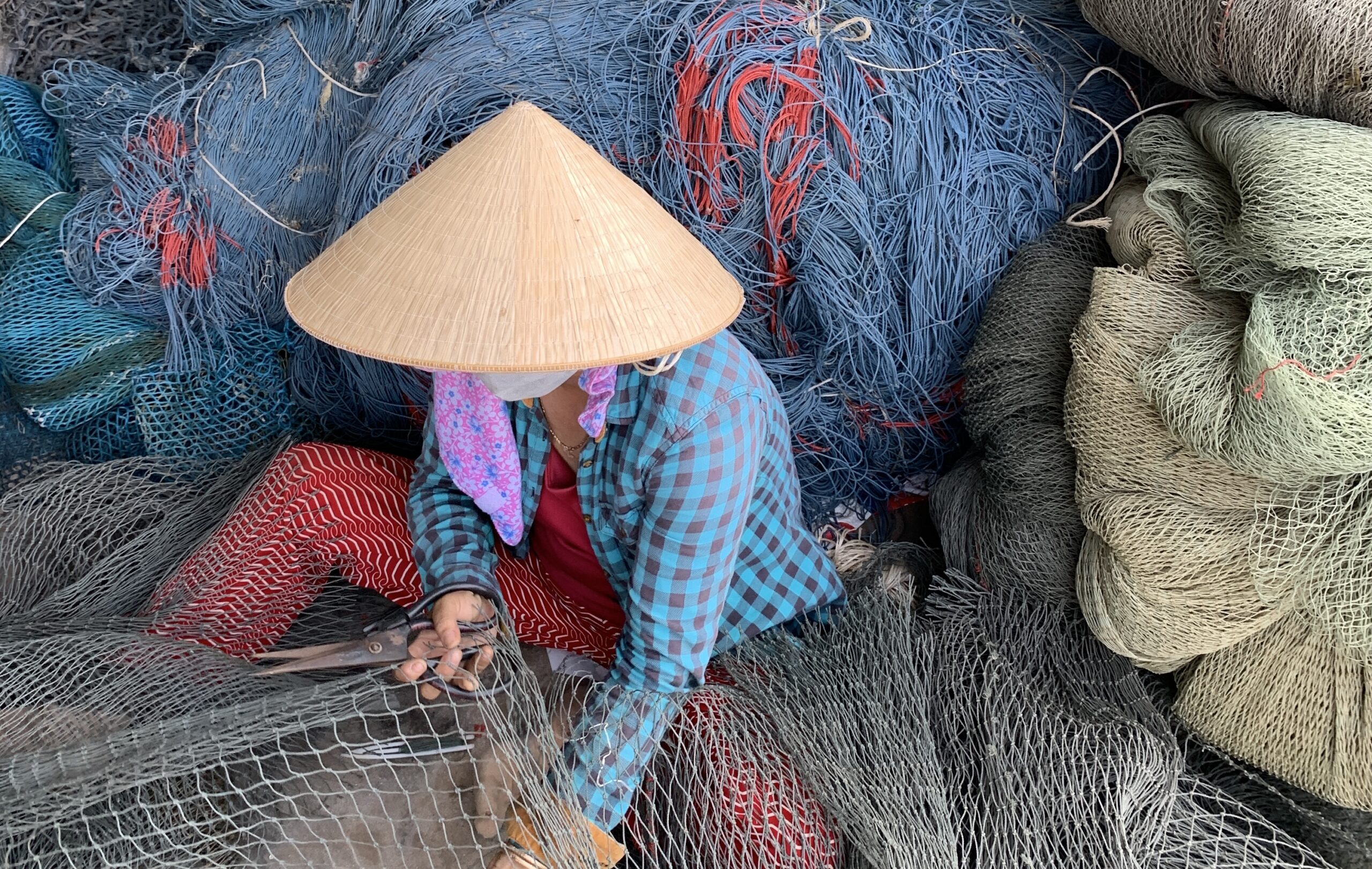
Banner image: A net mender repairs fishing nets in coastal Vietnam. Image courtesy of 3SIP2C project.
Carolyn Cowan is a staff writer for Mongabay. Her reporting focuses on wildlife, ecology, and communities responding to environmental challenges across Southeast Asia.
Citations:
Nguyen, D., Thanh, P. P., Burdett, H. L., Yaneva-Toraman, I., Liao, Z., Zou, Q., … Kaiser, M. J. (2026). Marine plastic pollution undermines the livelihoods and income of fishing communities in Viet Nam. Communications Earth & Environment, 7(1). doi:10.1038/s43247-026-03567-z
Jambeck, J. R., Geyer, R., Wilcox, C., Siegler, T. R., Perryman, M., Andrady, A., … Law, K. L. (2015). Plastic waste inputs from land into the ocean. Science, 347(6223), 768-771. doi:10.1126/science.1260352
Meijer, L. J., Van Emmerik, T., Van der Ent, R., Schmidt, C., & Lebreton, L. (2021). More than 1000 rivers account for 80% of global riverine plastic emissions into the ocean. Science Advances, 7(18). doi:10.1126/sciadv.aaz5803
Guerrato, N. R., Fidelman, P., & Gonçalves, L. R. (2026). Multilevel governance of marine plastic solutions in Australia and Brazil. Environmental Management, 76(3). doi:10.1007/s00267-025-02366-0
See related story:
‘Plastic pollution hotspots’ spawn a public health crisis across Latin America
FEEDBACK: Use this form to send a message to the author of this post. If you want to post a public comment, you can do that at the bottom of the page.
Cite this article
Carolyn Cowan (2026). Fishers bear deep costs of plastic pollution in Vietnam, but could help turn the tide. Mongabay Conservation news. DOI: https://doi.org/10.66709/news-329844

