


The world was just awakening to the novel coronavirus, and a full-fledged pandemic was still in the future, when Dr. Anthony S. Fauci jotted a note in his diary on Jan. 26, 2020, musing about whether the virus might have originated in an open-air “wet market,” where live animals were sold, in Wuhan, China.
“Now we know the market was not the source, it was the amplifier,” Dr. Fauci, then the government’s top infectious disease expert, wrote. “Having said that, somewhere the virus jumped from animals to humans.”
Those private reflections became public this past weekend when Senator Rand Paul, Republican of Kentucky, released more than 1,100 pages of Dr. Fauci’s diary as part of his investigation into whether the virus might have leaked from a laboratory and whether, as Mr. Paul claims, Dr. Fauci lied to Congress about it.
The diary does not provide the smoking gun the senator is seeking. Rather, it echoes past disclosures showing Dr. Fauci wrestling with a fast-moving crisis as scientists’ views evolved. But it further inflames a polarizing political battle over the origins of the virus and how history should treat Dr. Fauci.
It also paints a portrait of Dr. Fauci as obsessed with himself, reveling in his own importance and the celebrities he knows, from the actress Julia Roberts to the singers Joan Baez and Barbra Streisand. It shows, as well, the pressure he was under, as he became the public face of the government’s response while at the same time countering what he called “slanderous lies” about him spread by “extreme right elements in society.”
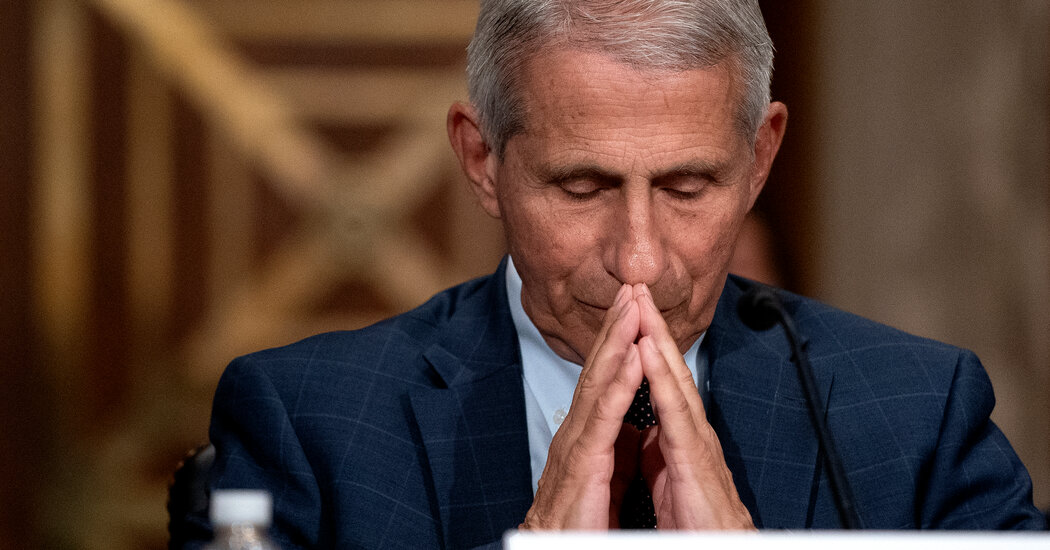
On Wednesday, Dr. Fauci is scheduled to testify under subpoena before the Senate Homeland Security Committee, which Mr. Paul chairs. Although Dr. Fauci received a “pre-emptive pardon” from former President Joseph R. Biden Jr., Mr. Paul has repeatedly referred him to the Justice Department for criminal prosecution.
“What he wrote privately and what he told the country are two different stories,” the senator wrote on the social media platform X.
Senator Paul’s office did not respond to requests for comment about how he obtained the diary. But it is typewritten, suggesting Dr. Fauci may have taken notes on his work computer, possibly for his memoir, published in 2024.
Dr. Fauci declined comment.
The debate over whether Covid-19 leaked from a lab, either accidentally or intentionally, has raged for years. Some Republicans fixated on it after President Trump floated the idea in the early months of the pandemic in his first term. Democrats rejected the theory, insisting that Mr. Trump was trying to blame China while distracting attention from his administration’s failings in containing Covid’s spread.
Dr. Fauci has long maintained that he is open to the idea of a lab leak, but believes the virus was natural in origin.
Much of the public discussion has centered on the question of whether the National Institute of Allergy and Infectious Diseases, which Dr. Fauci led for nearly 40 years, had funded so-called “gain-of-function” research at a laboratory in Wuhan, China.
“Gain-of-function” research, which Dr. Fauci referred to in his diary as “GOF,” involves tinkering with the genetic makeup of viruses to better understand how they evolve — and to prevent against future pandemics. It is strictly regulated by the government. Dr. Fauci has repeatedly insisted that his institute did not fund such research in China, and Mr. Paul has insisted that he did.
“If anybody is lying here, senator, it is you,” Dr. Fauci said in response to questions from Mr. Paul in July 2021.
At the outset of the pandemic, the public health establishment dismissed the idea of a lab leak as a “conspiracy theory.” Dr. Fauci wrote as much on Jan. 31, 2020: “There have been conspiracy theories that the virus was given GOF by inserted mutations and deliberately or accidentally released in Wuhan.”
But the diary, echoing previously released emails, reflects that Dr. Fauci was uncertain.
When a respected scientist expressed concerns that the virus might have indeed been engineered, Dr. Fauci convened a conference call with leading virologists and evolutionary biologists who debated the idea. In the emails, Dr. Fauci had said that if their suspicions bore out, the scientists would have to alert “appropriate authorities,” including the F.B.I.
“There was not total agreement” on the call, Dr. Fauci wrote in the diary. Of 11 scientists, not including Dr. Fauci, just two were convinced that the virus emerged naturally. The others were not sure. Dr. Fauci did not state his own view.
Mr. Paul pointed to the entry as an indication that the scientific establishment was more divided than Dr. Fauci let on. He also seized on Dr. Fauci’s January 2020 “amplifier” comment as evidence of dishonesty. But Dr. Fauci had made the same comment three weeks later in an interview with U.S.A. Today.
Dr. Fauci, 85, who retired from government service at the end of 2022, has long maintained a public profile. He has advised seven presidents, on matters ranging from AIDS to anthrax and Ebola, and has been a familiar figure in Washington circles, showing up at events like the White House Correspondents’ Association dinner.
But the pandemic catapulted him into new territory, as he himself notes.
“It is not hyperbole to say that today I am the most famous and talked about person in the country and one of the most recognizable” in the world, he wrote after a “very flattering” front-page story in The Washington Post.
The entries were also full of references to Hollywood stars, some of whom seemed star-struck over him.
Barbra Streisand called asking for vaccine advice. When Dr. Fauci told her he listened to her music on Alexa, the virtual assistant, she confessed she didn’t know what Alexa was. “I accidentally butt called her later in the evening,” Dr. Fauci wrote, and when he played her music over Alexa, she “absolutely loved it!”
Joan Baez painted a portrait of him. Julia Roberts introduced him at an awards ceremony.
“She is so charming, natural, fun and amazingly beautiful,” Dr. Fauci wrote of Ms. Roberts. “When my image came up on the screen,” he added, “she gasped and said that every time she sees me her throat gets dry and she gets nervous.”
Senator Paul taunted Dr. Fauci on social media about the disclosures, writing that “While America buried loved ones, Anthony Fauci was counting headlines that doted over him.” He posted what appeared to be an AI-generated image of Dr. Fauci, dressed in a bright sweater and lying on a pink blanket, writing in a diary as if he were a teenage girl.
Mr. Paul has been investigating Covid’s origins, and Dr. Fauci, for years.
Some government agencies, including the Department of Energy and the Central Intelligence Agency, now favor the lab leak theory. When President Trump returned to the White House in January 2025, his administration steered the Covid.gov website, used by the Biden administration to promote vaccines, to a new page that blared the words “LAB LEAK: The true origins of Covid-19.”
Last year, the Kentucky senator released some of Dr. Fauci’s emails, including one in which Dr. Fauci asked Dr. Francis Collins, then the director of the National Institutes of Health, to “please delete this email after you read it” — evidence, Mr. Paul has said, that Dr. Fauci was trying to keep information from Congress.
Dr. Fauci’s critics spent much of the past several days digging through the records for tidbits in which he appeared to contradict himself. In a 2022 interview with ABC News, reflecting on his 50 years of public service, Dr. Fauci said he had “nothing to do” with school closures.
But in March 2020, he wrote in his diary that he had “convinced” Mayor Bill de Blasio of New York to close city schools. He said he also spoke to a top aide to Gov. Gavin Newsom of California, who had “decided to close the schools in California as well as the bars and restaurants,” based on Dr. Fauci’s suggestion.
On Monday, Mr. Paul released another 500 pages of Dr. Fauci’s records. These were from 2001, documenting his work with former President George W. Bush to create a program to bring AIDS drugs to Africa.
Mr. Bush later awarded Dr. Fauci the Presidential Medal of Freedom, the nation’s highest civilian honor. “Those who know Tony do admit one flaw: sometimes he forgets to stop working,” Mr. Bush said during the ceremony. “He regularly puts in 80-hour weeks. And from time to time, he’s even found notes on his windshield left by co-workers that say things like, “Go home.’ ”
Benjamin Mueller contributed to this report.
