


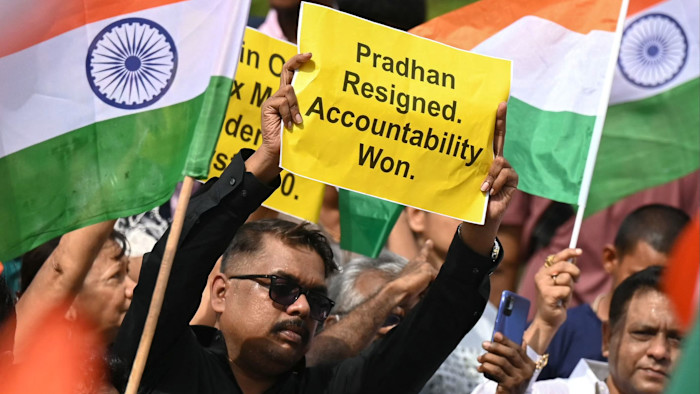
At the main site of India’s momentous youth protests in New Delhi, municipal workers have already painted over anti-government graffiti and jet-washed the streets — but the mark made by the student-led movement on the nation’s politics will be much harder to remove.
In just 36 days, the upstart Cockroach Janta Party (CJP) mobilised hundreds of thousands of students over failings in the exam system, forcing a rare climbdown by Prime Minister Narendra Modi and the resignation of his education minister, Dharmendra Pradhan.
After years in which protests were largely ignored or suppressed in India and Modi dominated the political narrative, the CJP’s humbling of his government has already inspired one copycat protest movement and analysts expect more to appear.
The E20 Janta Party, which takes its name from a new fuel blend containing 20 per cent ethanol, picked up 34,000 followers within 24 hours of appearing on social media site X on Sunday. It hopes to tap into public anger over the government’s imposition of the fuel nationwide despite worries over higher fuel consumption and damage to older engines.
Like the CJP, it wants a change of policy — all filling stations should offer 100 per cent petrol at an affordable price — and a minister’s resignation.
The E20 Janta Party is the “Voice of the People”, the movement says on its X profile page, which calls for justice, transparency, accountability and “People’s Rights”.
Pratap Bhanu Mehta, an Indian political scientist and lecturer at Princeton University, said the youthful ‘cockroach’ campaign offered “a template for a new way of making demands on the state” that would inspire others.
“I don’t know how much momentum this E20 Janta Party will get, but it’s an example of exactly this kind of thing,” he said. “People are sceptical that they can raise demands through formal institutional channels . . . so any time there is a significant demand, there’s going to be an attempt to create a public protest movement.”
The E20 campaign is targeting Modi’s transport minister, Nitin Gadkari, whose sons operate a family business that produces ethanol. Gadkari has denied any conflict of interest and has said his sons have less than 0.5 per cent of India’s ethanol market.
Tehseen Poonawalla, a political analyst who has been vocal against the new ethanol blend, has called for a “car march” on Friday to Gadkari’s house. Delhi taxi drivers last week announced a march to parliament on August 4 over the fuel issue.
CJP leaders have not yet evaluated whether to back fuel protests as the movement regroups after its success in forcing government concessions, which also included a promise to shake up the examination system and to compensate the families of students who killed themselves after the cancellation of India’s national medical entrance exam.
But Saurav Das, chief CJP spokesperson and one of its negotiators, said “the government should wake up and smell the coffee”.
“People are not going to accept any more them thrusting their policies and laws without any debate, discussion or deliberation,” he said.
Anger at the ethanol fuel push surfaced in Mumbai on Sunday, the day after the CJP’s deal with the government, as thousands rallied in India’s financial capital to celebrate the resignation of Pradhan.
Aamir Kazi, the Mumbai president of the All India Students’ Federation, who was present at the rally, said there was opposition to the imposition of the fuel blend among protesters and that the “struggle goes on” against government education policy.
“We are working on it,” he said, when asked if more demonstrations were planned.
The BJP has shrugged off the loss of its parliamentary majority in 2024, winning a string of state elections and persuading opposition members of parliament to defect.
Critics say that as the ruling party’s power has grown over the past decade, institutions such as the courts, the election authority and the mainstream media have increasingly bent to its will, limiting the space for dissent.
Shakuntala Banaji, a professor at the London School of Economics who researches Indian youth movements, said that “in different places, not just Delhi, there are other movements rising up around similar issues”.
The E20 fuel protests, she added, might well spread “because people have figured out that what gets traction is something that really, really affects middle-class BJP voters and their children”.
The student protests have triggered unease inside the BJP, particularly among members whose own children took part.
In one much-publicised case, the daughter of a minister in a BJP-led state government in northeastern Assam was seen in videos posted on social media expressing anger at Modi at a CJP protest, something almost unthinkable before this month’s events.
Some BJP members have privately spoken of shock at seeing student protesters beaten and tear-gassed by police at otherwise mostly peaceful demonstrations.
Eeshna Gupta of the student wing of the opposition Aam Aadmi Party said the CJP campaign had “changed the culture” in India.
“It has [laid to rest] the stereotype that Gen Z cannot be political or they cannot raise their voice,” she said.
“Even when this movement started, people were really underestimating us,” she said. “My personal opinion is that this movement doesn’t end here.”
Or, as the CJP’s Das put it: “I think it would be better for the government for the next three years before the [next general] election to start listening to people.”
Additional reporting by Chris Kay in Mumbai
