


- A documentary explores the legacy of mining along South Africa West Coast and its impacts on coastal ecosystems and the local population.
- The West Coast, an area stretching 450 kilometers up to the Namibian border, has historically been a hotspot for diamond mining.
- Out of Mined features the voices of the Indigenous Nama peoples, fishing communities and conservationists who live with the long-term impacts of the extractive industries.
- The region is now facing a new wave of mining applications, mostly targeting heavy minerals.
Stretching 450 kilometers (280 miles) from Cape Columbine, two hours north of Cape Town, to the Orange River which marks the country’s natural border with Namibia, South Africa’s West Coast is vast, remote and sparsely populated and, moving north, characterized by a harsh, arid climate.
In the very north, not far inland, lies the Richtersveld, which is the only remaining area in South Africa where the Nama people maintain their semi-nomadic traditions. It is also home to an extraordinary range of succulents and plant diversity, some only occurring there. The Richtersveld region, parts of which were declared a UNESCO world heritage site in 2007, is a unique biodiversity hotspot and has one of the highest density of succulent species.
The region is rich not just in diamonds, but also other mineral deposits whose presence has turned the region into one of South Africa’s most intensively mined landscapes over the past century.
A new documentary, Out of Mined, examines the legacy of mining along the West Coast at a time when the region is facing a renewed interest from the mining sector for its heavy minerals, found in terrestrial reserves, but also in heavy mineral sands along the coast and as offshore deposits.
Cape Town-based director Arthur Neumeier started working on Out of Mined after social media posts about a wave of new applications for mining rights along the West Coast by the local civil society organization Protect the West Coast (PTWC) caught his attention.
“I was so blown away by how much bigger this story was than I thought initially,” Neumeier told Mongabay in a phone interview, describing the damage he saw from historical diamond mining in the Richtersveld during a visit in 2024.
Neumeier had joined the PTWC team on a trip to Alexander Bay, a former diamond-mining town on the south bank of the Orange River mouth in South Africa’s very northwestern corner, and to the Richtersveld.
Following that trip, the filmmaker set out to capture the voices of people that have been affected by diamond mining operations, interviewing fishers, Nama community members, environmental organizations, scientists, researchers and industry representatives.

Communities left behind after mines closed
The film explores how communities used to live before the mines, what changed when the companies arrived promising jobs and economic opportunities and what was left behind when the miners left.
“It was heartbreaking to hear how they got left behind after the mines closed,” Neumeier told Mongabay.
For much of the 20th century, British multinational company De Beers Group was the biggest diamond miner in the region, but sold the majority of its mining rights to the local diamond company Trans Hex in 2014. With depleting deposits and shifting market prices for diamonds, onshore mines along the West Coast have become increasingly unviable, leading to their closure.
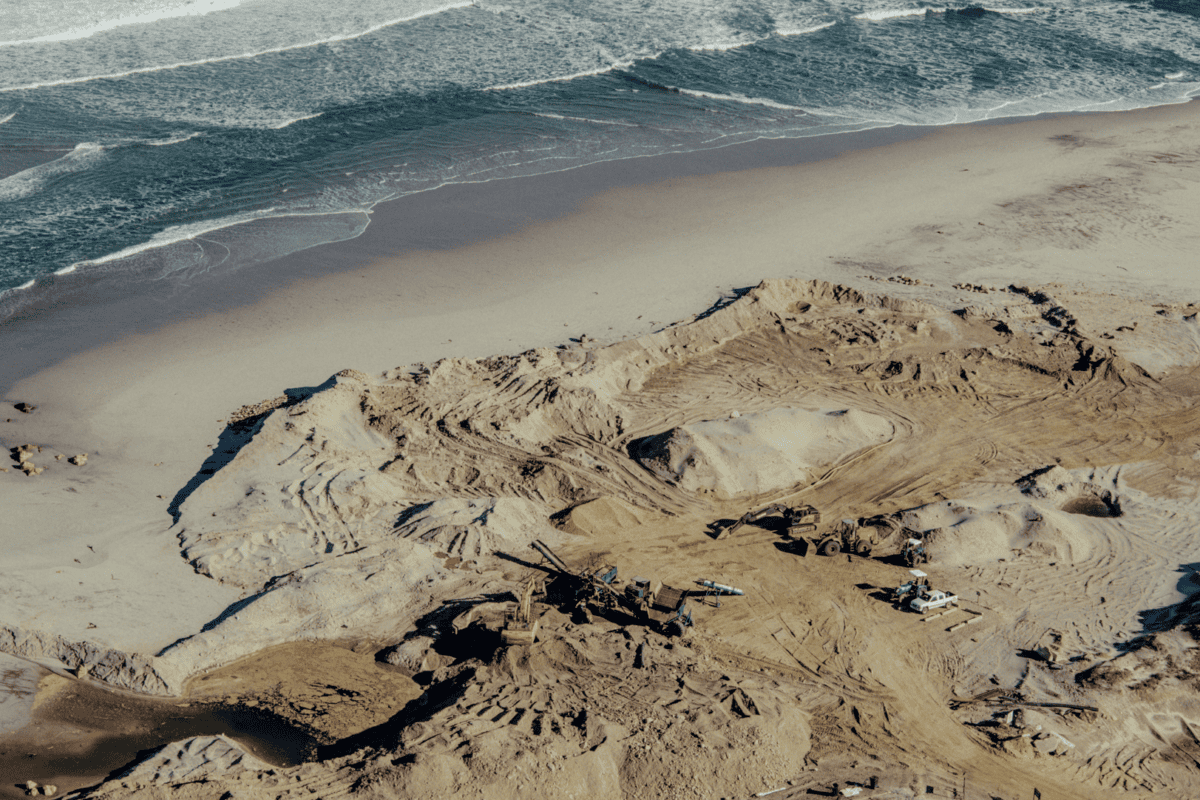
According to Mike Schlebach, managing director of PTWC, which co-produced the film, most of De Beers’ former mines remain unrehabilitated. The film uses aerial footage to show landscapes that have been transformed by mining operations, vast areas of desert scattered with large pits from closed mines, and large mounds of mining debris.
But it isn’t just the land that was altered.


One community member interviewed in the film said the instant the diamond miners came, people’s lives changed. “The companies come, they come to mine our grounds, they give the people work. At the end of the day, there’s a period of [the term of a mining permit], when that period is over, they leave and the people don’t have work anymore.”
Through people’s stories, the film captures how mining transformed local communities that had long depended on fishing, livestock farming and the region’s natural resources like ochre.
The film showcases the landmark land claim court victory by the Richtersveld communities in 2003, recognizing the customary ownership of the Nama people and restoring 85,000 hectares (210,000 acres) of ancestral land to 4,000 tribe members. The case was regarded as a global precedent for Indigenous land rights.
However, residents interviewed in the documentary say many of the economic benefits promised through mining have failed to materialize.

Legal disputes persist
The issues Neumeier covers extend beyond the film itself, as legal disputes over environmental authorizations for mining operations along the West Coast are ongoing.
Schlebach told Mongabay that several years ago, PTWC took the diamond mining company Trans Hex to court over its environmental management program and reached an out-of-court settlement preventing the company from mining diamonds in critical biodiversity areas in and around the Olifants River Estuary.
The documentary features Marco Wentzel, the CEO of the diamond company Trans Hex, which has been mining diamonds in Namaqualand since 1965. Wentzel said that there are “a lot of big holes” along the West Coast from diamond mining. He added that, for Trans Hex, mining on land is no longer profitable: “We’re not mining on land anymore. We mine marine. The future for us will be in the other minerals, heavy minerals deeper in the ocean,” Wentzel says in the film.
According to PTWC, more than 60 applications for new mining licenses in the region have been submitted so far in 2026.

Schlebach, as well as scientists interviewed in the documentary, warn of the cumulative impacts of all the mining operations happening in the region on biodiversity, ecosystems, heritage sites and local communities.
PTWC has been advocating for a Strategic Environmental Impact Assessment of the West Coast, which would map the combined impacts of all the mining operations together. “In order for the government to play the responsible role that it should play, they need to take a proper look at how best to utilize the West Coast, and a strategic environmental assessment is a great way to get that done,” Schlebach said.
Banner image: Heavy machinery is used to excavate pristine beaches for diamond mining along South Africa’s West Coast. Image courtesy of Arthur Neumeier.
FEEDBACK: Use this form to send a message to the author of this post. If you want to post a public comment, you can do that at the bottom of the page.
Cite this article
Victoria Schneider (2026). Documentary captures impacts of diamond mining along South Africa’s West Coast. Mongabay Conservation news. DOI: https://doi.org/10.66709/news-325174

