


- At the U.N. biodiversity summits, finance is often the center of tense discussions and negotiations — particularly on commitments by developed nations to mobilize funds to developing nations and how those funds will be distributed.
- The Democratic Republic of Congo is an insistent advocate on the world stage for increased, and “more effective,” finance to help industrially developing countries meet global biodiversity goals, and for an independent financial mechanism away from the Global Environmental Facility.
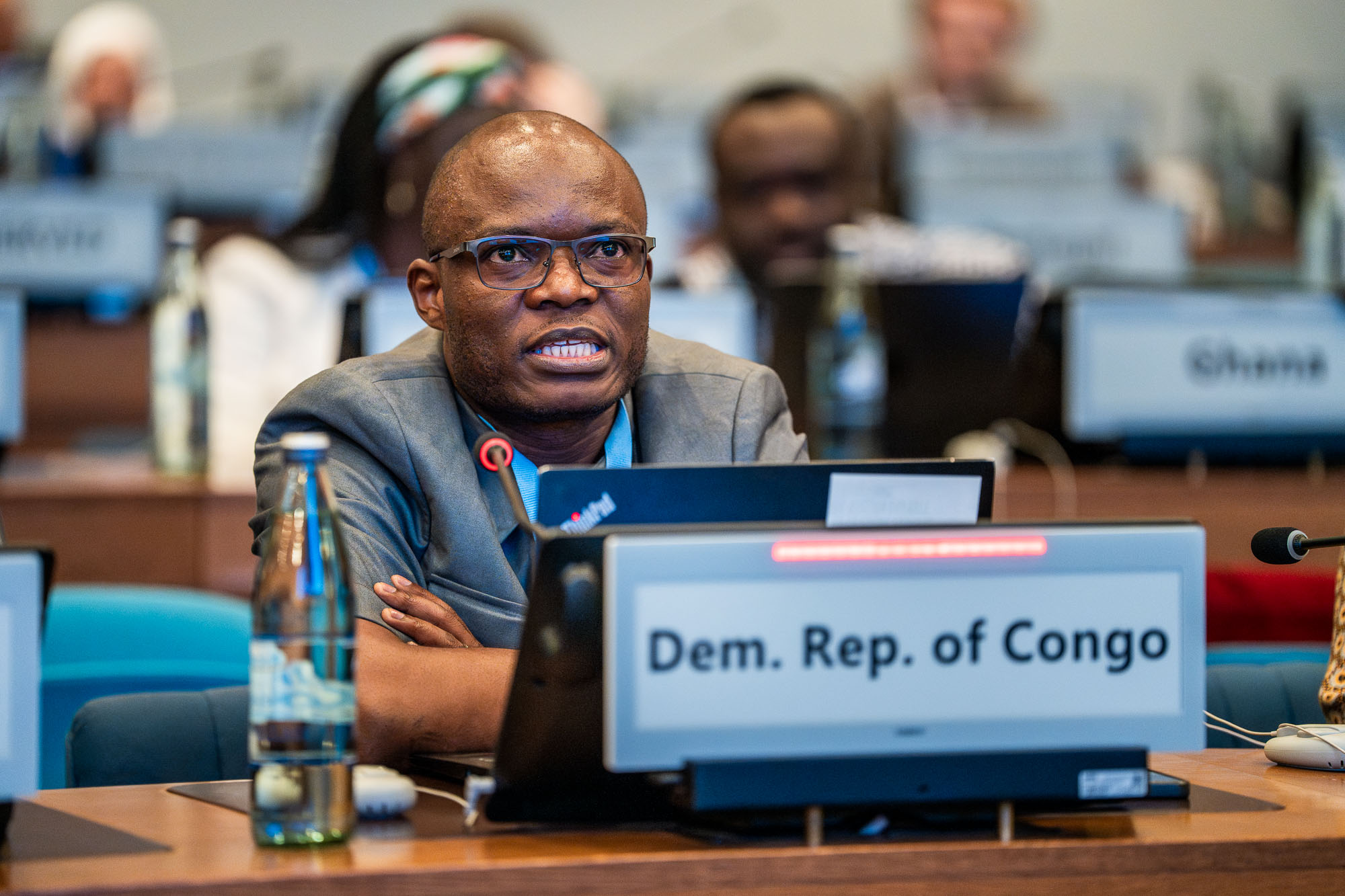
- Daniel Mukubi is a recurring figure representing the DRC during these negotiations, often at the microphone and seeking to build alternative strategies with other parties.
- Mongabay had an exclusive interview with Mukubi about what the DRC pushes for in finance negotiations and in the future, funding access for industrially developing countries, finding other diverse sources of funding, his perspective — and those of developed nations — during tense negotiations, where Indigenous peoples and local communities fit in, economic development in the country and more.
YEREVAN, Armenia — Discussions were running much longer — and tenser — than they were supposed to during one of the last sessions of the 2026 U.N. biodiversity summit (COP17) in Armenia. The recurring culprit: Money, or more specifically, biodiversity finance.
It recalled earlier discussions four years ago during the COP15 summit in Montreal, which ended in momentary panic when one party threatened to pull out at the last minute over finance issues.
One of the parties at the center of disagreements during both summits was the Democratic Republic of Congo (DRC): Holder of the biggest share of the second-largest rainforest in the world — the Congo Basin — and veracious critic on the world stage for increased, and “more effective,” finance to help industrially developing countries meet global biodiversity goals.
Among the recurring figures representing the country at environmental conferences is Daniel Mukubi, often on the microphone, intervening and vocal about better and more equitable access to finance.
“All this weight … the objectives, targets of the global biodiversity framework … It requires additional efforts for developing countries, such as the Democratic Republic of the Congo, to be able to find alternatives,” says Mukubi in an exclusive interview with Mongabay.
“Additional means to enable Indigenous peoples and local communities that depend on forests and ecosystems, but also on forest products for their livelihoods, to be able to find means of subsistence that will allow them not to continue destroying the forest.”
Parties turn to industrially developed nations to provide this significant finance to protect Earth’s biodiversity in other countries as they have historically placed heavier pressures on ecosystems to feed their economies, tend to possess more money — and have a formal obligation to do so under the Convention on Biological Diversity (CBD).
“The Global North countries think that we are asking for charity or favor. But it is their responsibility,” he added.
Mukubi, head of the climate change division at the ministry of the environment, was one of the negotiators who pushed for industrially developed nations to contribute $100 billion per year of biodiversity finance to industrially developing countries during the COP15 summit in Montreal, the conference which gave birth to the Kunming-Montreal Global Biodiversity Framework (the world’s current global biodiversity goals). In the end, parties agreed to give $20 billion annually by 2025 and $30 billion annually by 2030, as part of the $200 billion annual target to finance global conservation.
According to the new global report tracking progress, this smaller finance goal has likely not been met.
Mukubi recurrently attributes this to industrially developed countries being reticent to contribute their own funds to support global conservation and politicizing matters. At conferences, like COP17, parties representing industrially developed nations like the EU instead try to expand the pool of country donors, to include nations like China and Gulf states, as a method of increasing finance. At home, developed nations are met with a reduced appetite for international spending due to cost-of-living crises, military spending and geopolitical shifts.

“We’ve seen some rather surprising requests from developed countries, which would prefer to broaden the donor base in the hope that others might contribute — even though those already on the list of developed countries that are required to contribute are failing to do so,” Mukubi says.
“The world still doesn’t seem to be much more aware of the danger posed by biodiversity loss and tends to prioritize the interests of individual countries and parties, rather than looking at the bigger picture and considering the interests of future generations in inheriting a livable world and planet.”
At the center stage of finance discussions at COP17, which concluded Oct. 30, was how to mobilize the resources needed to implement the biodiversity goals, reviewing the institutions responsible for managing and distributing these funds and planning the future path for biodiversity finance.
The DRC has been an advocate for a dedicated independent financial mechanism under the CBD to distribute funds, stating that holding it within the Global Environmental Facility (GEF) makes it difficult for industrially developed countries to access money and that transaction and administrative costs are too high.
“[One of our] projects was approved very, very quickly, but now to access the fund, it’s been over a year that we still don’t have it,” he says.

So far, money to reach the biodiversity goals can be pooled from the Global Biodiversity Framework Fund (which is hosted by the GEF) and through funding cycles of the GEF (like GEF-8 and GEF-9), which have programmed about $362 million and $8.5 billion to projects respectfully. The DRC, with Mukubi as a negotiator, is part of ongoing discussions to create a separate dedicated financial mechanism.
Mongabay spoke with Mukubi about what the DRC pushes for in finance negotiations and in the future, funding access for industrially developing countries, finding other diverse sources of funding, his perspective — and those of developed nations — during tense negotiations, where Indigenous peoples and local communities fit in, economic development in the country and more.
This interview was translated from French and edited for clarity.
Mongabay: At COP15, you called for industrially developed countries to mobilize $100 billion for biodiversity, whereas the targets ultimately agreed upon were $20 billion by 2025 and $30 billion by 2030. Although funding for biodiversity is on the rise, progress remains insufficient, and the interim financial target for 2025 has likely not have been met, according to the latest global report. What is your perspective on this situation? And why does the DRC want or need additional funding?
Daniel Mukubi: Yes, in fact, studies have shown that there is a funding gap of $700 billion per year. And of that $700 billion per year, studies have shown that $500 billion is already being spent on subsidies that are harmful to biodiversity, particularly through oil extraction, chemical fertilizers, pesticides, and insecticides in agriculture.
Therefore, if we were to redirect or reform these harmful incentives toward actions that benefit biodiversity, we would be left with a funding gap of $200 billion per year.
So, if we’re left with a funding gap of $200 billion a year — and considering the economic situation, which has remained uncertain internationally in recent years — we figured, well, it’s clear that developed countries alone cannot bear the entire burden of funding biodiversity. That is why we asked COP15 to at least make an effort to reach $100 billion a year.
From their perspective, they said that $100 billion a year would only be possible by 2030.

That is how we reached a compromise: $20 billion per year through 2025 and $30 billion per year from 2026 to 2030. This would now help meet the $200 billion funding gap and would, therefore, put biodiversity back on track.
The Democratic Republic of the Congo does, in fact, need additional funding to implement the Kunming-Montreal Global Biodiversity Framework because the burden of biodiversity conservation, for example, has become much heavier, given that the DRC has more than 155 million hectares [383 million acres] of forests.
We have committed, for example, to conserving 30% of the DRC’s total land area by 2030 — an area that is, in any case, much larger than that of some countries in Africa and even in Europe.
Therefore, this conservation burden requires that we secure additional resources to ensure that Indigenous peoples and local communities — who depend on forests, ecosystems, and forest products for their livelihoods — are able to find sustainable livelihoods that will prevent them from continuing to destroy the forest.

We have also committed to restoring 30% of degraded lands and ecosystems by 2030, and all these challenges show that we ultimately need much more funding than in the past because the objectives and targets of the global framework—for example, combating invasive alien species and so on, require additional efforts from developing countries, such as the Democratic Republic of the Congo, to be able to propose alternatives that are in line with achieving the goals and targets of the global biodiversity framework.
Mongabay: In your opinion, why aren’t we meeting the financial targets that have been set, for example, $20 billion by 2025 and $30 billion by 2030 for developing countries? Why is there a bottleneck in international financing?
Daniel Mukubi: Well, we’re not meeting international financing targets because there’s already a problem with resource mobilization.
Article 20 of the Convention on Biological Diversity requires developed countries to mobilize resources for developing countries to enable them to cover the additional costs of implementing the Convention and its protocols.
The Kunming-Montreal Global Biodiversity Framework reiterated this requirement, particularly in Target 19, calling for developed countries to provide, at a minimum, at least $20 billion per year by 2025 and at least $30 billion per year from 2026 to 2030.
But we are not managing, are we, to mobilize this funding.

We found that, in the global assessment of collective efforts made toward achieving the goals and targets of the Kunming-Montreal Global Biodiversity Framework, efforts have been made, but progress has been very slow, especially when it comes to resource mobilization.
But when we look at the list of developed countries that are supposed to contribute and mobilize resources to fund biodiversity actions (there is a list of 25 developed countries) we noticed that, in terms of contributions to the ninth replenishment of the Global Environment Facility [GEF-9], only 12 countries actually contributed.
In other words, just under half of the contributors actually contributed, and that poses a serious problem in terms of resource mobilization.
And rather than first emphasizing the fact that the set targets were not met, we’ve seen some rather surprising requests from developed countries, which would prefer to broaden the donor base in the hope that others might contribute—even though those already on the list of developed countries that are required to contribute are failing to do so.
So, the debates have centered on why those on the list are not contributing, and they have not received answers to that; according to them, they have managed to come close to reaching the $20 billion target.

But when we looked at the available reports, we found that they were far from that figure because they included all the Rio indicators, which draw on all sources of funding—whether for combating climate change, land degradation, or biodiversity loss — and total spending on biodiversity barely reached $18.9 billion.
Mongabay: You participated in the discussions on resource mobilization and the financing mechanism during COP17. What are the main lessons you’ve learned from these negotiations?
Daniel Mukubi: Well, we’ve learned that the world still doesn’t seem to be much more aware of the danger posed by biodiversity loss and tends to prioritize the interests of individual countries and parties, rather than looking at the bigger picture and considering the interests of future generations in inheriting a livable world and planet.
When countries of the Global South, generally speaking, call for new and additional funding to combat biodiversity loss, countries of the Global North think we’re asking for charity or a favor. But this is a responsibility that falls on them, so that we, for our part, can bridge the gap in biodiversity financing.

So, the lessons we have learned are that, for example, with the United States’ withdrawal from several international treaties, the gap has become even wider, and developed countries believe they are shouldering a much heavier burden, even though the funding targets have not yet been met.
That is the first lesson we have learned.
A second lesson we have learned is that developed countries do not seem willing to comply with the text of the Convention because Article 21 of the Convention refers to a funding mechanism under the Convention on Biological Diversity that must be under the control and authority of the Conference of the Parties and accountable to it. And Article 39 of the Convention stipulates that the Global Environment Facility [GEF] is an interim arrangement.
Consequently, developed countries seem to agree that the GEF is the financing mechanism that must be permanent for biodiversity, whereas developing countries find that the GEF has many shortcomings, including cumbersome procedures, insignificant funding, and very difficult access, especially for Indigenous peoples, local communities, and even most developing countries.

That is why we have insisted that we must establish criteria for selecting an institution capable of hosting this financing mechanism, as referred to in the text of the Convention.
Thus, at COP17, we finally agreed on a number of criteria that this financing mechanism must meet. In particular, it must operate to achieve the objectives of the Convention and its protocols.
In particular, this mechanism must be under the control and authority of the Conference of the Parties and be accountable to it. It must operate under a democratic and transparent governance system, and it must disburse funding to all eligible developing countries to enable us to implement actions in support of biodiversity.

Mongabay: So, are you optimistic that this new financial mechanism will be established at COP18 or perhaps COP19?
Daniel Mukubi: Yes, as early as COP16 [the 2024 U.N. biodiversity conference in Colombia], Decision 16/34 established a roadmap to ensure the mechanism would be operational by COP19 [scheduled for 2030].
To achieve this, there were intermediate steps, and the first step at COP17 was completed: Reaching agreement on the criteria for this financing mechanism. And at COP18 [scheduled for 2028], we will now focus in particular on the fact that there are still divergent viewpoints between countries of the North and those of the South.
So COP18 will have to decide: Should we establish an entirely new mechanism, or should we designate an existing mechanism to now serve as this permanent biodiversity financing mechanism?
And at COP19, we will put in place the set of tools that will enable this mechanism to become operational.

Mongabay: Do you perhaps think that COP19 is a little too late to have all of this in place? Because, for example, the targets for the Global Biodiversity Framework are set through 2030, aren’t they?
Daniel Mukubi: Yes, exactly.
At the same time, we had a specific window known as the GBFF [Global Biodiversity Framework Fund], which is the fund for implementing the Kunming-Montreal Global Biodiversity Framework. And this fund has made it possible to begin financing certain projects aimed at implementing the biodiversity framework.
Unfortunately, this initiative, too, has so far only managed to mobilize just under $400 million.
There are also other initiatives, such as the Kunming Biodiversity Fund, which is a fund established by China and has recently issued calls for proposals to continue supporting the implementation of the Kunming-Montreal Global Biodiversity Framework.
There are also other partnerships, such as the NBSAP Accelerator Partnership, that is, the partnership to accelerate the implementation of national biodiversity strategies and action plans. These are aligned with the Kunming-Montreal Global Biodiversity Framework.

There are also certain initiatives, such as the High Ambition Coalition, which sometimes helps countries identify partners who may be able to support specific projects and initiatives aimed at implementing the Kunming-Montreal Global Biodiversity Framework at the national level.
So, there are a number of initiatives that will attempt to play this intermediary role until 2030, when we will have a permanent, functional mechanism in place to fund the biodiversity goals that will be defined for the decade following 2030.
Mongabay: What has been the DRC government’s experience so far with accessing the Global Biodiversity Framework? How do you assess the process, from project preparation through to approval?
Daniel Mukubi: Well, the process remains cumbersome and really difficult to navigate, because it’s based solely on the project. The projects are short-term, perhaps two to four years.
Furthermore, these are small-scale projects compared, for example, to the ambitions of the Kunming-Montreal Global Biodiversity Framework. What we want is funding that is predictable and not subject to conditions, such as those currently required to access funding from the Global Environment Facility.
One of the conditions is that there must be co-financing. If developing countries, which already lack sufficient resources, are also required to provide co-financing just to have a chance of accessing available funding, that in itself is a problem.

Another difficult situation involves the implementing agencies, which are primarily agencies of the United Nations system, such as the FAO [Food and Agriculture Organization of the United Nations], the UNDP [United Nations Development Programme] and so on.
And to access this funding, it is absolutely necessary to go through these agencies.
These agencies have enormous transaction costs and significant administrative costs, which prevent all of the funding from reaching the field.
As a result, we’re seeing dismal outcomes for biodiversity. That’s why we continue to demand and call for the reform, overhaul, and fundamental restructuring of current financing systems and mechanisms, so that they take into account the realities of developing countries, enabling us to meet the goals we’ve set for ourselves.
For example, the DRC submitted a project to support the implementation of the Global Biodiversity Framework through the National Biodiversity Strategies and Action Plans for 2025–2030. The project was approved very, very quickly, in August 2025, but we have been unable to access this funding for over a year now.

Mongabay: And just to clarify, you’re talking about the funds in the ninth replenishment of the Global Environment Facility (GEF-9), right? You’re not talking about the funds in the GBFF (Global Biodiversity Framework Fund), is that correct? Or is it both?
Daniel Mukubi: Well, it’s both. They’re two sides of the same coin. Because the GBFF is also hosted by the GEF.
So, the GEF Council or the GEF General Assembly, etc., decide on the procedures, and those procedures can be made more flexible. But anyway, we’ve noticed that, for example, with the GBFF, what has been made more flexible is the project approval process.
That went quickly. The project was approved quickly. But access to financing continues to drag on.
So even the GEF itself to access financing, sometimes the money comes in the form of loans as well. And developing countries, burdened by debt, are no longer keen on continuing with this financing system.


That’s why we’re pushing for sovereign financing that will enable developed countries to provide new and additional financial resources to developing countries by streamlining access mechanisms, simplifying procedures, and accelerating access to funding.
Mongabay: What do you find most frustrating about international discussions on biodiversity financing?
Daniel Mukubi: What frustrates us the most is, first of all, that developed countries are failing to fulfill their commitments under the Convention on Biological Diversity.
We see, for example, that official development assistance has declined. We see, for example, that the mobilization of funding is on the decline. When we look, for instance, at the ninth replenishment of the Global Environment Facility (GEF), it has barely reached $4.4 billion, compared to GEF-8 (the eighth GEF replenishment), which totaled just over $5.3 billion.
But if we have $4.4 billion in funding for four years, from 2026 to 2030, while the funding gap is several hundred billion dollars, and we’re talking about just $4.4 billion—that’s truly very, very frustrating.

Then, when we look, for example, at climate change, there’s the Adaptation Fund, there’s the Least Developed Countries Fund, there’s the Green Climate Fund, there’s the Loss and Damage Fund, and so on.
But for biodiversity, there’s only one mechanism, and that frustrates us even more.
And when we look at the GEF, which should be considered a funding mechanism specifically for biodiversity, unfortunately it isn’t. Because the GEF still funds climate change, the fight against land degradation, heavy metals and pollutants, and so on.
So, out of roughly six GEF-funded initiatives, biodiversity becomes something of an afterthought, whereas it should be at the forefront of the global funding agenda.
Mongabay: So, how can Indigenous peoples or local communities gain direct access to this funding? Are there any groups or organizations that have successfully gained effective access to biodiversity funding to date?
Daniel Mukubi: Well, it’s true that there has been a lot of advocacy recently for Indigenous peoples and local communities to have direct access to funding sources.

But it’s true that, for example, with the Global Environment Facility (GEF), under the Global Biodiversity Finance Facility (GBFF), it was planned that 20% of the funding mobilized through the GBFF would be directed toward [actions led by] Indigenous peoples and local communities. [This target has been surpassed, but it is not direct funding].
[In the DRC], we have developed a community-based biodiversity and livelihood conservation project in the context of climate change, which is expected to be implemented by the Ministry of Environment, Sustainable Development, and the New Climate Economy of the Democratic Republic of the Congo, in collaboration with the National Alliance for the Support and Promotion of Indigenous and Community Heritage Territories.
It’s not just an acronym — it’s an organization of Indigenous peoples and local communities that now has direct access to the fund and will manage nearly 40% of this total budget to implement community-based conservation and livelihood activities that take climate change into account.
Well, that is one of the few examples, because the government did support this organization in strengthening its administrative, technical, and institutional capacities so that it could begin to secure funding more or less directly. And this is part of the GBFF.

But this organization is also currently able to secure funding from other donors such as the IUCN (International Union for Conservation of Nature) and the RFN (Rainforest Foundation Norway), among others.
Consequently, these efforts are also being recognized, as the president and director of this organization representing indigenous peoples and local communities has been named an ambassador for primary forests in recognition of his efforts to conserve biodiversity. And the fact that he works in collaboration with the government allows him certain advantages in accessing funding directly.
But these are rare cases because there aren’t many examples of this kind in the region.
Mongabay: During a working group discussion at COP17, the European Union was reluctant to strengthen provisions regarding equitable access to financing, particularly by considering measures to facilitate access for “all” parties and young people — including those who have not yet received support from the GBFF. You strongly opposed this position. How did you interpret the European Union’s reluctance? And what is your opinion on this?
Daniel Mukubi: Well, our view is that we cannot politicize environmental diplomacy, nor can we politicize biodiversity conservation.
When we negotiate on biodiversity, we have guiding documents.
And these guiding documents include, in particular, the text of the Convention that has been ratified and other tools to support the Convention’s implementation, such as strategic plans.

Currently, the Kunming-Montreal Global Biodiversity Framework assigns responsibilities to various stakeholders because this framework was developed using an approach known as “whole-of-government and whole-of-society.” Consequently, the whole of government and the whole of society must come together to combat biodiversity loss and implement activities related to biodiversity conservation.
To our great surprise and astonishment, the European Union did not want us to mention “all” eligible parties for access to funding, as if certain parties would be selected while others would be excluded from access to funding.
Yet, in order for us to achieve the Sustainable Development Goals and the targets of the Global Framework, it is clear that all parties must play their part.
That is why we strongly opposed this and managed to convince the world that we must take into account “all” eligible parties, because we believed that if we start excluding certain parties, it would be solely for political reasons, and biodiversity has no place in politics.

Biodiversity has no place in our political considerations, because it continues to erode, and if the entire world cannot mobilize, we’ll have nothing left but our tears.
Mongabay: What do you think about the pressures placed on the DRC or the countries of the Congo Basin to strengthen their commitments and achieve more ambitious conservation goals? How do you feel when you see activists and organizations calling on countries like the DRC to do more to protect their forests?
Daniel Mukubi: Well, actually, these organizations need to understand that there is a principle at play here: National sovereignty. And national sovereignty means that the government sets the priorities, determines its means, and mobilizes the resources to achieve those goals.
So, external international pressure is often seen as interference in the internal affairs of countries like the DRC.
Because we find it hard to accept that others should lecture us on conservation when we ourselves, through our traditional practices and the customs of our indigenous peoples and local communities, have already promoted the conservation of biodiversity up to this point.
The Democratic Republic of the Congo has eight national parks, five of which are listed as World Heritage Sites.

This means that the value of biodiversity is truly enormous. The Democratic Republic of the Congo has just established the Kivu-Kinshasa Green Corridor, which is the world’s largest protected area dedicated to community-based conservation. The DRC, with its peatlands, tropical rainforests, miombo woodlands, mountain ecosystems, and savannas: A wide variety of ecosystems that have long been conserved up to the present day.
This depended on political will and domestic policy, but also on the customs and traditions of indigenous peoples and local communities.
So, these pressures are seen as attempts to hinder the country’s sustainable development, because today the concept has evolved. We no longer speak of “nature protection;” rather, we speak of “nature conservation.”
Nature conservation means that there are opportunities to use natural resources while preserving the original natural capital.
Consequently, when we implement sustainable natural resource management practices, this will enable us to continue conserving biodiversity.
But if pressures continue to mount — and unfortunately, this is happening in a context where we lack additional financial resources — we cannot continue to prohibit our Indigenous peoples and local communities, who depend on forest resources for their livelihoods, from using those resources if we are unable to provide them with alternative means of subsistence and additional income.

Mongabay: So, if I understand correctly, in order to continue conservation efforts — and even to raise the bar in the DRC — more international funding will be needed, is that right?
Daniel Mukubi: Absolutely, that’s right.
Mongabay: I know there is reluctance on the part of developed countries to fund projects, or even to increase their contributions. Where should this additional funding come from, given the limited number of countries willing to contribute more? Are there other ways, or, I don’t know, other sources, to increase international funding? Perhaps through companies, or maybe even domestic efforts, etc.
Daniel Mukubi: Yes, it is true that there is an urgent need to diversify the means or sources of biodiversity financing.
But even if it is diversified — with businesses contributing, philanthropy contributing, and internal resources being mobilized under the Convention on Biological Diversity, none of this can ever replace international public financing.
For example, the Cali Fund, which was established to facilitate the sharing of benefits arising from the use of genetic resources, particularly DSI, that is, digital sequencing information on genetic resources.
But there’s a problem because the Cali Fund is entirely voluntary. As a result, pharmaceutical companies, agribusinesses, cosmetics companies, and even artificial intelligence firms, which should be providing support to keep this fund running, are, given its voluntary nature, unable to muster the motivation to contribute. As a result, the Cali Fund, since its establishment in 2022, has failed to raise more than $10,000 — just imagine that.

So, as a result, international public funding is responsible for mobilizing the bulk of the funding required for biodiversity conservation, and the rest is just supplementary.
Companies, philanthropy, and domestic resources are, in fact, tools that merely complement the efforts of international public funding. That is why, when developed countries proposed broadening the donor base, countries with economies in transition also expressed reluctance, because they are convinced that this is primarily the responsibility of developed countries.
And the rest is on a voluntary basis, because for developed countries, it is mandatory.
Mongabay: So, developing countries are perhaps all in agreement that it is the developed countries that need to increase their contributions, is that right?
Daniel Mukubi: Absolutely.
Mongabay: What do you think of the Tropical Forest Forever Facility (TFFF) as a financing mechanism capable of mobilizing significant resources for the DRC?
Daniel Mukubi: Well, it’s true that the TFFF is primarily designed to help countries in tropical forest basins gain access to funding sources that will help mobilize more resources and ensure they can access them.
And we believe that mechanisms like this should be encouraged, because they are based on South-South cooperation, and such mechanisms are much better positioned to mobilize additional funding and facilitate access for developing countries — especially given the significance of the Congo Basin’s forests.

In the context of global climate regulation, initiatives like the TFFF are truly initiatives worth encouraging. And we have seen, for example, that the TFFF has currently mobilized more resources than other funding sources and long-standing mechanisms.
And this offers hope by demonstrating a funding model that can work.
That is why, during the ministerial meeting on the sidelines of COP17, some African ministers raised the idea of creating an African biodiversity fund. And we believe that if such initiatives can be supported, then we may be able to bridge the funding gaps and achieve biodiversity conservation goals.
Mongabay: The Global Report on the Implementation of the Global Biodiversity Framework indicates that progress remains limited in strengthening positive incentives for nature conservation, as well as in identifying and reforming incentives that are harmful to biodiversity.
To what extent is the DRC affected by this issue? Where does the country stand in terms of identifying, phasing out, or reforming incentives and subsidies that are harmful to biodiversity?
Daniel Mukubi: Well, currently, the Democratic Republic of the Congo is conducting an analysis, particularly as part of the BIOFIN biodiversity financing initiative project. We’re analyzing funding and funding sources at the national and international levels.
And the DRC does not, for example, provide incentives for mining, etc.

That’s why, when we look at the mining landscape in the DRC, it’s mainly foreign companies that are bringing in practices harmful to biodiversity.
That is why the DRC is initially observing these harmful incentives from a somewhat more distant perspective, because we do not have sufficient data and information. And even the global assessment of collective efforts made in implementing the Kunming-Montreal Global Biodiversity Framework has suffered from a lack of necessary data regarding Targets 18 and 19. And Target 18 primarily concerns these harmful incentives.
So, as a result, we still need a little more data and information to be able to properly assess our position regarding these harmful incentives affecting biodiversity.
Mongabay: As I understand it, there is a strategic partnership agreement between the United States and the DRC under which the DRC has committed to establishing preferential tax and regulatory incentives for U.S. investors as part of Eligible Strategic Projects and the Strategic Asset Reserve. Would this count as subsidies or incentives that are harmful to nature?
Daniel Mukubi: Currently, the DRC is conducting analyses, first and foremost to determine how to integrate biodiversity into relevant sectors, including mining, hydrocarbons, agriculture, and so on.

So, once these analyses on integrating biodiversity into the relevant sectors are complete, we will be able to determine whether any of this can be considered harmful incentives.
But in the current context, for example, we have a new forestry policy, and we are in the process of updating the forestry code.
As you know, for example, in the DRC there have been attempts to begin oil extraction in certain protected areas, such as Virunga National Park, which is a World Heritage Site.
But at the national level, we’ve conducted studies that have demonstrated the value of these parks, and we’ve halted all such activities, even concession contracts that were about to be signed were halted, because the studies showed that the park’s sustainability in and of itself was far more profitable than the exploitation of its non-renewable natural resources. So, as a result, the DRC relies heavily on these studies, given all of this.
You’ve heard, for example, that there were also plans to divert water from the Congo River to the basins of an island or Lake Chad, and so on.
But all of this, once again, required that we continue with analyses and studies at the international level. So, any partnership today must be based on the results of scientific research. As long as science shows that there are risks, then these partnerships cannot be implemented in this way.

And that is why the law in the Democratic Republic of the Congo requires that such projects first undergo environmental and social impact assessments, accompanied by environmental and social management plans.
Mongabay: The BIOFIN process underway in the DRC also examines biodiversity-related expenditures, funding needs, institutional arrangements, and potential financial solutions.
Existing initiatives include the Environmental Investment Fund and conservation trust funds. What is the ministry doing to increase domestic public funding for biodiversity conservation and reduce the country’s dependence on international donors?
Daniel Mukubi: Well, the BIOFIN initiative is still ongoing.
We have conducted an analysis of policies and institutions, and we will now carry out two additional analyses: An analysis of biodiversity expenditures, an assessment of biodiversity expenditures, and an analysis of the costs associated with implementing biodiversity measures, all with the aim of establishing a national biodiversity financing plan.
So, we found that biodiversity revenues are scattered and not effectively tracked at the national level, and that financing solutions need to be put in place to improve resource mobilization at the national level.

We need to implement initiatives that can support existing mechanisms such as the Environmental Intervention Fund (FIP), the National REDD+ Fund, and other existing trust funds, such as the Okapi Fund for Nature Conservation.
So, if we complete these analyses, develop this biodiversity financing plan, and implement specific financing solutions capable of meeting these requirements, then at that point, at the national level, we will be able to increase our capacity to mobilize resources.
Mongabay: Do you have any closing remarks you’d like to make regarding the outcomes of COP17?
Daniel Mukubi: Well, it’s true that COP17 received much more support from the Democratic Republic of the Congo, which was defending its positions (which it considers priorities) particularly regarding resource mobilization, the financing mechanism, digital sequencing information on genetic resources, Article 8(j), and other related provisions of the Convention on Indigenous Peoples and Local Communities, as well as the global assessment of collective efforts made in implementing the Global Biodiversity Framework.
All these decisions have been made, and the Democratic Republic of the Congo can take pride in the efforts made, the results achieved, and the commitment and collaboration demonstrated. And we believe it is important to continue raising awareness around the world to ensure that multilateralism works and that global goals are achieved.
This article was first published in French on Mongabay Afrique on Nov. 11, 2026.
Banner image: Daniel Mukubi Kikuni at the 65th Session of the Intergovernmental Panel of Climate Change on Oct. 14, 2026. Image by IISD/ENB | Danny Skilton.
Leaders grapple with finance and harmful subsidies at UN’s COP17 biodiversity conference
Related Mongabay podcast episode: What would it cost to protect the Congo Rainforest? Listen here.
Citation:
Hickel, J., O’Neill, D. W., Fanning, A. L., & Zoomkawala, H. (2022). National responsibility for ecological breakdown: a fair-shares assessment of resource use, 1970–2017. The Lancet Planetary Health, 6(4), e342–e349. doi:10.1016/s2542-5196(22)00044-4
FEEDBACK: Use this form to send a message to the author of this post. If you want to post a public comment, you can do that at the bottom of the page.
Cite this article
Latoya Abulu (2026). ‘Developed nations are not honoring their commitments’: DRC negotiator on biodiversity finance. Mongabay Conservation news. DOI: https://doi.org/10.66709/news-335690

