


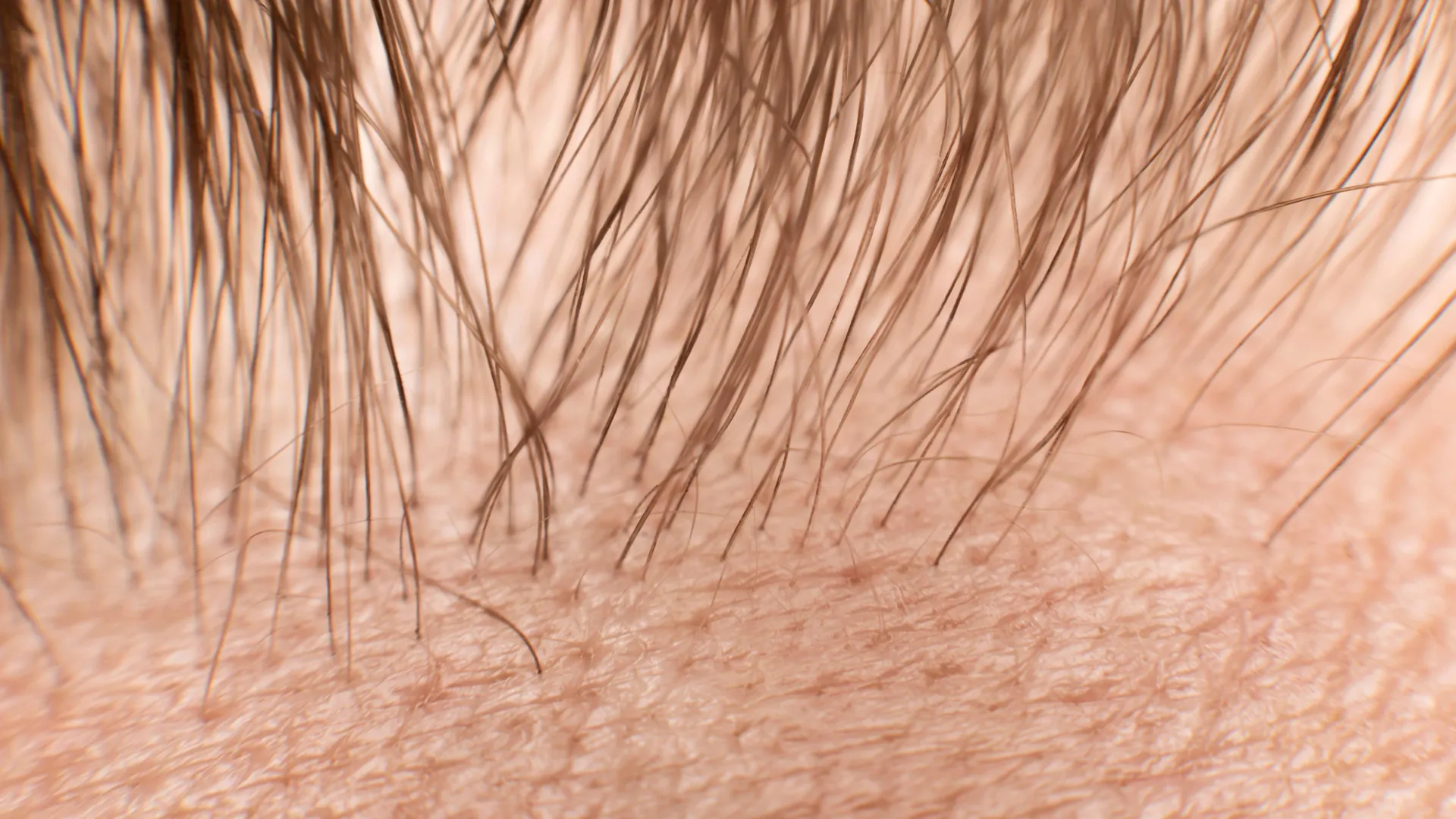
Long before a mammal is born, its skin begins establishing the precise locations where hair will eventually grow. These developing hair follicles form intricate geometric arrangements that differ from species to species. But what determines where each follicle appears, and how does the body create such orderly patterns?
Researchers at the University of Geneva (UNIGE) have identified a surprisingly simple process that may help explain this biological mystery. By studying how cells move in response to chemical signals, the team developed a model that successfully recreates the formation of hair follicle patterns in two mammalian species. Their findings, published in PNAS, suggest that elaborate biological structures can emerge naturally from basic interactions between neighboring cells.
The discovery could help explain a much broader phenomenon in nature. Hair, feathers, and most types of scales begin as small structures called placodes that appear during embryonic development. Scientists have spent decades investigating how these early structures establish the distinctive arrangements seen across different animal species.
Challenging a Long-Standing Theory of Hair Growth
For laboratory mice (Mus musculus), the leading explanation has traditionally been the expansion-induction model. This theory proposes that when a new placode appears, it releases a chemical that prevents additional placodes from developing too close to it.
As the embryo’s skin grows and stretches, some areas move far enough away from existing placodes to escape the chemical’s influence. New placodes can then develop in those spaces, gradually creating a more complete pattern across the skin.
Although this explanation has gained widespread acceptance, scientists have not experimentally established that it can account for the diversity of follicle patterns found across species.
A Simpler Mechanism for Hair Follicle Formation
To investigate another possibility, researchers led by Athanasia Tzika, Senior Lecturer, and Michel Milinkovitch, Professor, both in the Department of Genetics and Evolution at UNIGE’s Faculty of Science, focused on a process called chemotaxis.
Chemotaxis occurs when cells move in response to differences in chemical concentrations. The same basic process helps guide white blood cells toward areas of inflammation, allowing the immune system to respond where it is needed.
The researchers created a mathematical model that tracks how mobile cells in the dermis interact with an attracting chemical signal released by the epidermis, the skin’s outer layer. They then simulated the growth of embryonic skin to see whether these interactions could produce the gradual appearance of placodes.
Remarkably, the model recreated the developmental patterns observed in laboratory mice, including the same sequence of follicle formation that scientists had previously explained using the expansion-induction theory. This suggests that a complex system of instructions may not be necessary to determine where follicles develop.
“Our findings show that the observed patterns do not require a complex system telling each placode where to form,” explain Muhamet Ibrahimi and Ebrahim Jahanbakhsh, researchers in the Department of Genetics and Evolution. “Instead, placodes emerge spontaneously from local interactions between cells and chemical signals.”
One Simple Process Creates Different Hair Patterns
The team next investigated whether the same mechanism could explain follicle arrangements in another mammal with a very different coat structure.
They selected the spiny mouse (Acomys dimidiatus), a rodent whose hair follicles develop in an unusually regular pattern with a strong directional alignment. This distinctive organization cannot be explained by the traditional expansion-induction model.
Using experimental information gathered from three-dimensional images of developing embryonic skin, the researchers adapted their simulations to reflect the spiny mouse’s particular biochemical characteristics and the way its skin grows.
The results showed that the same underlying process of cells responding to chemical signals could also reproduce the spiny mouse’s highly organized follicle pattern. The differences between the two species could be explained by variations in their cellular interactions, chemical properties, and skin growth rather than entirely different mechanisms.
These findings suggest that the remarkable variety of structures found throughout the animal kingdom may arise from a shared set of relatively simple biological rules. By adjusting how cells interact and respond to their surroundings, nature can generate dramatically different patterns without requiring a separate developmental blueprint for every species.
“Our work suggests that simple cellular interactions can generate the remarkable diversity of tissue architectures observed throughout evolution,” concludes Athanasia Tzika. “The differences observed between species therefore result from the same self-organization process, but with variations in the interactions between cells and chemical signals.”
