


- Less than one-third or 31% of the garment factories in Bangladesh have adopted renewable energy technologies, including rooftop solar, despite the sector having significant potential.
- A study shows that financing is still a barrier owing to the upfront costs, limited working capital and procedural red tape from the lenders.
- Industry insiders also believe that limited space and a lack of knowledge among owners slow the adoption of sustainable options.
- According to an estimate, the garment and textile sector could install up to 2,800 MWp of rooftop solar capacity with an investment of about 126.7 billion Bangladeshi Taka ($1.03 billion).
Bangladesh’s energy system is facing intense pressure from the country’s ongoing fuel crisis and rising electricity bills. Yet thousands of garment factories’ rooftops that could be fitted with solar panels remain largely unused.
Renewable energy such as solar could be a potential solution to the escalating crisis, but has been overlooked for many years despite Bangladesh having sufficient amounts of sunshine.
Rather, the country relies almost entirely on grid electricity, which is mostly generated from imported fossil fuels.
More than two-thirds or 69% of factories have still not adopted renewable energy technologies (RET), according to a recent study funded by the International Growth Centre (IGC).
“Only 31% of factories have adopted RET (predominantly rooftop solar), with very low average capacity,” the study says. “Half of all solar installations do not even contribute to production processes.”
This analysis is based on a survey of 661 factories in the cities of Gazipur and Savar, located close to the capital Dhaka, conducted by Atonu Rabbani of Dhaka University and a BRAC University research team and completed in October 2025.
Bangladesh’s garment sector has more than 3,320 active factories. Of these, more than are located in Savar and Gazipur. The study focuses on these two industrial hubs using the Mapped in Bangladesh (MiB) database and samples more than 650 factories out of 1,937 in the two cities.
A separate study conducted by the Centre for Policy Dialogue (CPD) finds that solar adoption is mostly seen in large and environmentally certified factories (LEED-certified).
Large factories still consume around 65% of their total power consumption from the grid, with the rest sourced from captive generation and renewables, including solar.
On the other hand, small and medium enterprises (SMEs) depend on the grid for nearly 87% of their power demands, while micro-factories depend on it for more than 93%, as the smaller firms can’t absorb the upfront cost or lack the technical capacity to install solar.
Consequently, the country’s total renewables account for just 1,822.22 MWp or 5.61% of total power generation capacity, according to the Sustainable and Renewable Energy Development Authority.
Why aren’t more smaller factories inspired?
According to Rabbani’s survey, about 94% of solar-adopting factories financed i entirely from their own pockets; they have no bank loan, no green fund and no buyer-subsidy facilities.
Among non-adopters, two-thirds or 65% blamed high installation costs, while 43% cited a lack of resources more broadly. Of them, one-third of factory owners say decision-makers inside the factory aren’t aware that renewable options exist.
Denim Expert Ltd, for example, is a garment manufacturer that wanted to install rooftop solar but could not proceed with plans to do so after failing to secure financing.
“A few years ago, we planned to install a 1-megawatt rooftop solar system with financing from IDCOL,” Mohiuddin Rubel, additional managing director of Denim Expert Limited, told Mongabay. “However, we could not secure the funding because of lengthy bureaucratic procedures.”
Rubel said access to finance remains one of the biggest obstacles. Although Bangladesh Bank and IDCOL offer concessional financing for RET, factories often have to invest their own money first and wait for reimbursement, tying up scarce working capital for months.
“Many manufacturers simply cannot lock up that amount of capital for several months,” he said.
He also pointed to high import duties on balance-of-system components, the hardware that ensures solar power is safely converted, transported and integrated, despite the reduction in duties on solar panels themselves.
“Import duties on solar panels have come down significantly, but the supporting equipment such as mounting structures, electrical components and battery storage, still attracts high taxes,” he said. “That increases the upfront investment and discourages many factory owners.”

According to Rubel, technical concerns further discourage investment, particularly in older factories. Many garment units have corrugated galvanized iron (CGI) roofs that require structural assessments before solar panels can be installed, raising concerns over retrofitting costs and potential damage to existing buildings.
Beyond financing and infrastructure, Rubel believes the industry also faces a knowledge gap.
“Many entrepreneurs still view rooftop solar as a complicated project rather than a long-term investment that reduces electricity costs and improves energy security,” he said.
He said that rooftop solar deployment could accelerate rapidly in Bangladesh’s garment industry if policy bottlenecks were addressed.
“If financing became easier, taxes on key components were rationalized and technical support was more readily available, rooftop solar adoption in the RMG sector would accelerate much faster,” he added.
What about the large factories that have adopted solar?
Ha-Meem Group, one of the world’s leading apparel and denim manufacturers, said it has installed 29.2 MWp of rooftop solar capacity and plans to add another 3 MWp this year as part of its goal to achieve net-zero emissions by 2050.
Solar power has helped the business cut diesel consumption by nearly 60%, as its systems generate strong output between 10:00 am and 3:30 pm, according to Tanul Chakraborty, head of the group’s energy department.
He said the investment has reduced both the company’s carbon footprint and its reliance on diesel generators during grid disruptions.
Md Fazlul Hoque, managing director of Dhaka-based Plummy Fashions Ltd, knows both the promise and the limitations of rooftop solar.
Hoque’s factory, which earned LEED Platinum certification in 2015 for meeting the highest standards of energy efficiency and environmental sustainability, is about 40% more energy-efficient than a conventional factory and generates around 13% of its electricity from rooftop solar, he said.
“We are definitely benefiting because the electricity generated from our solar panels is essentially free,” Hoque said.
“But the biggest barriers for most factories are adequate rooftop space, the factory’s location and the large upfront investment required.”

Hoque said factories in densely built-up industrial areas often receive inadequate sunlight due to surrounding high-rise buildings, limiting the effectiveness of rooftop systems.
Fahmida Khatun, executive director of the CPD, said Bangladesh’s slow renewable energy transition stemmed not from a lack of policy targets but from weak implementation and insufficient incentives.
“The government had set renewable energy targets, but there was no effective monitoring or accountability to ensure they were achieved,” she said.
Khatun said that businesses faced high import costs for solar equipment and limited fiscal incentives, while implementation strategies and institutional support remained inadequate.
“The latest budget has introduced some incentives, which is a positive step,” she said. “Hopefully, these measures will help expand renewable energy adoption.”

The scale of the opportunity
Bangladesh’s textile, garment and export processing zone (EPZ) sectors have an estimated technical potential to install 2,815 megawatt-peak (MWp) of rooftop solar capacity, requiring around 126.7 billion Bangladeshi Taka (around $1.03 billion) in investment, according to internal estimates by the government-owned financial institution IDCOL.
IDCOL has identified 1,016 companies across 180 industrial groups with the highest potential, representing 879 MWp, according to Md Enamul Karim Pavel, head of renewable energy at IDCOL.
However, Pavel dismissed concerns that IDCOL’s financing procedures are a barrier to solar adoption.
“There is no bureaucratic bottleneck from our side,” he said. “We are always ready to finance factories willing to invest in renewable energy.” Projects must meet the lender’s technical and financial requirements, he added.“Some applications face compliance issues, which cannot be overlooked during the financing process.”
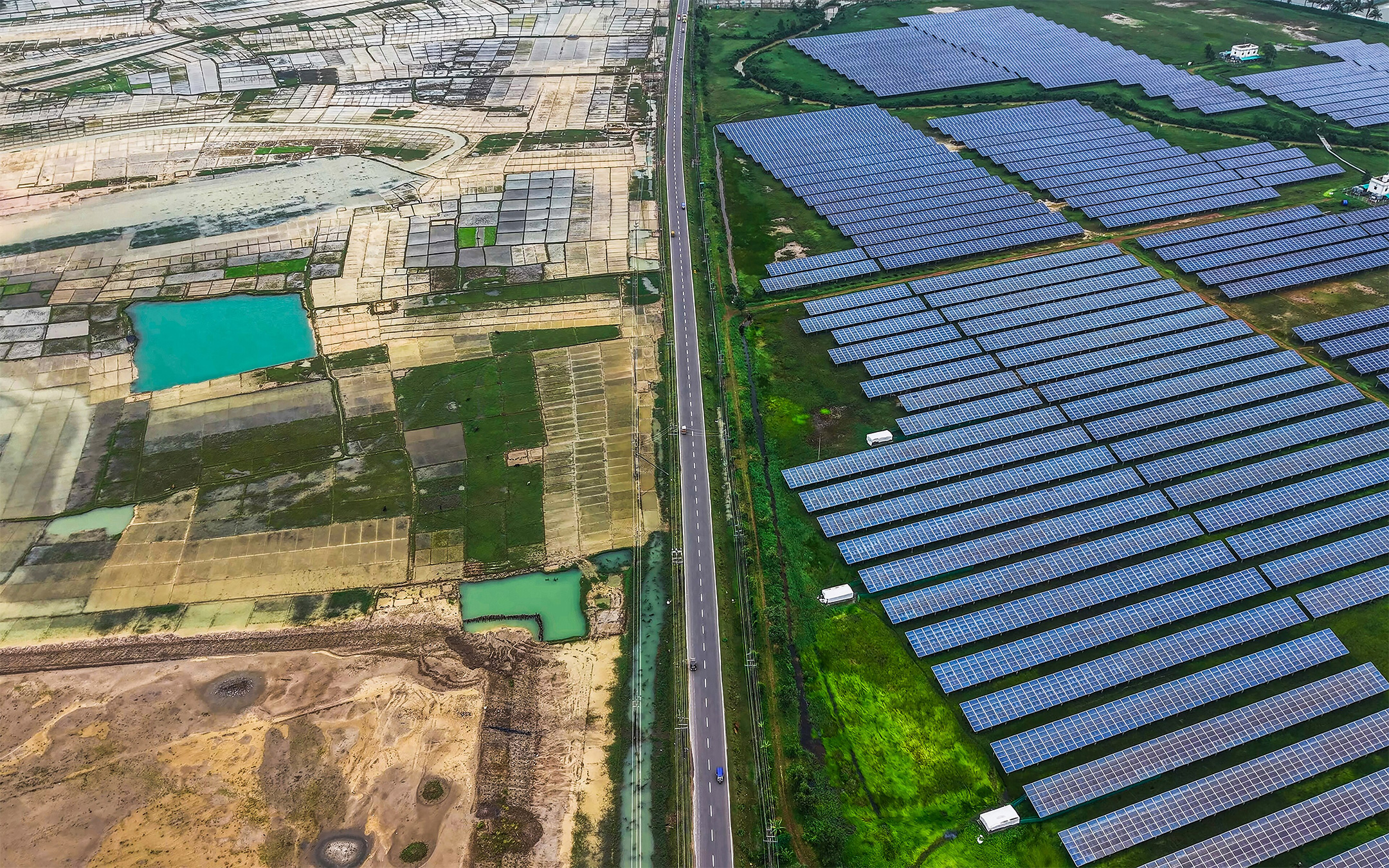
Banner image: A solar power plant beside farmland and salt pans in Ukhiya, Cox’s Bazar. Image by Md shameem ul islam via Wikimedia Commons (CC BY 4.0).
Bangladesh’s energy crunch highlights the promise — and limits — of solar
Fossil fuel-based mega projects displace locals in Bangladesh, pushing youth out
Feedback: Use this form to send a message to the author of this post. If you want to post a public comment, you can do that at the bottom of the page.
Cite this article
Md Asaduz Zaman (2026). Despite energy crisis, Bangladesh’s factories are slow to adopt solar power: Study. Mongabay Conservation news. DOI: https://doi.org/10.66709/news-326474

