


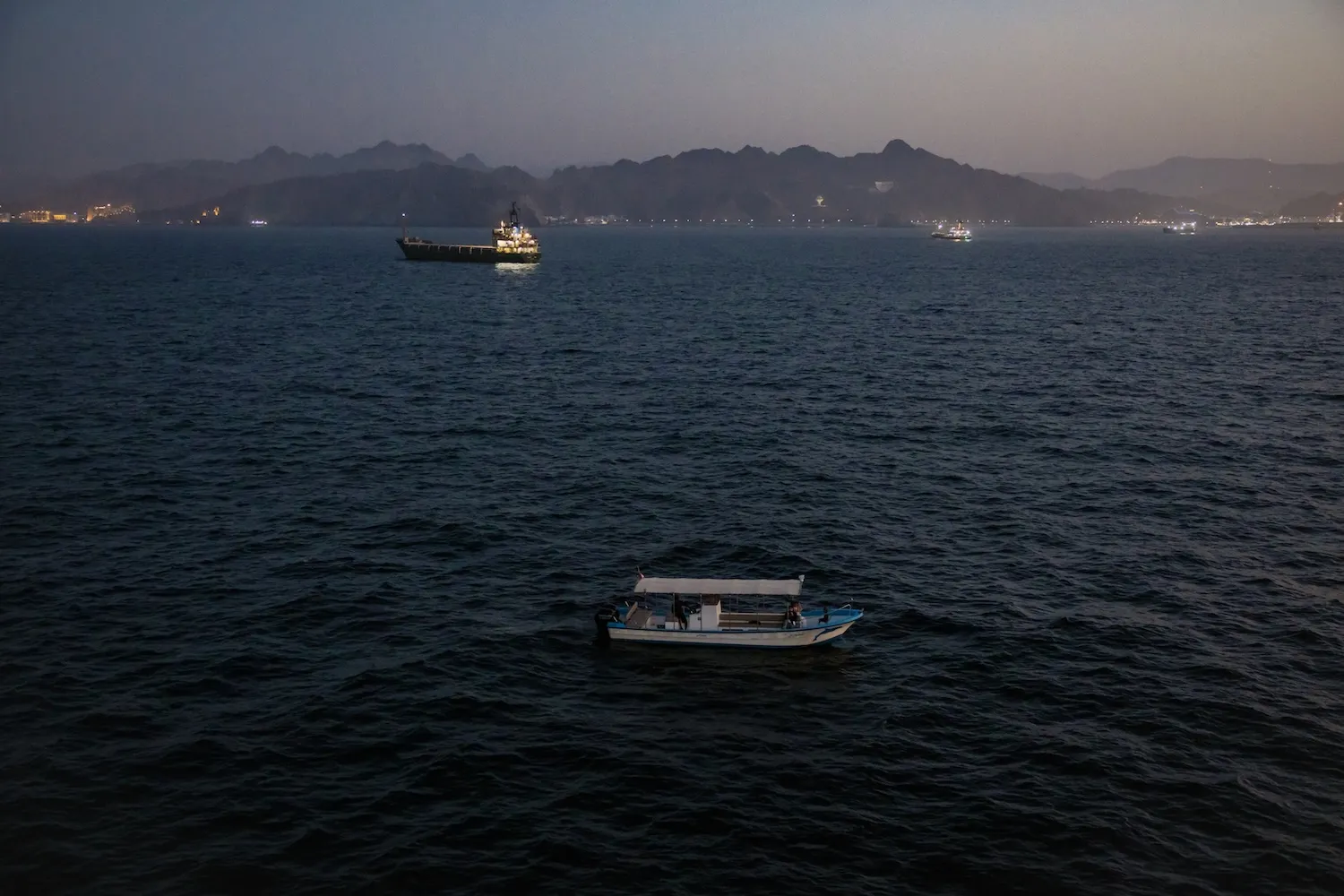
“I have just been informed by the United States Navy that all mines have been removed and/or detonated from within the International Waters of the Strait of Hormuz,” U.S. President Donald Trump posted on Truth Social on Aug. 25. At the beginning of the war, Iran had mined the Strait of Hormuz’s Traffic Separation Scheme (TSS), the official shipping lane that runs through the middle of the strait. Mines, of course, make it extremely risky for ships to sail through. And now, Trump has said that the mines are gone.
It is fantastic news because removing mines is painstaking and dangerous work, particularly during an ongoing conflict. “Now that the mines have been cleared, ships will be able to move simultaneously in both directions through the strait with protection from the U.S. Air Force, allowing the export of more oil to global energy markets,” Axios reported.
“I have just been informed by the United States Navy that all mines have been removed and/or detonated from within the International Waters of the Strait of Hormuz,” U.S. President Donald Trump posted on Truth Social on Aug. 25. At the beginning of the war, Iran had mined the Strait of Hormuz’s Traffic Separation Scheme (TSS), the official shipping lane that runs through the middle of the strait. Mines, of course, make it extremely risky for ships to sail through. And now, Trump has said that the mines are gone.
It is fantastic news because removing mines is painstaking and dangerous work, particularly during an ongoing conflict. “Now that the mines have been cleared, ships will be able to move simultaneously in both directions through the strait with protection from the U.S. Air Force, allowing the export of more oil to global energy markets,” Axios reported.
The shipping community, alas, didn’t believe the announcement. Despite the news from Washington, ship traffic remained steady at around 30 transits each day, compared to a daily average of 129 before the war—and most of them opted for the routes along the Iranian and Omani coasts, respectively, not the supposedly safe TSS.
Indeed, cognitive dissonance now dominates the Strait of Hormuz: There’s what Trump the President of the United States says, and there’s what shipowners see on the ground (or rather, on the water). Indeed, cognitive dissonance now seems to dominate Trump’s relations with the world.
“That sucker is open,” Trump insisted on Aug. 27, two days after his first announcement. The following day, U.S. Central Command leader Brad Cooper delivered a similar message on social media. “We have successfully cleared sea mines in the strait’s international shipping lanes,” he said, adding that “internationally recognized transit routes are free of Iranian sea mines thanks to the incredible work of the U.S. military.” Bravo Zulu to the U.S. Navy divers and SEALs who, with great skill and bravery, managed to clear the mines. Unlike Trump, however, Cooper didn’t say that all the mines had been cleared, because it’s impossible to know how many mines have been laid and where they are.
Trump’s messages, and even that of Cooper, appeared to have been intended to mollify global oil markets. But traffic in the strait still did not increase; the shipping community had deduced that not all mines had been cleared. What’s more, mines are not the only peril facing ships in the strait these days. On Aug. 30, the United States fired missiles and rockets at Iran once again, after Centcom discovered that Iran was planning to lay more mines in the Strait of Hormuz. The following day, Trump posted an artificial intelligence video of Iran’s Kharg Island “being blown to smithereens.” Oil prices promptly rose.
The cognitive dissonance in the White House extends far beyond a narrow maritime passage in the Middle East. In January of this year, when Trump was entertaining taking Greenland from Denmark, he let it be known that the Greenlanders “want to be with us.” But in an opinion last year, 85 percent of Greenlanders said that they didn’t want the island to be annexed by the United States, and the island’s leaders have repeatedly told the world as much.
A few weeks after weighing in on the wishes of Greenlanders, Trump attacked Iran. In his speech to the nation, he also turned to the people of Iran, promising that “the hour of your freedom is at hand. Stay sheltered. Don’t leave your home. It’s very dangerous outside. Bombs will be dropping everywhere. When we are finished, take over your government. It will be yours to take.”
U.S. intelligence agencies, though, had no information indicating that the Iranian regime would collapse or fold in case of a U.S. attack. Once again, cognitive dissonance had led Trump astray.
For a certain amount of time, cognitive dissonance works—if one is a powerful country ruled by a person with autocratic tendencies. Trump imagining that North Korean leader Kim Jong Un was his friend did seem to result in Kim becoming friendly, if only to humor his American counterpart or because he knew that North Korea stood to benefit enormously from the charade. But at a certain point, reality proves stubborn. Declaring that Hormuz is fully demined or that it’s “fully open and operating” (as he’s also said) will inevitably be disproven by a glance at a maritime-traffic site. Assertions that Greenlanders want to join the United States will melt when faced with opinion polls. And predictions that Iran’s regime will collapse won’t survive the clash with said regime.
Whatever marginal gains that Trump may achieve by presenting a distorted view of the world, the losses are much higher. The United States’ credibility has been dealt an enormous blow. These days, people looking for facts on any matter involving the United States often consult sources other than the U.S. government. Even Iranian and Russian government reports seem to hew closer to the facts than Trump’s posts do. More alarmingly, the cognitive dissonance has led the United States into adventures from which it will struggle to extricate itself.
Trump doesn’t know much about other countries, and acquisition of knowledge is not his thing. Fair enough. But where are the White House staffers who are willing to present their boss with the phenomenal wealth of knowledge that resides within the U.S. government before he leads the country into more international misfortune? By presenting Trump with the truth, they could do a good deed for him, for the country, and for the world. It is, in fact, their duty.
