


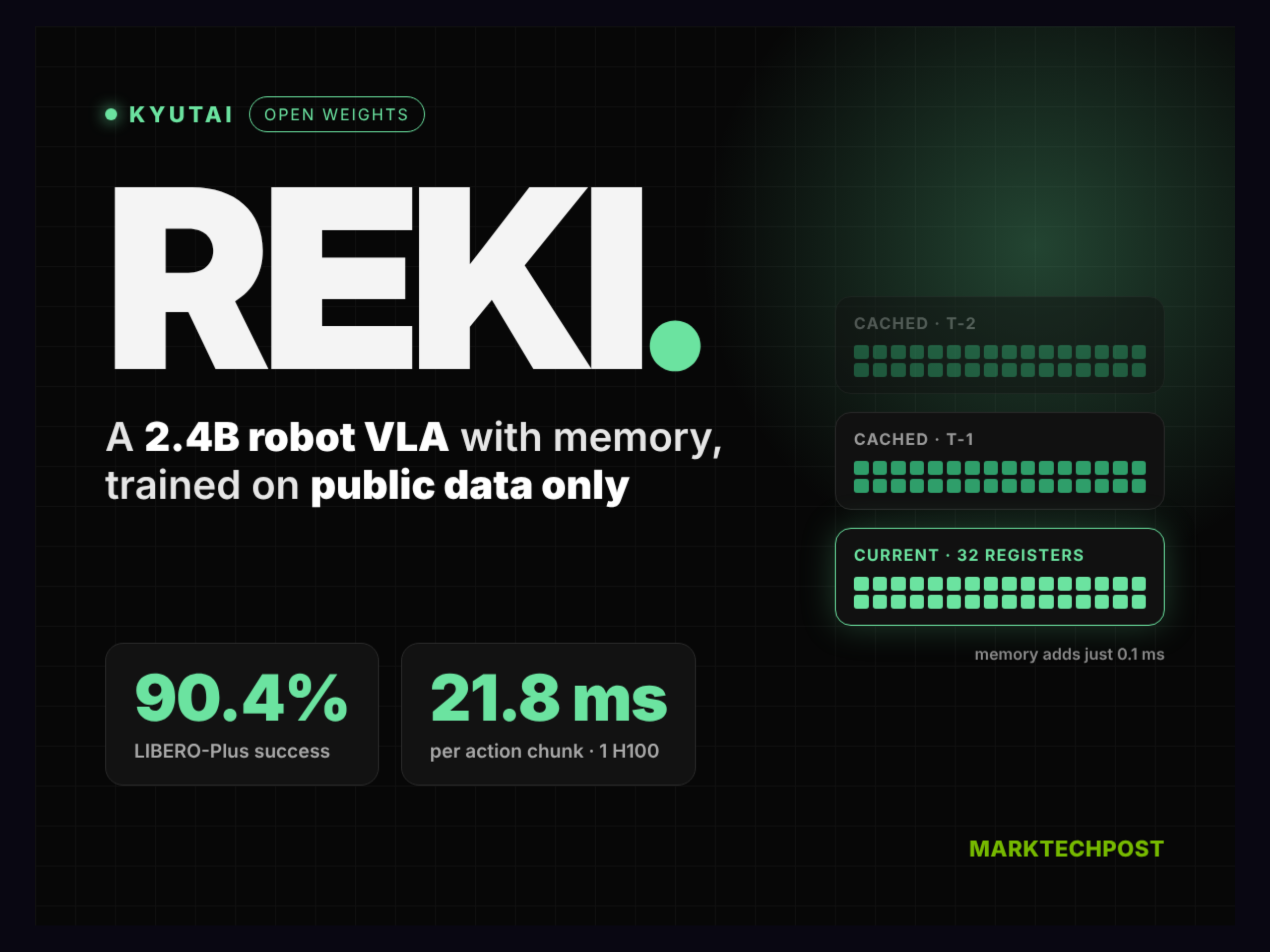
Kyutai, with Inria and École des Ponts, has released REKI, a 2.4B vision-language-action model (VLA) for robot manipulation. The REKI vision-language-action model is pretrained only on public data. It also carries a cheap memory of its recent past. On three out-of-distribution benchmarks, only models about twice its size beat it. All weights are live on Hugging Face today.
TL;DR
- Size: 2.4B parameters (2.2B Qwen3.5-2B VLM + 0.2B flow-matching action expert). Memory covers the last 3 frames, 1 s apart.
- Runs on: Benchmarked on 1 NVIDIA H100. 21.8 ms per action chunk, compiled, from 2 cameras at 256×256. Weights ship in BF16. No quantized variants announced.
- Performance: Best among VLAs pretrained on public data on LIBERO-Plus and RoboTwin Clean2Rand.
- Best: 90.4% on LIBERO-Plus, the top score in Kyutai’s comparison.
- Worst: 38.4% on RoboCasa365, well behind Xiaomi-Robotics-1 (57.4%).
What is REKI?
REKI is a vision-language-action model from Kyutai that maps camera views and an instruction to robot actions. It pairs a Qwen3.5-2B backbone with a 200M-parameter action expert. The expert generates action chunks by flow matching, integrated in 10 Euler steps. Robot state and flow time enter through adaptive RMSNorm. Each robot state layout gets its own small state MLP.
How does REKI’s memory work?
Most VLAs act on the current frame alone. Prior memory methods feed past frames to the VLM, unroll training, or add modules. Each option adds cost.
REKI places memory inside the action expert instead. Before each frame’s action tokens sit 32 learned register tokens. They cross-attend the encoded prompt and views of that frame. They also self-attend the registers of earlier frames.
Registers never read action tokens. So they depend only on observations, not flow time or robot state. They are computed once per frame and cached in a rolling window.
The cost is small, per the project page:
- Reading cached registers adds 0.1 ms to a 21.8 ms chunk.
- The cache uses about 2 MiB of GPU memory per past frame.
- Training packs a 3-frame window into 1 batched pass.
Memory also fixes a failure mode. Without it, arms often oscillate between 2 poses. On RoboTwin, oscillating episodes fall from 18.6% to 4.1% with memory. Kyutai attributes this to perceptual aliasing.
How does REKI perform on benchmarks?
REKI is pretrained once, then finetuned separately per benchmark. Scores below come from the model card and project page.
- LIBERO-Plus: 90.4%, ahead of Qwen-RobotManip (89.0%) and π0.5 (85.7%).
- RoboTwin Clean2Rand: 65.8%, behind only Qwen-RobotManip (68.5%).
- RoboCasa365: 38.4%, ahead of RLDX-1 (36.0%) and Qwen-RobotManip (35.9%).
- LIBERO (4 suites): 97.6%.
- RoboTwin 2.0 Easy / Hard: 85.9% / 84.6%.
Pretraining helps most out of distribution. It adds 13.8 points on Clean2Rand and 30.3 under clutter. Memory adds 1.5 points on LIBERO-Plus and 5.4 on RoboCasa365.
