


In Colombia’s remote Pacific region of Chocó, isolation has long been a fact of life. Roads are few, electricity and health care are limited, and much of the population lives in poverty while armed groups control parts of the territory.
Then came the earthquake. Already one of the country’s most vulnerable areas, Chocó was also the epicenter of a 7.4 magnitude quake that struck last week, killing at least 298 people across the country.
In Chocó, the full extent of the devastation is unknown, as the authorities struggle to reach communities scattered across the region. Now, Chocó faces a reconstruction effort that will have to overcome the same geographic, economic and political barriers that have shaped the region for generations.
“We were left in ruins,” said Juan Fernando Taborda, 35, who does odd jobs in La Ye, a town of about 600 people two hours from the Quibdó, the capital of Chocó, where most buildings were destroyed or damaged. “We have nothing.”
For much of Colombia’s history, Chocó was a remote mining frontier where enslaved Africans were brought by the Spanish to work in the mines. Some escaped and formed communities beyond colonial control.
Basic infrastructure and public services lag far behind the rest of the country, while the rugged roads connecting it to major cities are plagued by difficult terrain and landslides. Out of Colombia’s 32 states, or departments, Chocó, with a population of about 600,000, ranks highest in poverty, according to government data.
A predominantly Afro-Colombian and Indigenous region on the Pacific coast bordering Panama, Chocó is crisscrossed by dense jungle and rivers and known for its distinctive culture, festivals and cuisine. But many residents, politicians and historians attribute the region’s isolation to state neglect and structural racism. The earthquake weakened many of the already fragile links tying it to the rest of the country.
While the death toll was high in major cities with higher population density and taller buildings, Chocó faces a different kind of catastrophe, said the governor, Nubia Carolina Córdoba, from her office in Quibdó.
“The dimension of the tragedy in Chocó lies in how many living people today have nothing,” she said. “In how many months of suffering, pain, hunger and homelessness await those who survived.”
In San José del Palmar, the remote town closest to the earthquake’s epicenter, residents have spent days sleeping outdoors, afraid that another tremor could bring down already weakened homes. Two days before the earthquake, residents had been frightened by drone attacks attributed to an armed group.
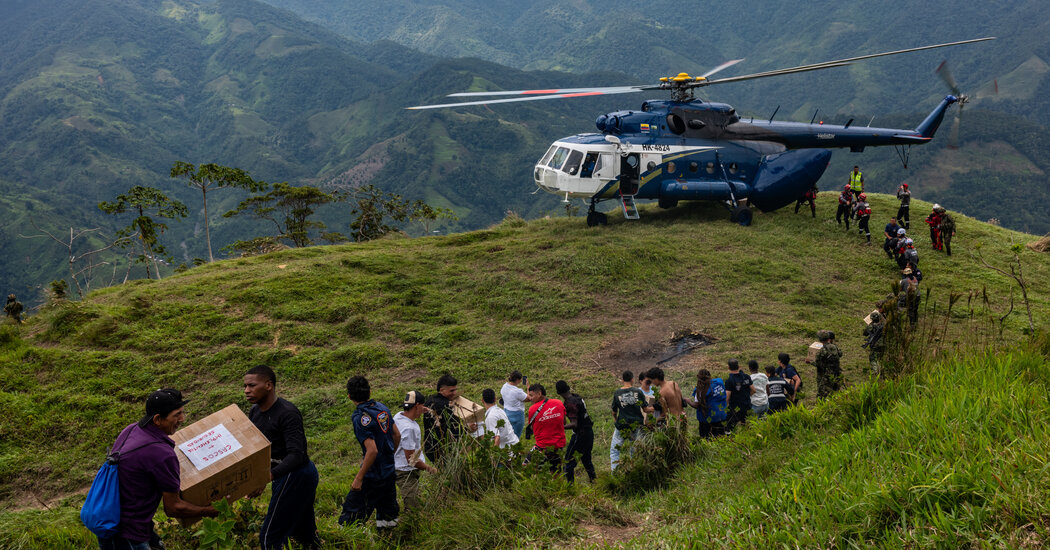
Landslides from the earthquake severed the town’s only road, forcing relief workers to rely on helicopters to deliver all food, water and other supplies.
The earthquake has brought an unusual burst of national attention to a region that has long complained of being overlooked. President Abelardo De La Espriella, who took office three days before the quake, has visited Chocó twice in his first week in office, as national officials and private aid groups have descended on the region.
“The situation right now is distressing,” said Mariluz Rodríguez, the chair of San José del Palmar’s City Council. The municipality is small and has few resources, she said, and even before the earthquake, it had struggled not only with poor infrastructure, but also frequent landslides.
“We have only one access road,” she said on Friday as a helicopter dropping off aid whipped the humid air around her. “We have no connection with the rest of the department of Chocó.”
Yanizela Ibargüen, 27, said her two children had become terrified of the aftershocks.
“It’s been so agonizing. Honestly, it’s been deeply unnerving,” said Ms. Ibargüen. Her youngest daughter sometimes wakes up saying that the walls are falling, she said. “She points over there, and I tell her, ‘No, sweetheart, nothing’s falling, nothing’s falling at all.’”
Crews from Helistar, a private air ambulance company, have flown into tiny communities across Chocó that can consist of only a dozen houses, picking up injured residents and delivering emergency supplies. In some places, there are no formal landing sites. Residents provide a location by identifying GPS coordinates and open fields where helicopters can land.
In Dos Quebradas, a small Indigenous community of the Embera Katio people, a medical helicopter flew into the mountains to evacuate Eliza Nequito Murri, a 17-year-old who was eight months pregnant, when her home collapsed, breaking her leg and leaving her unable to walk. Members of a civilian patrol known as the Indigenous guard carried her from the house and loaded her onto a stretcher as the helicopter hovered nearby.
She had never received prenatal care, said Dr. Adriana Valero, a physician with Helistar, who treated her. The rescuers did not know whether her fetus was alive until she was aboard the helicopter and they detected a heartbeat.
The crew had flown through clouds, searching for a gap so that the pilot could descend safely. A helicopter flight costs thousands of dollars an hour, said Dr. Valero. Helistar has been donating the flights, she added.
Chocó has only one hospital with more than basic medical capabilities, in Quibdó, which already struggled with shortages of supplies and equipment. Rural patients can wait weeks to be transferred elsewhere for urgent treatment.
Armed groups control some roads and waterways, making access unsafe. The ELN, one of Colombia’s most powerful armed groups, repeatedly blocked roads and burned vehicles on the region’s supply routes in the weeks before the earthquake, according to the governor and local news reports. Business owners and donors have called the governor’s office asking whether it is safe to send trucks and machinery, fearing kidnappings, extortion or burned vehicles.
The internet went down in Chocó immediately after the quake. People managed to send initial emergency requests for doctors and rescuers solely because the governor had a personal Starlink satellite antenna mounted on her vehicle.
More than 200 school buildings were destroyed, disrupting meal programs along with classes, according to the governor. National emergency housing subsidies are of limited use because there are few homes available to rent.
Some buildings that didn’t collapse are still structurally unstable. Engineers have been traveling through the territory assessing damaged buildings and marking those considered unsafe with spray paint.
Despite the displacement of thousands of people because of the quake, there are few signs of the kind of sprawling shelters seen elsewhere after disasters. Most families have been taken in by relatives, friends or neighbors.
“We are poor but honorable,” said Leidy Maturana, 35, who was sleeping with her husband and two children in a relative’s living room after the one-bedroom home her husband had built was destroyed. With no electricity to cook, the family relies on donated food and bottled water.
The department is creating a “bank of materials” to help residents rebuild, but Ms. Córdoba said full reconstruction would require direct national funding.
Mr. De La Espriella said that the tragedy presented a “tremendous opportunity” when he visited last week. “I want to propose a special plan — a Marshall Plan for Chocó,” he said, without providing details. “Chocó has been left to fend for itself by the centralization of power in Bogotá, as if it didn’t exist.” In public comments on Monday, Mr. De La Espriella said that an early estimate of the economic losses tied to the earthquake was about 30 trillion pesos (about $9.58 billion).
Shakira, the global superstar, raised funds to help students and rebuild schools, and visited Quibdó on Monday with Howard Buffett, the son of Warren Buffett.
In La Ye, most of the town’s businesses, homes and other buildings, including the church, were destroyed or marked for demolition. Roofs had collapsed into rooms filled with concrete and debris; some buildings stood crookedly.
Six days after the earthquake, residents sat on plastic chairs in the street outside what had been their stores, staring at what remained.
For many, there was little to fall back on. Work in La Ye is largely informal and day-to-day.
“There are no major businesses here,” said Luis Fernando Palacio, 33, the town priest. “We live here relying on God’s mercy and generosity.”
Yanith Liliana Palacio, 38, no relation, lived with her 10-year-old son on the second floor of a building whose upper level had collapsed in the quake, leaving the rooms open to the elements. She had escaped by jumping from a balcony, she said. She now lives with her son and another mother and child in a borrowed room, while trying to make ends meet through whatever work she could find, including selling fruit and cleaning.
“Material things can surely be recovered,” she said. “But what’s gone won’t come back.”
Annie Correal contributed reporting.
