


- Using simple keyword searches on Chinese social media, Mongabay found hundreds of videos promoting the sale of endangered wildlife in Laos. Two major Chinese media companies have user agreements specifically barring the posting of content related to the illegal wildlife trade; a third does not have specific terms.
- Group tours leading Chinese tourists to wildlife markets in Laos are part of a recent boom in visitors following the opening of the China-Laos Railway and the lifting in pandemic travel restrictions.
- Experts say that Chinese media companies, and their counterparts in the West, must do more to keep their platforms free of content promoting the illegal wildlife trade.
- Warning: This story contains disturbing images of animals.
“The wet markets in Laos are like wildlife parks; however, while you can only look at the animals in our zoos back in China, the wild animals in Lao markets can be eaten.”
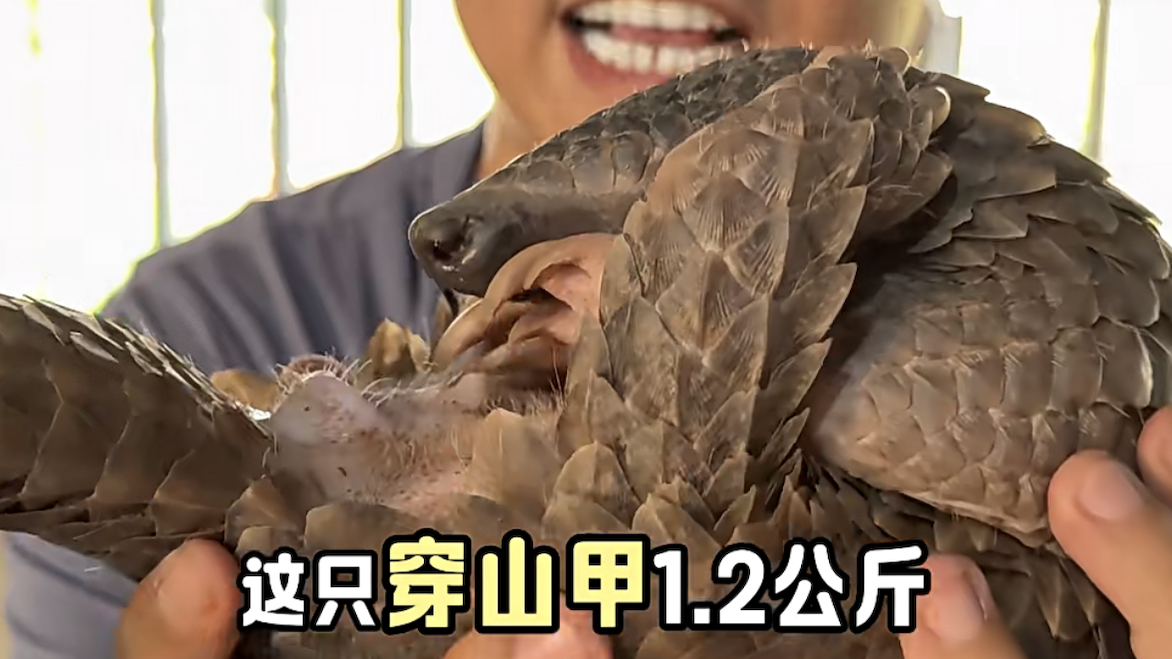
So proclaimed a Chinese vlogger as he toured a wildlife market. As he explored, he filmed himself showing off bear paws, various birds, dried rats, monitor lizards, and a live pangolin in his hands.
The Chinese Embassy in Laos has issued repeated warnings to citizens that “Lao law prohibits the sale of ivory, rhinoceros horns, pangolins, and other wildlife products. Violators will be punished by law.” But vloggers continue to imply, incorrectly, that such sales are legal.
“Brothers, look at what this is. This is not a zoo, but a wet market in Laos. The owner just weighed it and said it’s 3.3 kilograms for 1,200 Chinese yuan [about $54 per kilo or $24.60 per pound]. Back in China, let alone 3.3 kilograms, even for a single scale, you would have to go to jail,” he added, referring to the pangolin.
Videos like this are easily found on Chinese social media platforms — WeChat Channels (known as Weixin Channels in mainland China), Douyin, and Xiaohongshu — using Chinese search terms like 老挝穿山甲 (Laowo chuanshanjia or Lao pangolin); 老挝野味 (laowo yewei or Lao wild game); and 老挝熊掌 (Laowo xiongzhang or Lao bear paw).
With the opening of the China-Laos Railway in 2021 and the lifting of China’s pandemic lockdowns in early 2023, Laos has become a top choice for Chinese tourists traveling abroad. According to the official Lao News Agency, nearly 1.16 million Chinese tourists arrived in the country in 2025.
The booming tourism has contributed to large-scale wildlife trafficking issues in Laos. In turn, Chinese social media has become a hotbed of promotions for illegal wildlife tours in Laos.
‘Just one, two, three dishes on a table’
One Chinese influencer has posted 96 videos related to the wildlife trade since August 2025. His videos openly depict protected wildlife being offered for sale, while also using coded language to skirt censorship, such as suggesting viewers might like to “rescue” animals.
“Animals like these are protected at the first, second, or third levels in our country, but here in Laos, they are truly just one, two, or three dishes on the table,” he says in a video published on Douyin in March 2026 and still online as of publication, which depicted a pangolin being weighed and priced at a market stall. “With your ability, how many can you rescue? I feel that here in Laos, you truly cannot save them all. There are really just too many in Southeast Asia.”
In the comment section of the videos, multiple viewers asked him whether he could buy pangolin scales and paws. He replied with thumbs-up emojis or a request to send a private message.
“They appear to be marketing to an audience that has yet to receive much or any effective education on wildlife conservation,” said Steven Glaster, the founder of Bangkok-based antitrafficking NGO Freeland Foundation. ”They are boasting about the abundance of endangered species available for consumption.”

“Every country has its own laws; Laos allows the consumption of pangolins, whereas eating pangolins in China leads to imprisonment. Come here under the guise of traveling in Laos, but actually with the theme of eating wild animals. Life is short, live in the moment.”
This caption is from a WeChat Channels user. In a video published on Nov. 1, 2025, he held a curled pangolin surrounded by other Chinese tourists in the dining room of a restaurant in Laos. As tourists curiously fiddled with the live pangolin, a younger man who appeared to be their tour guide said, “Those pangolin scales are widely used in Chinese herbal medicine. Really good stuff. 2,000 Chinese yuan per catty [about 60 U.S. cents per gram, or $16 per ounce]. Fried rice can be cooked with pangolin blood. And then you braise its meat with hen.”
When such videos circulate on social media, they can potentially drive more people to consume wildlife like pangolins and bears in Laos.
The caption of another video, uploaded in June 2026 by a WeChat user, says, “In Laos, you can eat a pangolin weighing about 6 kilograms for 1,000 RMB [about $150/kg, or $68.60/lb], and it can be cooked at the restaurant.”
“It is legal to eat bear paw, pangolin, and other wild game,” she added in the comment section. Right below her comment, another viewer wrote: “Great! I will definitely go and eat it when there is a suitable opportunity.”
The original poster replied: “You must visit Laos sometime, and eat bear paw and pangolin while you’re there!”

The accountability gap
Global social media platforms like Facebook and WhatsApp have been widely criticized for failing to effectively crack down on the use of their platforms for wildlife trafficking. In the United States, where Facebook and WhatsApp’s parent company Meta is headquartered, laws shield media companies from liability for content posted by users, largely leaving the industry to regulate itself.
Chinese media companies are well known for their ability to carry out highly efficient censorship of certain topics: politics, pornography, disinformation, among others. Censorship mechanisms vary among Chinese Internet companies, but generally rely on tight human-AI collaborations to decide what content is allowed to be published.
China’s Wildlife Protection Law prohibits publishing advertisements for the sale of wild animals or illegal wild animal products, and notes specifically that online platforms are prohibited from providing services for such sales. However, the law does not specifically address the question of social media users filming illegal wildlife content.
The two major Chinese social media companies — Tencent, which owns WeChat, and ByteDance, which owns Douyin and is the original owner of TikTok — do specifically prohibit users of their platforms from posting content promoting the illegal wildlife trade. Another social media company widely used in China, Xiaohongshu, does not have similar provisions in its community guidelines.

The prevalence of videos promoting the wildlife trade on these channels suggests that the current measures are insufficient to curb illegal wildlife content. Some videos Mongabay found had been online since 2023.
ByteDance and Xiaohongshu did not respond to Mongabay’s emailed requests for comment. Tencent responded via a series of emails.
“Weixin Channels expressly prohibits the sale or distribution of protected wild animals and endangered species. We use a combination of user reports, proactive review, account-level signals, and repeat offender controls to identify and act against violating activity. Once a potential violation is flagged, we immediately investigate and take action, which may include content removal, account restrictions, and cooperating with appropriate authorities where warranted,” a Tencent spokesperson wrote. At Tencent’s request, Mongabay provided screen captures of 24 pangolin videos found on the service, as well as the Chinese search terms used to find them.
“Following a thorough investigation into the reports received, we have taken swift action to remove all violating content. We enforce a strict zero-tolerance policy for misuse of our services and remain fully committed to ensuring the safety of our community,” the Tencent spokesperson said.

However, as of the time this story was published, Mongabay found that only seven out of the 24 videos had been removed, and new videos about eating pangolins are still being posted on the service.
Experts on the trade say that media companies, in China and elsewhere, must do more to ensure their platforms don’t provide a forum for promoting the illegal wildlife trade.
“Internet companies must program their AI to recognize wildlife, including body parts, that are being marketed for sale,” said Galster from the Freeland Foundation. “Reading text alone would not work because traffickers are tricky and use code names and say things like ‘DM me if interested.’”
Large-scale illegal wildlife shops in Laos found scamming Chinese tourists
Facebook is a hub for illegal wildlife trade, and that’s by design, report says
FEEDBACK: Use this form to send a message to the editor responsible for this story. If you want to post a public comment, you can do that at the bottom of the page.
