


- In a milestone for Caribbean science, researchers recently conducted one of the most comprehensive surveys ever undertaken in the deep-sea waters off the coast of Trinidad and Tobago.
- It marks the first time a team of predominantly Caribbean scientists have worked on deep-ocean exploration in the region, according to expedition leader Diva Amon, a deep-sea ecologist and Trinidad and Tobago native.
- The expedition team collected more than 700 specimens, including many Amon believes will be identified as new species, and found 25 cold seep ecosystems formed by methane and other gases emanating from the ocean floor.
- Amon said she hopes the data gathered on the expedition will be used by decision-makers in Trinidad and Tobago to improve stewardship of the country’s waters, which are threatened by oil and gas drilling, plastic pollution and climate change.
During a recent monthlong expedition, a team of scientists conducted one of the most comprehensive surveys ever undertaken in the deep waters of Trinidad and Tobago, a dual-island nation located in the southern Caribbean Sea.
Nearly 93% of the country’s waters are deeper than can be reached by recreational scuba diving, making it impossible to map them without specialized equipment. This expedition, which took place between June 29 and July 28 onboard the California-based Schmidt Ocean Institute’s research vessel R/V Falkor (too), helped fill major gaps about Trinidad and Tobago’s deep-sea environment by deploying remotely operated vehicles and other technology in the nation’s deep waters. The scientific team documented dozens of active cold seeps and species believed to be new to science, and mapped about 13% of the country’s marine territory, according to a press release.
The expedition also marked a milestone for Caribbean science. It was led by deep-sea ecologist Diva Amon, a Trinidad and Tobago native and co-founder of SpeSeas, an organization that works to advance marine science, education and conservation across the country and the wider Caribbean. Amon, who is also a scientific advisor at the Benioff Ocean Science Laboratory at the University of California, Santa Barbara, was joined by fellow scientists from across the Caribbean as well as from the U.S., Canada and Spain.

“This is the first time there has ever been a team that was predominantly Caribbean scientists working on the deep ocean in the Caribbean,” Amon told Mongabay. “Previously, it’s been a lot of — speaking very plainly — parachute science, and so this was really precedent setting.”
The Caribbean-led team mapped 11,335 square kilometers (approximately 4,376 square miles) of previously uncharted seafloor — an area about two-and-a-half times as big as Grand Canyon National Park in the U.S. The expedition team also collected more than 700 specimens, including many Amon said she believes will be identified as new species.
“We know that there are certainly at least 20 new species, and that includes potential new genera as well, which isn’t surprising, given how little is known about deep-sea biodiversity in the Caribbean,” Amon said. “Once we actually begin to look into these samples more deeply, we expect there to be many, many more.”
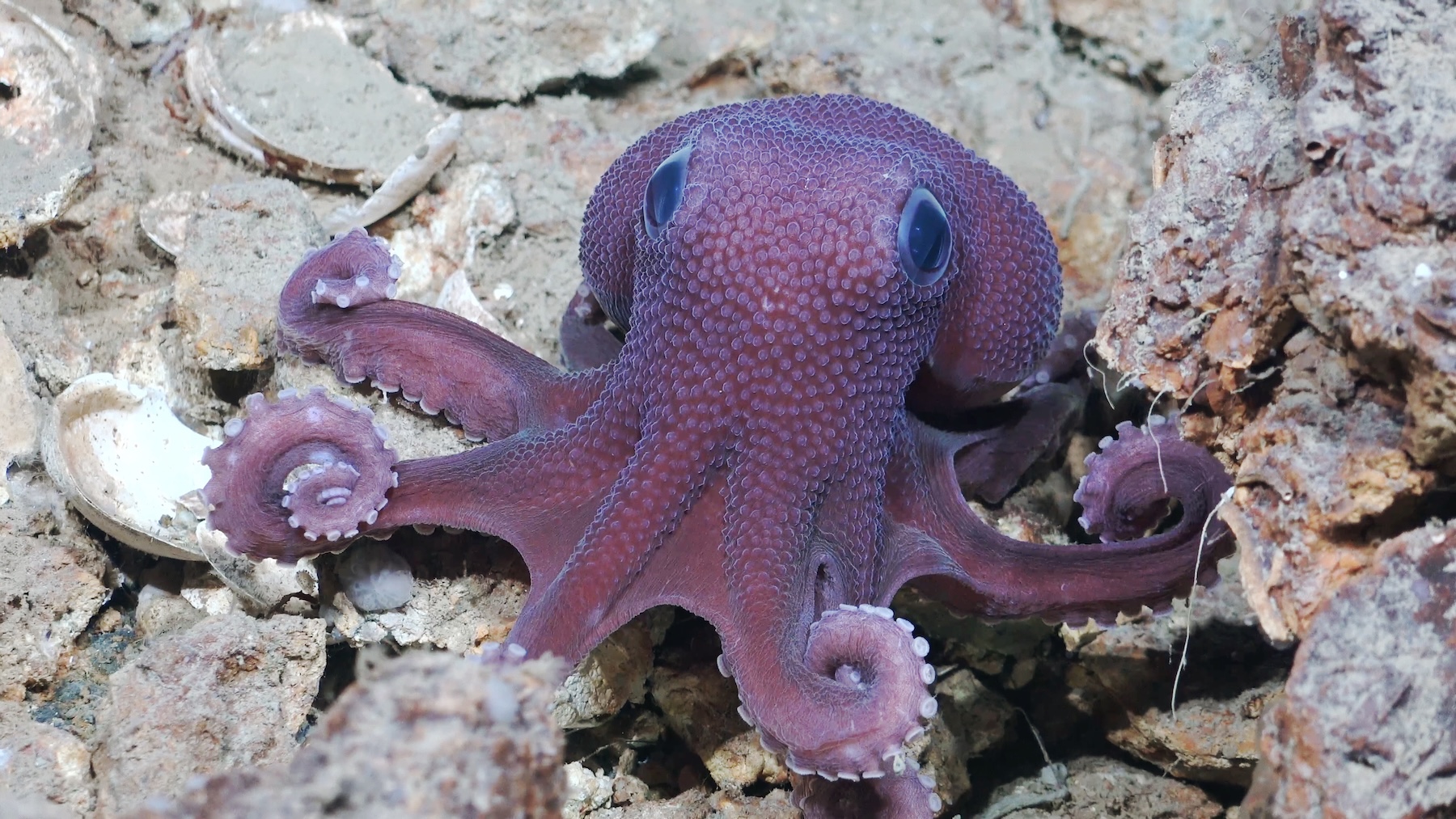
One possible new species is a octopus of the genus Graneledone, which Amon said she first observed during a 2014 expedition onboard the E/V Nautilus in Caribbean waters, but couldn’t collect at the time.
“This time we were able to collect it, and we were able to run some quick genetic molecular analyses on the boat, and we are … highly certain that this is a new species of octopus,” Amon said.
The team also captured some striking footage of a black swallower fish (Chiasmodon niger) with a round, distended stomach, showing that it swallowed a meal larger than itself. There was also a carcass of a type of Mobula ray resting on the seafloor, where crabs and worms had gathered to feed on it. They also encountered corals, deep-sea sharks, carnivorous sponges, squat lobsters and lizardfish.


“How absolutely blessed we all were to have this incredible opportunity to get a glimpse of Trinidad and Tobago’s deep sea in 2026,” La Daana Kanhai, a marine scientist at the University of West Indies, St. Augustine, said in a press release. “Every sample from this expedition helps us advance knowledge about this remarkable ecosystem and provides a platform for evidence-based decision-making.”
The team also identified 219 bubble streams, according to the press release, which indicated the possible presence of cold seeps — complex ecosystems that form as methane and other gases emanate from the ocean floor. Following these bubble streams with the help of Schmidt Ocean Institute’s remotely operated vehicle (ROV), SuBastian, and a cutting-edge, low-cost deep-sea camera, the team was able to identify 25 active cold seep ecosystems. One of the largest stretched out to more than 2,000 square meters (around 28,000 square feet), an area eight times the size of a professional tennis court.
“We expected to see life, but certainly not at the scale that we did,” Rachel Lauer, a marine hydrogeologist and geoscientist at Canada’s University of Calgary, who joined the predominantly Caribbean team as a co-principal investigator, told Mongabay. “It was impressive.”
Lauer said the team sometimes anticipated finding an extensive cold seep ecosystem based on large methane plumes in the water column, only to descend and find just a few tiny bubbles coming from the seafloor. In other instances, a “tiny, anemic-looking bubble stream” led them to a vast ecosystem with “a ginormous pile of mussels and tube worms” stretching across roughly a square kilometer (0.4 mi2), she said.
Once all collected specimens are identified, they will eventually be housed in the Zoology Museum at the University of the West Indies, St. Augustine, in Trinidad and Tobago, which will increase the size of the museum’s deep-sea collection twelve-fold, according to the expedition team.
Amon said the collection will be available for scientific inquiry, but will also be used for public outreach.


“This will be a chance for Trinigonians — locals — to come and see these specimens with their own eyes,” Amon said. “Having those biodiversity collections at home is so important because we just haven’t had that until very recently.”
Amon said she also hopes the data gathered on the expedition will be used by decision-makers in Trinidad and Tobago to improve stewardship of the country’s waters.
“We have deep-water oil and gas exploitation on our doorstep, and there are next to no stewardship mechanisms for our waters,” Amon said. “We have one marine protected area, which is a shallow water coral reef. Nothing else. There’s no offshore protection of any kind, and there are no management mechanisms of any kind.”
While oil and gas is currently being extracted in Trinidad and Tobago’s shallower waters, the nation is contemplating drilling deeper as reserves run low.
Beyond the potential for the oil and gas industry to move into deep waters, Amon said Trinidad and Tobago’s deep-sea environment also faces threats from plastic pollution and climate change.
“This is not just about doing the science, but it’s about the impact story beyond this expedition,” Amon said. “I think the real work starts now.”
Banner image: A suspected new octopus species of the Graneledone genus moves across the seafloor during a deep-sea ocean expedition off the coast of Trinidad and Tobago. Image courtesy of ROV SuBastian/Schmidt Ocean Institute
Elizabeth Claire Alberts is a senior staff writer for Mongabay and was a 2024-2025 fellow with the Pulitzer Center’s Ocean Reporting Network. Find her on Bluesky and LinkedIn.

