


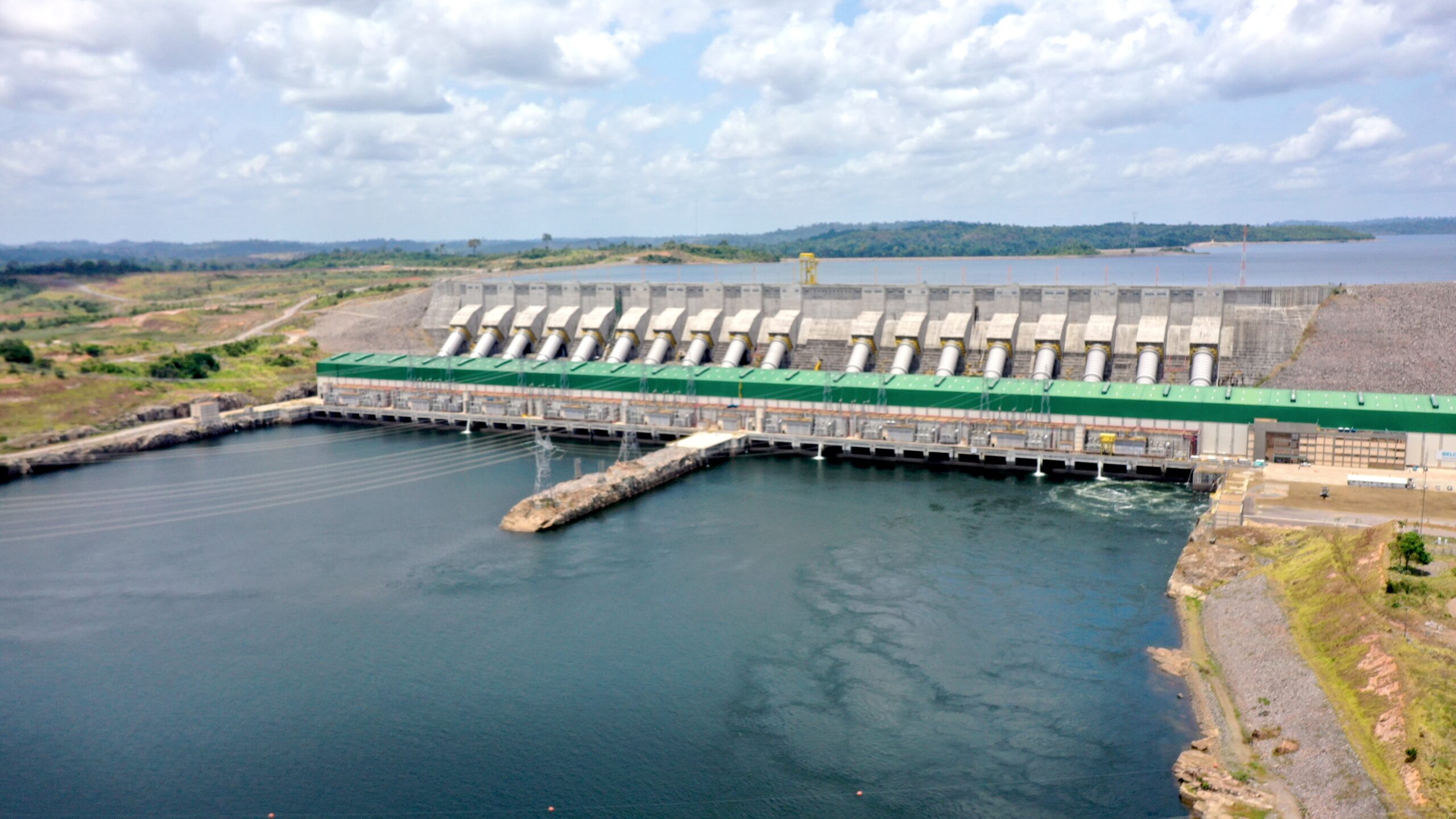
Brazilian authorities have temporarily relaxed an environmental rule for the Belo Monte hydropower plant on the Xingu River in the northeastern Amazon. The change comes in anticipation of another potentially severe, El-Niño-fueled dry season.
Under the temporary measure, Belo Monte’s operator Norte Energia can cut the flow of the dam’s 119 square-kilometer (46 square-mile) intermediate reservoir from the current minimum of 300 cubic meters per second (10,600 cubic feet per second) to 100 m³/s (3,530 ft³/s). It has already begun the gradual cuts to reduce flow. They will remain until Nov. 30.
Regulators told Mongabay the change will allow the plant to both preserve electricity generation and water flows through the Volta Grande do Xingu, a large bend in the Xingu River where Indigenous and riverine communities depend on the river for fishing, transport and daily life.
Reduced water flow in the reservoir increases the risk of poorer water quality, with potential consequences for both aquatic life and people as the river flows downstream.
“Between a worse option and a bad one, they chose the bad one,” André Oliveira Sawakuchi, a geoscientist at the University of São Paulo, Brazil, told Mongabay by phone.
Norte Energia said the measure will ensure that the required flow through the Volta Grande will remain unchanged. They also said that they will monitor water quality and fish movements and report back to regulatory agencies.
“Significant social and environmental impacts are not expected.” IBAMA, Brazil’s federal environment agency, told Mongabay by email. “If the measure were not adopted, it would probably be necessary to significantly draw down Belo Monte’s reservoirs to maintain the flow regime established for the Volta Grande do Xingu.”
Norte Energia has sought permission to reduce the flow during every dry season for the past three years. In 2024, regulators approved the request for the first time as a drought emergency measure. In 2025, the company submitted the same request again, but federal regulators rejected it, citing environmental risks.
Now, with another El Niño projected to cause extreme drought conditions, the measure was approved once again. Such stop gaps underscore a larger problem: A recent government report warned that hydropower plants in the region could lose up to 40% of their generation capacity over the coming decades.
Sawakuchi said that the Belo Monte project, the largest hydropower plant in the Amazon, was designed using historical river flows dating back to the 1950s, rather than projected river flows that accounted for climate change and deforestation.
“There are two factors that reduce water availability in the Xingu. One is deforestation in the basin over the past few decades. The other is longer-lasting and more intense droughts, which may be associated with climate change,” Sawakuchi said. “The project wasn’t designed with this in mind, so the likelihood is that this situation will get worse.”
Banner image: Belo Monte hydropower dam on the Xingu. Image courtesy of TV Brasil.
