


Most galaxies are thought to harbor a supermassive black hole at their center. These enormous objects can weigh millions or even billions of times more than the sun, creating some of the strongest gravitational environments known in the universe.
When a star passes dangerously close to one of these black holes, destruction is not always immediate. Some stars survive the encounter and return for additional close passes, generating a fresh burst of light each time.
These events, known as repeating partial tidal disruption events (rpTDEs), allow astronomers to observe the same star interacting with the same black hole multiple times. Wide-field time-domain surveys make this possible by repeatedly scanning large regions of the sky and tracking objects whose brightness changes.
Yet some of these systems have presented astronomers with a mystery. Instead of producing similar flares on each return, they become steadily fainter. For years, theoretical models struggled to reproduce that behavior.
New research from astrophysicists at Syracuse University suggests that a previously underappreciated property of the star could provide the answer: how rapidly it was spinning before its first close encounter with the black hole.
The study, published in The Astrophysical Journal, was led by doctoral student Ananya Bandopadhyay, working with postdoctoral researcher Benjamin Amend and associate professor Eric Coughlin, all in the Department of Physics, along with collaborators at other institutions.
How Black Holes Tear Apart Stars
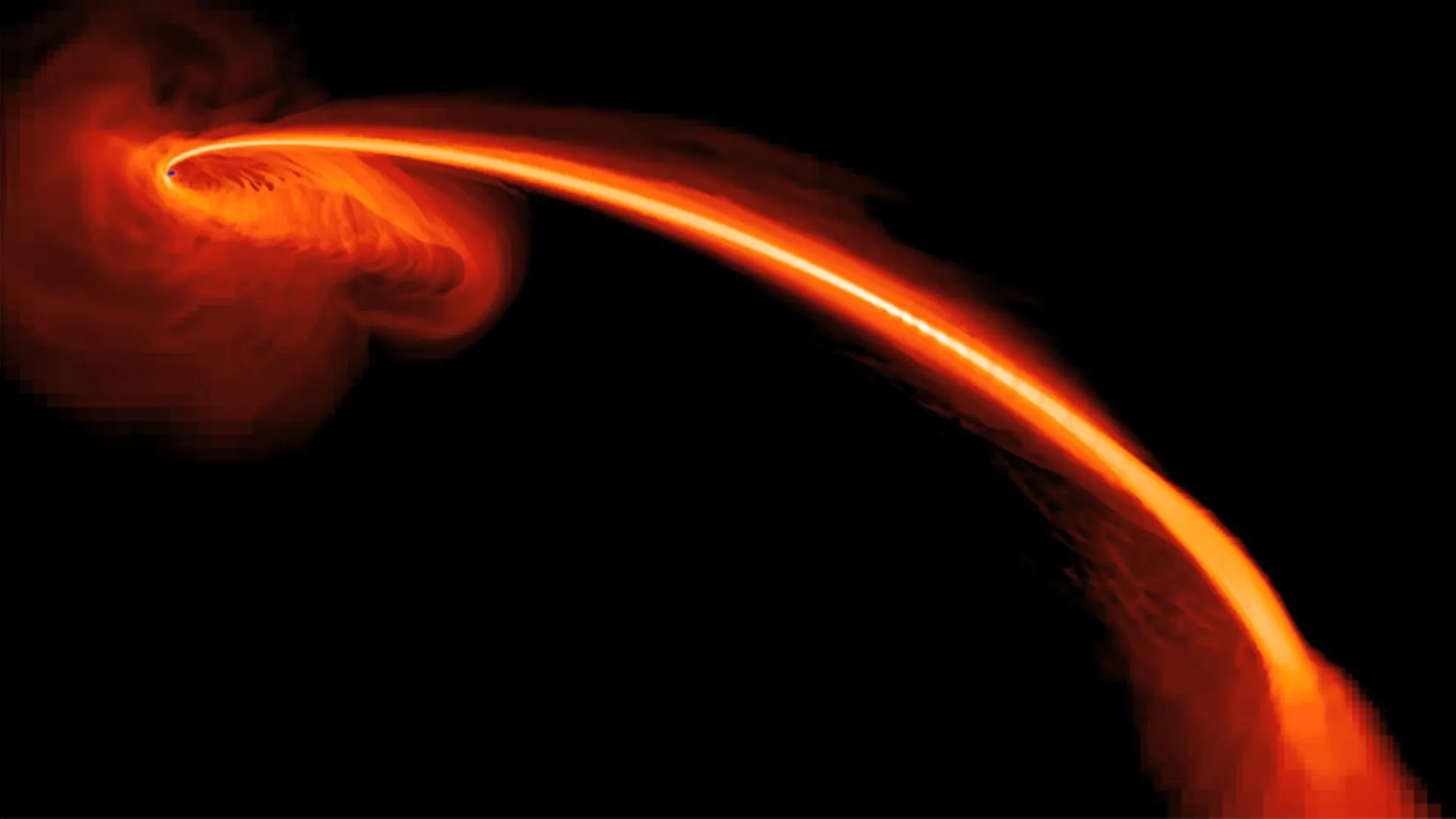
In a standard tidal disruption event (TDE), the gravitational pull from a black hole varies so strongly from one side of a nearby star to the other that the star is completely torn apart.
The resulting stellar debris begins falling toward, or “accretes” onto, the black hole. As that material loses energy, it releases light over periods ranging from days to months.
Black holes themselves do not emit light, but a TDE temporarily supplies material that can illuminate the region around one. That glow gives astronomers an indirect way to investigate objects that would otherwise be invisible.
Not every encounter ends with the star being completely destroyed. If a star passes close to a black hole without crossing the threshold for total disruption, it can lose only part of its mass, producing a partial TDE. During a repeating partial TDE, the star’s surviving core remains in orbit and returns for additional close encounters, shedding more material each time. These passages can occur months or several years apart.
Why Some Black Hole Flares Keep Fading
The amount of material stripped from a star during repeated encounters depends in part on the star’s internal structure. Bandopadhyay likens a low-mass star to a fluffy meringue. Such a star can become increasingly susceptible to the black hole’s tidal forces.
A higher mass star behaves differently. Its material is more concentrated toward the center, with an onion-like internal structure. It can lose its outer layers while its dense core remains comparatively unchanged, causing the amount of mass lost to decrease over successive encounters.
Those structural differences can help explain why not all rpTDEs evolve in the same way. But one observation has been especially difficult to understand. Of the roughly 10 repeating systems identified so far, four have shown flares that become progressively dimmer.
It might seem natural to assume that smaller amounts of stripped material would simply produce weaker flares. Previous hydrodynamical simulations, however, revealed a complication. Even when the star lost less material during each passage, the models still predicted flares with approximately the same peak brightness.
“We were puzzled by this for two years,” Bandopadhyay says.
Their previous work uncovered another important consequence of the black hole’s tidal forces. Besides pulling material away from the star, those forces also apply torque, causing the star to rotate faster after each close encounter.
That increased rotation changes how quickly stripped material returns toward the black hole. Even though less material comes back, it does so over a shorter period of time. The more concentrated flow helps maintain a similar peak fallback rate, and therefore roughly the same predicted flare brightness.
A Rapidly Spinning Star Changes the Picture
To reproduce the fading flares astronomers actually observe, the researchers needed what Bandopadhyay called “a new ingredient”: a star that was already rotating rapidly before its first encounter with the black hole.
The new simulations suggest that such a star cannot be spun up nearly as much during later passages. Without a large increase in rotation after each encounter, the time required for the stripped material to fall back toward the black hole remains relatively steady.
That changes the outcome. As progressively less material is stripped from the star, the peak fallback rate also decreases. The predicted flare can then become fainter with each encounter, matching what astronomers have seen.
How the Star May Have Been Captured
The finding raises another question: Why would a star approaching a supermassive black hole already be spinning so quickly?
“It is also extremely difficult to ‘bind’ a star to a supermassive black hole so tightly that it orbits the black hole in a matter of months, and yet they seem to do so in rpTDEs,” Coughlin says.
A process known as the Hills mechanism may provide an explanation for both the rapid rotation and the star’s unusually tight orbit.
In this scenario, two stars orbiting closely around each other approach a supermassive black hole. The black hole’s gravity tears the binary system apart. One star is hurled away, while the other is captured into orbit around the black hole.
Stars in a very close binary can become tidally locked, meaning each star rotates on its axis at the same rate that the pair orbits one another. The tighter the binary, the shorter the orbital period and the faster a tidally locked star must rotate.
To leave one captured star on the short orbit observed in rpTDEs, the original binary system would have to be extremely compact. That same tight configuration would naturally produce a rapidly spinning, tidally locked star before the black hole captured it.
“Ananya’s work demonstrates that each of these peculiarities can be explained by the same underlying phenomenon: the tidal destruction of a binary system and the capture of one of the stars,” Coughlin says. “From a theoretical standpoint, this is a major step forward in our understanding of the physics at play in these systems.”
A Possible Connection to the Milky Way
The implications may extend beyond distant repeating flare systems. Coughlin notes that Hills capture may also be responsible for some of the stars now orbiting Sagittarius A*, the supermassive black hole at the center of the Milky Way.
If so, the same mechanism that may explain fading rpTDE flares could also help astronomers understand some of the unusual stellar populations surrounding the black hole in what Coughlin calls “our own cosmological backyard.”
