



July’s PCE inflation reading held at 3.7% headline and 3.3% core on Aug. 26, both still above the Fed’s target.
Futures markets responded by pushing the odds of a September rate hike to roughly 44%, up from 36% before the report. Bitcoin hit an intraday high of $79,251.60 the same day, trading near $78,000 as of press time.
Bitget Research chief analyst Ryan Lee said in a note:
“In-line is not the same as harmless. A core print at consensus leaves the existing policy debate largely intact and settles little.”
With rate expectations offering nothing new, Lee expects Bitcoin’s price to keep taking its direction from elsewhere, in ETF flows, spot liquidity and derivatives positioning.
| Indicator | Before / baseline | After Aug. 26 PCE | Why it matters for BTC |
|---|---|---|---|
| Headline PCE | Fed target: 2% | 3.7% | Inflation remains too high for an easy dovish pivot. |
| Core PCE | Fed target: 2% | 3.3% | Consensus print did not create a fresh bullish catalyst. |
| September hike odds | 36% | 44% | Macro pricing became marginally more hostile. |
| Bitcoin intraday high | — | $79,251.60 | BTC still held near rally highs despite the macro headwind. |
| Press-time BTC price | — | Near $78,000 | Suggests consolidation, not a breakdown. |
The Bitcoin demand underneath the rally
Glassnode said US-traded spot Bitcoin ETFs absorbed $2.23 billion around Bitcoin’s initial squeeze, with no single outflow day and the strongest seven-day intake of 2026.
Farside Investors’ daily tracker shows another $314.3 million of inflows on Aug. 25 alone, led by $284.4 million into BlackRock’s IBIT, extending the run of positive days from Aug. 17 through Aug. 25 to roughly $2.6 billion.
Every wallet-size cohort was accumulating at the same time, from small holders to the largest addresses.
Aug. 19 produced the largest dollar-denominated single-day short liquidation event in Glassnode’s dataset since 2019, and roughly 85% of the liquidations across that window came from short positions.
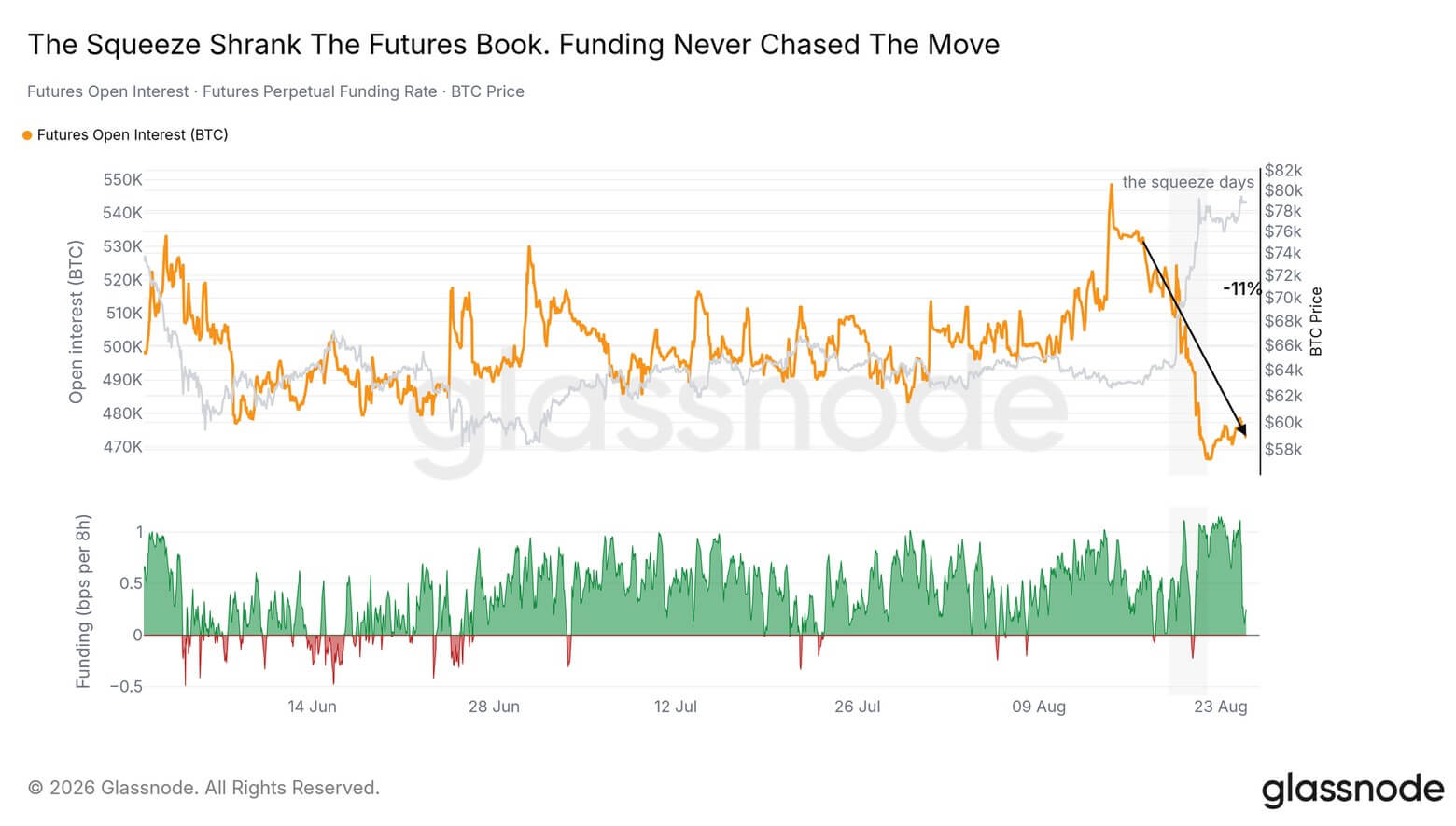
A rally built entirely on forced buying would normally leave a visible trace in the futures market, fresh leverage rebuilding as fast as it gets liquidated.
Futures open interest fell 11% in BTC terms through the move. Funding stayed close to neutral, and Glassnode said new speculative longs did not replace liquidated shorts.
| Rally component | Data point | Interpretation |
|---|---|---|
| ETF creations during squeeze window | $2.23B | Spot demand absorbed supply during the move. |
| Aug. 25 ETF inflows | $314.3M | Demand continued after the initial squeeze. |
| IBIT contribution on Aug. 25 | $284.4M | BlackRock remained the dominant flow driver. |
| Positive ETF streak | Aug. 17–Aug. 25 | Persistent demand, not a single-day anomaly. |
| Cumulative inflows across streak | Roughly $2.6B | Cash bid stayed present through the rally. |
| Short-liquidation share | ~85% | The first leg was squeeze-driven. |
| Futures open interest | Down 11% in BTC terms | Speculative leverage was flushed, not rebuilt. |
| Funding | Near neutral | No obvious sign of overheated long positioning. |
The liquidity backdrop for Bitcoin that survives a quiet print
Sygnum Bank CIO Fabian Dory shared in a note:
“A core PCE print in line with consensus, after strong service-led PMI data and a weak payroll month, describes gradual disinflation rather than a demand shock.”
He called that combination the most useful for digital assets even though it is also the least dramatic.
That distinction forces the Fed’s hand in neither direction, keeping expectations for the September meeting intact.
Treasury cash balances, the eSLR, private credit creation and continued stablecoin expansion are channels Dori says do not require a policy pivot to remain constructive, adding that the mistake is reading a quiet print as a quiet backdrop.
Total stablecoin market capitalization sits near $303.7 billion, up $2.8 billion over the past week even though its 30-day growth remains modest. Separate data from NYDIG shows stablecoin supply rose $1.25 billion during the rally, mostly from USDC, suggesting liquidity on trading venues improved faster than broader offshore participation.
The next test is a real confluence zone
Between roughly $81,000 and $86,000, a self-custody cost-basis shelf, a dealer gamma flip near $82,300, surviving short-liquidation levels, and concentrated long-term-holder supply all sit close together.
Glassnode’s confirmation level for a genuine breakout is a settled close above $83,300, with ETF intake still holding.
On the downside, the short-term-holder cost basis sits near $70,000, with a firmer floor around $62,000 to $65,000. A retreat back to Bitcoin’s original squeeze level near $62,900 would, in Glassnode’s own words, unwind the entire episode.
Theo CIO Iggy Ioppe said:
“Nothing in this number forces a hike, and nothing in it delivers a cut.”
He argued that the policy stance stays easier than current inflation and labor data would justify, and has for months. Every FOMC meeting that passes without action functions as easing by default, a structural support under risk assets that does not depend on the Fed turning outright dovish.
Ioppe said Bitcoin “remains more contained than the return of institutional flows would suggest,” a gap he treats as a timing issue while the underlying thesis stays intact.
Whether Friday confirms the bid or exposes it
Roughly 81,700 Bitcoin options worth $6.44 billion expire on Deribit Friday at 08:00 UTC, with calls outnumbering puts 44,639 contracts to 37,061 and notable call concentrations at the $75,000 and $80,000 strikes.
Calls now cost more than puts through the October expiry, and Bitcoin’s implied volatility has climbed from the fourth percentile of its trailing twelve months on Aug. 17 to the 56th percentile today.
| BTC level / zone | Market structure | Signal if tested |
|---|---|---|
| $81,000–$86,000 | Cost-basis supply, seller asks, gamma positioning, remaining short-liquidation levels | Main resistance and absorption zone. |
| $82,300 | Dealer gamma flip | Could amplify or dampen moves depending on positioning. |
| $83,300 | Glassnode breakout confirmation level | Settled closes above here support the bull case. |
| $95,000–$100,000 | Stretch upside target zone | Becomes plausible if ETF demand persists and $86K is cleared. |
| ~$70,000 | Short-term-holder cost basis | First major downside warning level. |
| $62,000–$65,000 | Deeper support floor | Bear-case test if ETF demand fades. |
| ~$62,900 | Original squeeze level | Retest would largely unwind the rally episode. |
| $6.44B Friday options expiry | Deribit BTC options deadline | Near-term volatility catalyst testing both bull and bear cases. |
DWF Labs market insights lead Martin Lee noted:
“Traders are now paying for upside in the short term. An expected reading would allow optimism from last week to continue, and risk-on assets will maintain their momentum.”
The bull case has Bitcoin closing settled sessions above $83,300 while ETF inflows keep arriving and funding stays contained.
In the scenario, the $81,000 to $86,000 band stops acting as resistance and becomes supply the market has absorbed, opening the door to $95,000 to $100,000 as the next stretch targets.
The bear case has wallet-cohort accumulation losing breadth and ETF flows flipping toward outflows, pulling Bitcoin below its $70,000 short-term-holder cost basis.
Under that path, this stops looking like a cash-funded recovery and starts looking like delayed profit-taking, with the $62,000 to $65,000 floor as the next real test if the retreat continues.
If the buyers absorbing supply near $81,000 are real, they now have to prove it Friday against options expiry, Jackson Hole, and a $6.4 billion deadline all landing at once.
