

Close Menu
NCIJ Network NCIJ Network
    What's Hot

    A new cancer vaccine may keep melanoma from coming back

    August 25, 2026

    Pennsylvania Lags Far Behind on Solar. Here’s How It Could Catch Up.

    August 25, 2026

    BW LNG builds on 174k LNG carrier workhorse with 177k cbm three-tank design

    August 25, 2026
    Facebook X (Twitter) Instagram
    Trending
    • A new cancer vaccine may keep melanoma from coming back
    • Pennsylvania Lags Far Behind on Solar. Here’s How It Could Catch Up.
    • BW LNG builds on 174k LNG carrier workhorse with 177k cbm three-tank design
    • Peacemaking Is Power Politics Again
    • Was George Clooney ‘very upset’ about Mamdani’s NYC wealth tax?
    • India’s Summer of Youth Protests Is Boiling Over
    • Sánchez’s ministers clash over whether Madrid missed Ceuta migrant warnings – POLITICO
    • UK to warn citizens to stock up on food amid threat from climate crisis and hostile states | Defence policy
    • About
      • Our Team
      • Editorial Policy
      • Editorial Independence
      • International Support
    • Trust & Standards
      • AI Usage Policy
      • Conflict of Interest Policy
      • Corrections Policy
      • Ethics Policy
      • Fact-Checking Policy
      • Source Protection
    • Get Involved
      • Guide for Sources
      • Support Independent Journalism
    • Legal
      • Cookie Policy
      • Privacy Policy
      • Terms of Use
    Facebook X (Twitter) Instagram
    NCIJ Network NCIJ Network
    Tuesday, August 25
    • Home
    • World
    • Ai
    • Business
    • Politics
    • Health
    • Crypto
    • Science
    • Technology
    • Cybersecurity
    • Defense & Security
    • Economy
    • Energy
    • Europe
    • More
      • Fact Check
      • Investigations
      • Opinion & Analysis
      • Environment
    NCIJ Network NCIJ Network
    Home»Science

    Atomic catalyst unlocks the hidden value of plant waste

    NCIJ NETWNCIJ NETWORKBy NCIJ NETWNCIJ NETWORKAugust 25, 2026 Science No Comments3 Mins Read
    Share
    Facebook Twitter LinkedIn Pinterest Email

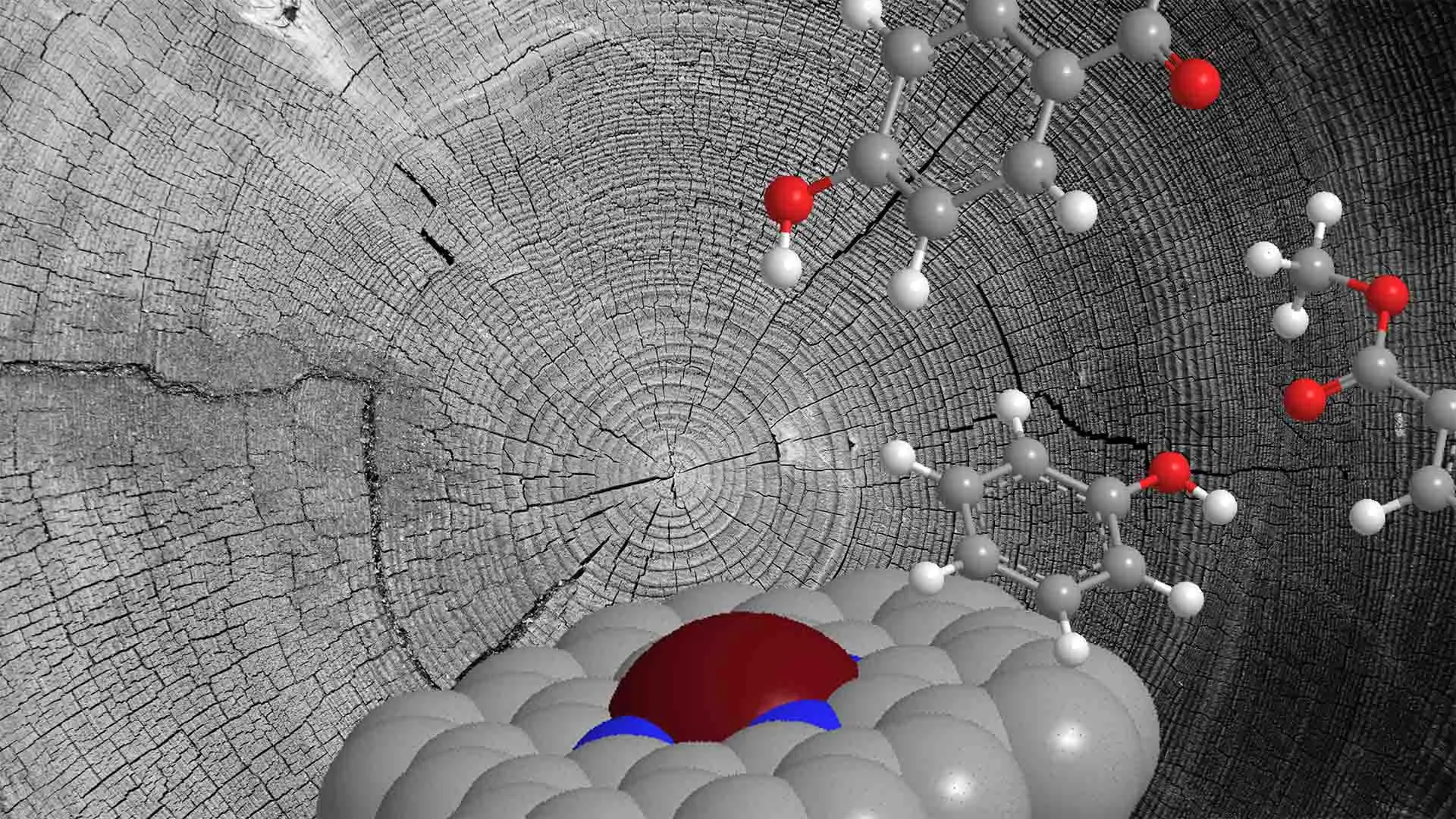
    Lignin gives plants much of their structural strength and represents the largest renewable source of aromatic chemicals found in nature. It can make up a substantial share (up to 35%) of waste biomass from agriculture and forestry. Yet lignin’s complicated molecular structure makes it notoriously difficult to break apart efficiently, which has limited its potential use in sustainable manufacturing.

    In a study published in ACS Catalysis, an international team that included Dr. Christopher Parlett, Xinyue Zhou, and Yutao Jiang from the Department of Chemical Engineering developed a highly efficient “single-atom catalyst.” The researchers also determined, at the molecular level, how the catalyst breaks the strong chemical bonds that help hold lignin together.

    The catalyst contains individual ruthenium atoms embedded within a nitrogen-doped carbon material. By keeping the ruthenium atoms isolated, the design can deliver strong catalytic performance while requiring only very small amounts of metal, improving efficiency compared with conventional systems.

    Revealing How the Catalyst Breaks Down Lignin

    One persistent obstacle in lignin research has been identifying exactly which parts of a catalyst are responsible for breaking the material’s unusually strong chemical bonds. Without that information, researchers have had limited guidance for designing more effective catalysts.

    The team found that a particular atomic arrangement known as a “Ru-N4 site” is especially important. These sites activate oxygen molecules and help trigger the breaking of both carbon-oxygen and carbon-carbon bonds within lignin.

    Using a combination of laboratory experiments and computational modeling, the researchers were able to reconstruct the process in greater detail. The catalyst first activates oxygen, producing highly reactive species. Those species then attack the lignin structure and split it into smaller molecules.

    High Conversion With Milder Conditions

    When tested under optimized conditions, the catalyst converted nearly all of the model lignin compounds and generated high yields of valuable chemical products, including phenol.

    The process also works under relatively mild conditions and does not require harsh chemicals. That combination could make the approach useful for developing more sustainable methods of chemical manufacturing.

    The researchers went beyond simplified model compounds and tested the catalyst on real lignin collected from several biomass sources. It successfully converted those samples into useful aromatic compounds that could potentially become building blocks for fuels, plastics, and other materials.

    A Potential Path Toward Biomass-Based Chemicals

    The findings provide a more detailed picture of how single-atom catalysts operate during biomass conversion. That understanding could serve as a guide for developing more efficient catalytic systems in the future.

    “Understanding exactly how these catalysts work at the atomic level allows us to design better materials for converting renewable resources into valuable chemicals,” said Dr. Christopher Parlett, Lecturer in Chemical Engineering.

    By making it easier to upgrade lignin and convert it into higher-value products, the research could support a broader shift away from traditional linear petroleum-derived chemical production and toward a more circular, biomass-based economy.

    atomic catalyst hidden plant unlocks waste
    NCIJ NETWNCIJ NETWORK
    • Website

    Keep Reading

    A new cancer vaccine may keep melanoma from coming back

    Integrating Model-Based Systems Engineering and Fault Management to Enable Autonomous Space Missions

    A Manhattan-sized ice island just broke free from Greenland

    Supercharged “natural killer” cells could be a powerful new cancer weapon

    Shingles vaccine linked to 24% lower dementia risk

    Trump to award Congressional Space Medal of Honor to Artemis II astronauts

    Add A Comment
    Leave A Reply Cancel Reply

    Editors Picks

    A new cancer vaccine may keep melanoma from coming back

    August 25, 2026

    Pennsylvania Lags Far Behind on Solar. Here’s How It Could Catch Up.

    August 25, 2026

    BW LNG builds on 174k LNG carrier workhorse with 177k cbm three-tank design

    August 25, 2026

    Peacemaking Is Power Politics Again

    August 25, 2026
    Latest Posts

    Flying Eagle Android RAT Traces Found on 170 Servers as Source Code Circulates

    July 29, 2026

    Inside the rogue ChatGPT hack of Hugging Face

    July 29, 2026

    ECB wage tracker at 2.7% in Q1 2027, indicating stable negotiated wage pressures

    July 29, 2026

    Subscribe to News

    Get the latest sports news from NewsSite about world, sports and politics.

    NCIJ Network is an independent digital news platform delivering trusted investigative journalism, European and global news, in-depth analysis, and fact-based reporting with accuracy, transparency, and integrity.

    Facebook X (Twitter) Instagram Pinterest YouTube

    A new cancer vaccine may keep melanoma from coming back

    August 25, 2026

    Pennsylvania Lags Far Behind on Solar. Here’s How It Could Catch Up.

    August 25, 2026

    BW LNG builds on 174k LNG carrier workhorse with 177k cbm three-tank design

    August 25, 2026

    Subscribe to Updates

    Get the latest creative news from FooBar about art, design and business.

    Type above and press Enter to search. Press Esc to cancel.