


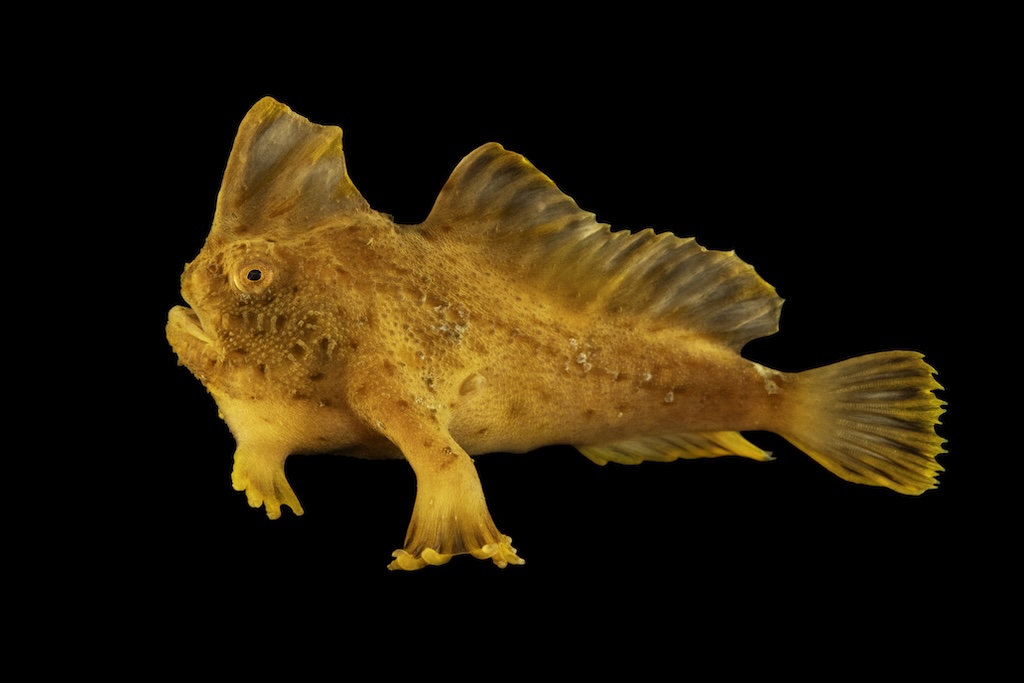
- Wildlife photographer Joel Sartore’s National Geographic Photo Ark turned 20 this year and reached its 18,000th animal, a critically endangered red handfish.
- The project aims to photograph every species living in the world’s zoos, aquariums, and sanctuaries, so the portraits can move people to care about extinction.
- Some animals Sartore has photographed, including the northern white rhino Nabiré and the frog Toughie, were among the last of their kind, and have since gone functionally or entirely extinct.
- After more than 30 years as a photographer, Sartore keeps a relentless pace and is preparing his son Cole to carry the Photo Ark forward.
For 20 years, Joel Sartore has been on a quest: to photograph every animal species in human care, and then some. This year, on the 20th anniversary of the Photo Ark somewhere in Australia, Sartore photographed the project’s 18,000th animal. He’s not totally sure which one pushed the project over the threshold, but gives it to the critically endangered red handfish (Thymichthys politus) a grumpy, red Muppet of a fish that could use the publicity.
When Mongabay asked Sartore, just a few days after the official anniversary, about the last animal he had photographed, he got very excited about a small moth on the screen door of his home in the U.S. state of Nebraska. He coaxed it into an old cup and photographed it. He was still waiting on an identification from a couple of moth experts, who, he notes, are night owls.
If you find Joel, you’ll likely find him working. Midwestern-friendly, practical, and optimistic, the National Geographic photographer shoots wherever animals turn up. This includes zoos and aquariums, pet shops, bioblitzes — where scientists and volunteers race to find and document as many species as they can — stream samplings by the Tennessee Valley Authority (a power utility), a cave in Kenya, and, as in the case of the moth, on his porch.
When it comes to scheduling, “I would say we are almost 100% opportunistic,” Sartore tells Mongabay on a call in mid-August. He’s also persistent. “I scouted up a bull moose that I’ve been watching for four years.”
The resulting portraits are instantly recognizable. Each animal, whether an insect or an elephant, sits against a plain black or white background, and the result is striking detail.
“Big and small we love them all,” Sartore says. “I like that line because it rhymes.”
The Photo Ark was born out of love for both animals and his family. Two decades ago, Sartore was traveling the world on assignment for National Geographic when his wife was diagnosed with cancer. He came home to be near her and started photographing animals at nearby zoos. His wife recovered, and the project never stopped.
“We want to show people what biodiversity looks like at this point in time,” he says, “so people will wake up and care and want to do something other than fight with each other.”

Photography can be an essential part of conservation, giving a face to a story or, in the case of the famed Ark, drawing international attention. For example, when conservationists rallied around the Florida grasshopper sparrow (Ammodramus savannarum floridanus), he says, publicity from the Photo Ark helped to get attention to the critically imperiled bird in the nick of time.
“Joel Sartore represents the truest spirit of conservation photography, putting his storytelling skills to work for the planet long before the term was widely used…When you look at the scale of the Photo Ark, the sheer effort behind it, and how effectively he puts that work to work, it’s mind-boggling,” Morgan Heim , a National Geographic Explorer and executive director of the International League of Conservation Photographers, who was once vomited on by a vulture while holding lights for Sartore told Mongabay. “Don’t worry —I used his softbox as a shield, and the photos were phenomenal.”
Sartore hands the credit for conservation wins to others. “I can’t sit here and pound my chest over any of them,” he says. “I meet environmental heroes every single day. I’m kind of a voyeur. I’m popping in and harvesting the good work that these people do. And then I go on down the road. But I’m not skipping away. I’m kind of walking with my head down on a lot of these.”
Some of the more heart-wrenching memories are of species that, at the time of the photo shoot, were extinct in the wild, and are now functionally or entirely extinct.

A loss that still stings, he says, is a northern white rhino named Nabiré, who lived at the Dvůr Králové Zoo in the Czech Republic. This subspecies, Ceratotherium simum cottoni, is now functionally extinct. After the last male died, only two females remain, a mother and daughter penned in Kenya, both descended from that same zoo. A few frozen embryos remain, and, Sartore says, maybe 30 chances to bring the animal back.
By the time Sartore arrived to photograph the grand beast, Nabiré was very old and could not be operated on for the fluid-filled cysts inside her. A keeper who had raised her from a baby led her out of the zoo exhibit with her favorite food, pushing the greenery ahead of him with a push broom and luring her into a room prepped with Sartore’s iconic black backdrop.
“She was super sweet,” Sartore says. “She came over to the bars and sniffed us, and we scratched her nose and her ears and she ate a little bit more. And then she laid down, went to sleep.” As the crew pulled their black backdrop off the wall, Sartore stopped and put his hand on her. “I could feel her breathing,” he says.
She died a few weeks later.
“That one still stings really badly for me,” Sartore says. “I don’t like it.”
He also took a portrait of Toughie, a Rabbs’ fringe-limbed tree frog (Ecnomiohyla rabborum) from Panama, believed to be the last of his kind. Toughie died in 2016 under care at the Atlanta Botanical Gardens in the U.S., and a song was written to honor the endling, a term that means the last of its kind.
“What people don’t realize is as these other species go away, so will we,” Sartore says.

Even so, he calls himself an optimist, mostly because of the people he meets along the way, who have dedicated their lives to conservation. “I don’t get down or depressed … we have too much work to do.”
After more than 30 years behind the camera, Sartore still works seven days a week, he says, pretty much every day of the year except Christmas. Besides planning trips and photographing animals, he’s busy with interviews, speaking engagements, and even some writing.
The Frequently Asked Questions page on his website addresses questions such as: How can I be a National Geographic photographer? What camera should I buy? Can I intern for you? How many times have you almost been killed?
Chun-Wei Yi, who directed the PBS film RARE: Creatures of the Photo Ark, once watched Sartore drop to his knees at the end of a fruitless 10-hour hike through the Cameroon highlands in Central Africa, trailing Wildlife Conservation Society scientists in search of Cross River gorillas (Gorilla gorilla diehli).
“We’re rolling on him and figure we’re getting more funny ‘exhausted Joel’ footage, but we soon realize he’s not capitulating. Rather, he’s digging through a fresh pile of cow dung!” Yi told Mongabay after the documentary’s release in 2018. “I’ve never seen anyone more excited about poop. As he peels back each moist lump, we see the gold he’s after: dung beetles … he pulls out four new species of dung beetle to add to the Photo Ark.
“All I could think was, ‘This guy knows how to get a picture,’” Yi added.

Sartore has no plans to quit, but he’s planning for the day he can’t keep up. His son Cole, 33, whom he calls his “heir apparent,” goes with him “on all the foreign shoots. He cares deeply and he’s a good photographer,” Sartore says. “So that is our plan, so that we can keep it going once I’m too old to do it.”
He also says he believes animals are smarter than most people give them credit for. Ravens solve problems. Prairie dogs, he notes, can describe threats to one another in complex calls. Bees dance to give directions.
“I just have looked so many animals in the eye,” he says. “When you are really close to an animal and you are looking them in the eye, don’t they have a basic right to exist, all the way down to the grasshoppers and the praying mantises? Don’t they? I think they do.”
Banner image of critically endangered female red handfish (Thymichthys politus) at the Institute for Marine and Antarctic Studies in Hobart, Tasmania by Joel Sartore for National Geographic.
New population of extremely rare ‘red handfish’ discovered off Tasmania
Liz Kimbrough is a staff writer for Mongabay and holds a Ph.D. in ecology and evolutionary biology from Tulane University, where she studied the microbiomes of trees. View more of her reporting here.
FEEDBACK: Use this form to send a message directly to the author of this post. If you want to post a public comment, you can do that at the bottom of the page.
