


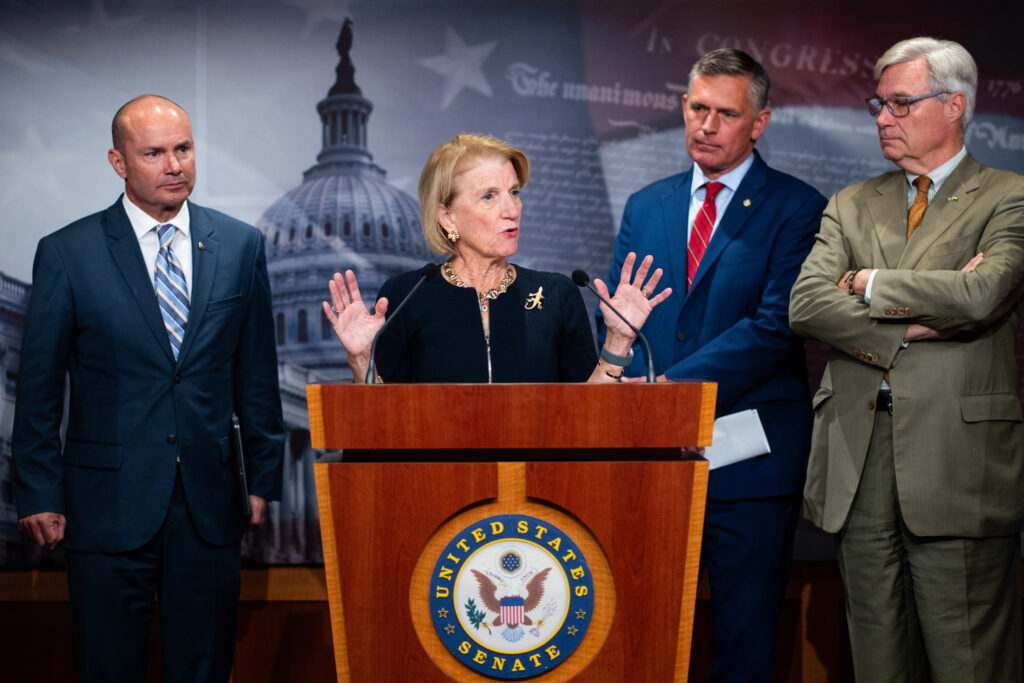
In less than two weeks, U.S. Senate leaders plan to take an initial vote on the divisive permitting reform bill aimed at easing regulatory barriers that can delay energy projects. As the date nears, some of the country’s leading environmental groups are ramping up their opposition, arguing that the measure would do more harm than good.
A new report from Resources for the Future, a research nonprofit, projects that the bill’s power-sector provisions would cut carbon emissions by 1.8 gigatons by 2041 and reduce annual electricity-system costs by an average of 3.5 percent to 7 percent compared to a scenario without the bill.
But the projected benefits are unlikely to convince the bill’s critics, partly because the analysis doesn’t address the provisions that have drawn the most opposition, including changes to the Clean Water Act, the Endangered Species Act, the National Environmental Policy Act and the National Historic Preservation Act.
The debate over the bill, called the Bipartisan American Affordability and Jobs Act, or BAAJA, has divided environmental and clean energy advocates and threatens to unravel a compromise between the bill’s Democratic and Republican co-sponsors.
On one side, clean energy business groups and advocacy organizations praise the bill’s approach to accelerating timelines for building transmission lines and renewable energy projects. On the other side, key environmental advocacy groups say the proposal would speed up fossil fuel infrastructure buildout and remove current tools to oppose projects.
“Over the next two years, BAAJA would create more legal runway for this president to make corrupt deals and greenlight harmful projects of all kinds, and it would constrain any future president from repairing the damage,” said Abigail Dillen, president of Earthjustice, an environmental law nonprofit, in a commentary posted on Tuesday.
The same day, four Senate Democrats sent a letter to the bill’s co-sponsors saying they have concerns that President Donald Trump’s administration cannot be trusted to follow through on promises that were made during negotiations.
“Beyond consideration of the actual text, the promise of BAAJA will only succeed if President Trump takes care that it is faithfully executed,” reads the letter from Democratic Sens. Tammy Duckworth of Illinois, Ed Markey of Massachusetts and Jeff Merkley and Ron Wyden, both of Oregon. “The Trump administration’s record gives us no basis to assume that he will.”
The senators cite the Trump administration’s cancellation of already-approved clean energy grants and loans and evidence that decisions were made with intent to harm states that voted for Democrats. They said the administration should reinstate all canceled awards and commit in writing to no longer basing grant decisions on the political affiliation of a state’s elected officials.
If the administration doesn’t comply, the senators have threatened to oppose a motion to proceed to debate on the bill at a vote scheduled for Nov. 9. Losing the support of four senators who have been vocal advocates for environmental protection could make it harder to secure the 60 votes needed to overcome a filibuster.
In a statement, a Trump administration spokesperson said the White House supports the bill because it will deliver jobs and investment.
“The text of the legislation has been published, and all that is left to do is vote,” the spokesperson said. “We are in direct conversations with the lead negotiators in the Senate and are looking forward to action on this historic legislation to unleash more energy in the United States.”
A co-sponsor of the bill, Sen. Sheldon Whitehouse, D-Rhode Island, has also expressed concerns that the Trump administration will go to extraordinary lengths to oppose renewable energy even if the bill becomes law.
“We await real signs of regulatory good faith,” he said in a post on X, along with a link to a Bloomberg article about the administration’s recent contradictory actions on wind power.
Meanwhile, a coalition of conservative groups, many funded by the petrochemical billionaire Koch family’s network, urged the Senate this week to pass the bill to “protect property rights, promote energy abundance, and restore America’s ability to build.”
Emissions Cuts, But an Incomplete Picture
The new analysis by Resources for the Future follows several by other organizations that also show substantial cuts in emissions resulting from the power-sector provisions of the bill.
Resources for the Future is a leader using economic models to estimate the effects of complex legislation. Among the findings:
- The bill would increase the country’s transmission line capacity by 30 percent by 2041, meaning more power can be transported on interstate power lines. A lack of transmission capacity is one of the main factors impeding construction of new wind, solar and battery projects and more lines would allow more of those systems to be built.
- Building new, cleaner power sources would help displace some of the older, more polluting sources on the grid, adding 60 gigawatts of clean power capacity compared with a baseline scenario without the bill. The analysis also found that removing existing constraints would lead to a small increase in combined-cycle natural gas plants, though that effect would diminish over time.
- Power-sector carbon dioxide emissions would be lower under the bill than without the bill, although both scenarios show emissions growth over the study period. Adopting the bill would reduce cumulative carbon emissions by 1.83 gigatons through 2041. In the final year, emissions would be 6 percent less than the baseline level.
This story is funded by readers like you.
Our nonprofit newsroom provides award-winning climate coverage free of charge and advertising. We rely on donations from readers like you to keep going. Please donate now to support our work.
Kevin Rennert, a research fellow at Resources for the Future and co-author of the report, acknowledged the limitations of focusing only on the power sector.
“Anybody that is making up their mind about this bill should look across a fulsome set of analyses to inform their overall take on what the bill would do,” he said.
Rennert was not aware of any report that attempts to estimate the emissions effects of the entire bill. One reason may be that some parts are challenging to analyze because of uncertainty about their potential effects.
Kevin Kircher, a mechanical engineering professor at Purdue University, has criticized the use of the economic models in the debate over the bill. He said models that examine only the power sector overlook potentially huge issues, such as methane leakage from increased gas use and emissions from fossil fuel exports, among others. He had no comment about the Resources for the Future report, which he had not yet read.
“I think hyper-focusing on the [power sector] is sort of missing the forest for the trees,” he said.
Kircher has concerns about the bill, including about the “project certainty” section, which would allow developers to sue the federal government for permit denials or delays. The change would let the Trump administration set implementation parameters, leaving future presidents little leeway to change course.
He has written that streamlining the permit process would largely benefit natural gas, based on the queue of projects in the PJM Interconnection and Midcontinent Independent System Operator regions.
Kircher also expressed dismay that the bill has divided groups that are usually allies.
“It’s really telling that so many people formed strong opinions before they would have had any time even to read [the bill], let alone to kind of think carefully about it,” Kircher said.
Marianne Lavelle contributed to this story.
About This Story
Perhaps you noticed: This story, like all the news we publish, is free to read. That’s because Inside Climate News is a 501c3 nonprofit organization. We do not charge a subscription fee, lock our news behind a paywall, or clutter our website with ads. We make our news on climate and the environment freely available to you and anyone who wants it.
That’s not all. We also share our news for free with scores of other media organizations around the country. Many of them can’t afford to do environmental journalism of their own. We’ve built bureaus from coast to coast to report local stories, collaborate with local newsrooms and co-publish articles so that this vital work is shared as widely as possible.
Two of us launched ICN in 2007. Six years later we earned a Pulitzer Prize for National Reporting, and now we run the oldest and largest dedicated climate newsroom in the nation. We tell the story in all its complexity. We hold polluters accountable. We expose environmental injustice. We debunk misinformation. We scrutinize solutions and inspire action.
Donations from readers like you fund every aspect of what we do. If you don’t already, will you support our ongoing work, our reporting on the biggest crisis facing our planet, and help us reach even more readers in more places?
Please take a moment to make a tax-deductible donation. Every one of them makes a difference.
Thank you,
