


- The Central African country is facing its largest and also the fastest-spreading Ebola outbreak on record.
- Health agencies are seeking to revise their strategy to tackle the public health crisis but focusing on response at the village level in the affected provinces of the DRC.
- Dr. Jean Kaseya, director-general of Africa CDC underscored the need to bring the outbreak response to the village level, saying that a community-centered approach helps build trust between local populations and health teams while strengthening participatory surveillance.
- One of the reasons this outbreak has turned out to be more difficult to contain is because a rare strain of the Ebola virus, Bundibugyo ebolavirus, is driving the cases.
The Democratic Republic of Congo (DRC) recorded more than 4,300 Ebola cases with more than 2,000 deaths as of Aug. 9, making this the country’s largest outbreak, to date.
In the last major Ebola outbreak, the country reported around 3,500 confirmed and probable cases over two years (2018-20). However, this time, the number was surpassed in just 12 weeks from the time the outbreak was officially declared on May 15 of this year, making it the fastest-spreading Ebola outbreak on record.
“The scale of these epidemic reveals, for the first time, the gravity of the situation and forces us to rethink our response strategies in order to provide a more effective and better-coordinated response,” Dr. Jean Kaseya, director-general of Africa Centres for Disease Control and Prevention (Africa CDC), said during an online press briefing on Aug. 6.
In May, the DRC declared its 17th Ebola outbreak in Ituri province, which borders Uganda.
Kaseya said the official figures provide only a partial picture of the epidemic’s true scale in the eastern DRC. In remote villages and rural areas, which are among the hardest hit, many cases may go undetected by surveillance systems due to difficult access and operational constraints.
The World Health Organization and the Africa CDC had previously estimated that the DRC needed $1.4 billion to tackle the crisis in a comprehensive manner, including for humanitarian response, and that available funding was well below that target. A recent announcement by the U.S. of an additional $242 million will help cover the funding gap.
However, the head of Africa’s apex public health agency emphasized that “money is not the issue today. The issue is we are not listening [to] communities.”
In previous interviews with Mongabay, community leaders from affected areas said they were faced with widespread misinformation about the disease and resistance to safe burials, which are essential to curb the spread of Ebola. Bodies of people who die of the disease can still carry the virus and be contagious. Bodily contact is a part of some customary funerary traditions in this region but puts people at very high risk of contracting the deadly illness. Tensions with communities has created a volatile environment and also prompted attacks on some Ebola treatment facilities.
Kaseya recently visited some of the most severely affected parts of eastern DRC and described meeting community members. “What is the critical message I got from them? We are not involved and we want to be involved,” he said.
Africa CDC and its partners have identified seven priorities to accelerate and strengthen the response: community-led action, free medical care, better working conditions for health workers, digitalizing the response, reopening schools by September, coordinating health and humanitarian aid and boosting cross-border cooperation to ensure transparency and accountability.

Kaseya underscored the need to bring the outbreak response to the village level, saying that a community-centered approach helps build trust between local populations and health teams while strengthening participatory surveillance. In eastern DRC’s Ituri province, local actors across 6,542 villages will be mobilized to help families organize safe and dignified burials, promote early testing for symptomatic individuals, and encourage isolation when necessary.
One of the reasons this outbreak has turned out to be difficult to contain is because a rare strain of the Ebola virus, Bundibugyo ebolavirus, is driving the cases. There are no approved vaccines or treatments for this strain. Trials are currently underway to test whether an oral medicine could prevent onset of disease post-exposure to the virus.
Given the rate at which the disease is spreading, the health agencies are considering research to investigate if the virus is undergoing mutations, which would make it harder to control.
Kaseya said they are also looking to vaccinate populations in affected provinces in the DRC against the Zaire strain of Ebola, which is the most prevalent strain and has caused the largest number of outbreaks. He said that preliminary data suggest that those vaccinated against the Zaire strain might show milder symptoms of the disease caused by the Bundibugyo strain. Scientists are still investigating this. The agencies are also looking at procurement of the antiviral drug remdesivir. It was used in Uganda as part of the emergency response but is still being tested for the Bundibugyo strain.
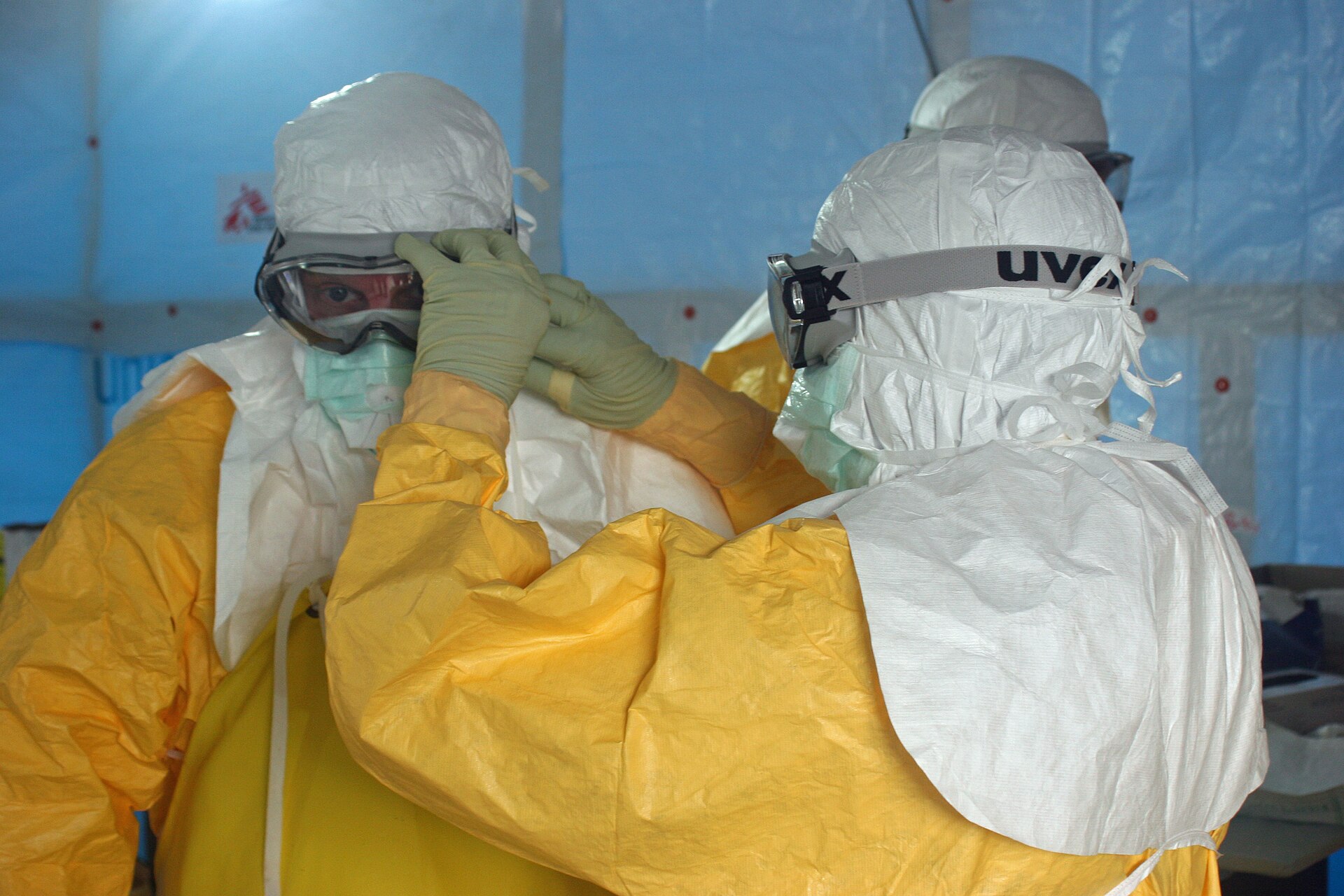
Banner image: Preparing to enter an Ebola treatment unit during the 2014 outbreak. Image by Athalia Christie via Wikimedia Commons (CC BY 2.0).
Ebola responders persevere in the DRC as Uganda nears end of outbreak
FEEDBACK: Use this form to send a message to the author of this post. If you want to post a public comment, you can do that at the bottom of the page.
Cite this article
Mongabay.org (2026). As DRC confronts largest Ebola outbreak, health agencies revise strategy. Mongabay Conservation news. DOI: https://doi.org/10.66709/news-326013

