


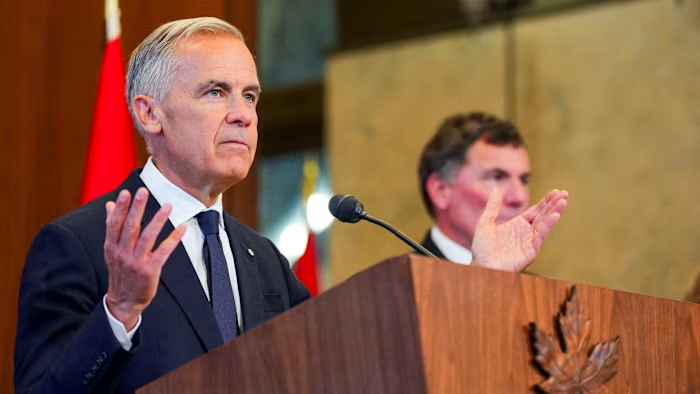
The North American trade war is back on. Heroically defiant Canadian Prime Minister Mark Carney said so after days spent in tariff brinkmanship with the Trump administration before choosing “no deal” and promising dollar-for-dollar retaliation. I persist in the belief that we’ve seen global peak tariff, but President Donald Trump getting hold of shiny new toys — the duties on Canada involve the obscure Section 338 — means he’s always got the power to lash out in select cases.
Today I look at how Trump’s ludicrous list of demands actually made Carney’s choice much easier, as well as how these tariffs will go down politically in the US. Charted Waters, where we look at the data behind world trade, is on cattle prices.
Carney is lucky in his enemies
Carney’s philosopher-king act at Davos in January where he prophesied a post-US international order, following his sterling work last year facing down Trump’s trade threats, is surely enough to get him sainthood. The prime minister’s speech over the weekend after talks broke down was clear and eloquent and the Canadian public is solidly behind him. But I think he got lucky.
As I wrote in June, Canada’s rhetoric in the run-up to the negotiations took a turn towards the emollient, bowing to the fact that geography is destiny for trade. Carney himself, tacking back from his Davos stance, emphasised the importance of the US-Canada trade relationship. Doug Ford, the pugnacious premier of Ontario who trolled Trump last year with an anti-protectionist television advert quoting former US president Ronald Reagan, returned to his earlier call for a “Fortress North America” in trade. The US’s strident and hard-to-impress ambassador to Canada, Pete Hoekstra, said he was pleasantly surprised.
Canadian diplomacy in the run-up to the talks was less than sure-footed, with the episode of the Gordie Howe International Bridge across the US-Canada border from Ontario to Michigan being one example. The bridge was completed this summer after eight years of construction, but earlier this year Trump suddenly demanded a share of the toll revenue, despite Canada having financed it. Carney aroused annoyance among the Canadian public by making opaque concessions which, in any case, weren’t enough to placate Washington. In the end, Canada held the bridge opening ceremony on its own.
A well-crafted and targeted set of demands in the trade talks would have put Carney in a difficult position, giving him nothing but unpalatable options. Canada was reportedly ready to accept permanent duties in some sectors, rather than demand a return to the pre-Trump zero rates, and to agree tighter rules of origin to force more of the cross-border auto supply chain into the US.
These would have caused consternation at home and accusations of selling out. Fortunately for Carney, he’s dealing with the clodhopping bullying of the Trump administration which, possibly acting under the malign influence of commerce secretary Howard Lutnick, introduced a whole bunch of new demands at the last minute.
The US apparently demanded the abolition of requirements for promoting the French language — presumably Québécois requests for French product labelling and quotas for French-language content on digital platforms. There were reports that the US wanted exclusive access to Canada’s critical minerals, which Carney said would never happen, and that the US wanted to pull Canada more tightly into its trade orbit by restricting Ottawa’s right to sign deals with other countries.
All this immediately changed Carney’s political quandary to a no-brainer. He had no qualms about turning the deal down and promising retaliation instead. Trump might have been trying to play divide and rule in Canada; he contrived only to unite and provoke. Like an incompetent mafia, the US has given an opponent an offer it can only refuse. This is not a novelty: the same happened last year when Trump attempted to threaten Brazil over the imprisoned former president Jair Bolsonaro.
To be clear, there’s no obvious overarching strategy for what Canada should be doing in response to Trump. Defiance seems to have been the best policy so far, but it’s not a universal rule. Canada is stuck in a top-floor apartment with a destructive and eccentric neighbour crashing around downstairs, however much it might want to relocate to Europe Towers. On this occasion, though, Carney’s decision was quite an easy one, and I suspect Canadian public resolve will hold firm in supporting it.
Congress resolutely refuses to do its job
So does this personally weaken Trump irrevocably and doom Republicans in the US midterms? Will US Congress and Capitol Hill Republicans decide at long last to distance themselves from the political toxicity of tariffs? Respectively, maybe and no.
The threat to Trump’s already very weak popularity is obvious. Inflation is already high, and tariffs get blamed for rising prices whether or not they are actually responsible. A chorus of complaint arose over the weekend from lawmakers, governors and business leaders about the collapse of the Canada talks.
The US public isn’t a big fan of tariffs. Opinion is divided on partisan grounds — as is everything, including whether the sun rises in the east or the west — but independents have taken a pretty strong stance against them. Trump at times seems vaguely aware of this — he recently granted a new six-month duty-free quota of ground beef, presumably in an attempt to buy votes with cheap hamburgers — but in the end tariffs are too tempting a weapon.
The president has also unwisely kept his duties in the public eye by fulminating against the US Supreme Court ruling that struck them down and then laboriously rebuilding the tariff wall with multiple instruments.
And yet, there isn’t a strong history of Trump getting hit electorally by the impact of his tariffs. Farmers have been clobbered by retaliation against US tariffs since he started raising them in his first term, yet farm counties have voted for Trump by increased majorities in elections since. Districts that were hurt by his tariff war of 2018–19 nonetheless subsequently swung towards the Republicans.

Meanwhile, Congress is as hopeless as ever. It’s currently putting through a bill, originally proposed by the late senator Lindsey Graham, designed to push Trump to impose tougher sanctions on Russia. Critics say the proposal has mutated into a catch-all delegation allowing the president enormous discretion to raise tariffs. Georgetown University law school professors Jennifer Hillman and Peter Harrell have a devastating critique of the bill here. Graham was a longstanding Russia hawk but also a convert cheerleader for Trump, so I guess this is a fitting memorial in two ways.
The bill, incredibly, has gained bipartisan support, passing the US Senate with 86 votes to 11. Perhaps Congress does not want to be seen voting against a Russia sanctions bill, but it’s perfectly possible to craft one without making it a blank cheque. I think we should just put another mark on the scoreboard of “Congress is all over the place on tariffs” and hope that sanity one day returns.
Charted waters
Cattle prices had already been falling before Trump made his announcement about opening up a new beef import quota, whereupon they slipped further.

Trade links
-
The FT examines how the transformation of ports, cities and trade by shipping containers may be reaching its limit.
-
In the latest sign of flexing its extraterritorial muscle, China has banned individuals and organisations from co-operating with an EU investigation into a bid for a German retailer by Chinese ecommerce giant JD.com.
-
Zurich and Beijing have revised and expanded their existing trade deal to give Switzerland almost complete tariff-free access to the Chinese market.
-
FT reporters look at the impact of the recent drought on the European economy.
-
Trump wants to put Section 232 “national security” tariffs on imports of brass musical instruments — not his maddest proposal ever but certainly up there in the leading pack.
Trade Secrets is edited by Harvey Nriapia
