


Reading Time: 6 minutes
This article was originally published by Votebeat, a nonprofit news organization covering local election administration and voting access.
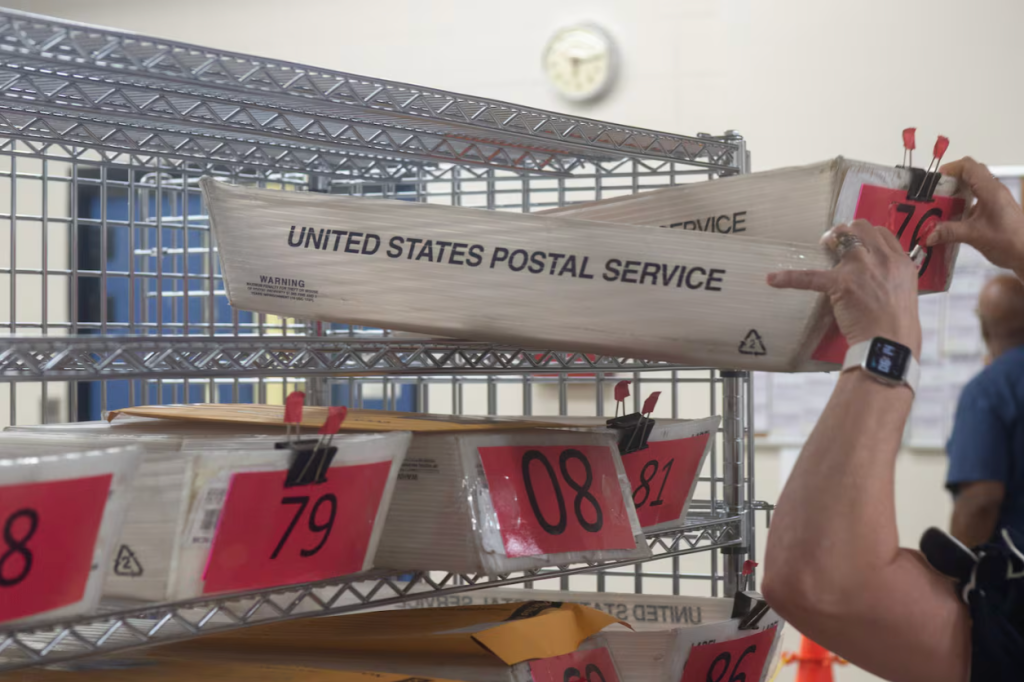
Milwaukee election officials spent Tuesday trying to prove they had a better way to count absentee ballots — faster, smoother and with less reason for anyone to doubt the process.
Then, after 15 hours of nearly flawless work, a few minutes of human error blew up the plan.
At around 11:10 p.m. on Tuesday night, city officials left their central count facility without exporting results from five of its nine tabulators, forcing them to race back under police escort and delaying Milwaukee’s results by about 90 minutes. It was the third time in recent years that a significant tabulator-related mistake disrupted the city’s heavily scrutinized absentee-ballot operation.
So, right around midnight, chief Milwaukee election official Paulina Gutiérrez and other city officials climbed into a white van under police escort and headed back along the Milwaukee River to the central count facility they thought they had shut down about an hour earlier.
There was ample evidence of what had gone wrong — and no evidence of tampering or any sign the results were affected.
“We’re all human, and humans can make errors,” Gutiérrez told Votebeat, just past 12:30 a.m. on Wednesday, after she and several other city officials shuffled from tabulator to tabulator to export the results they had failed to retrieve the first time.
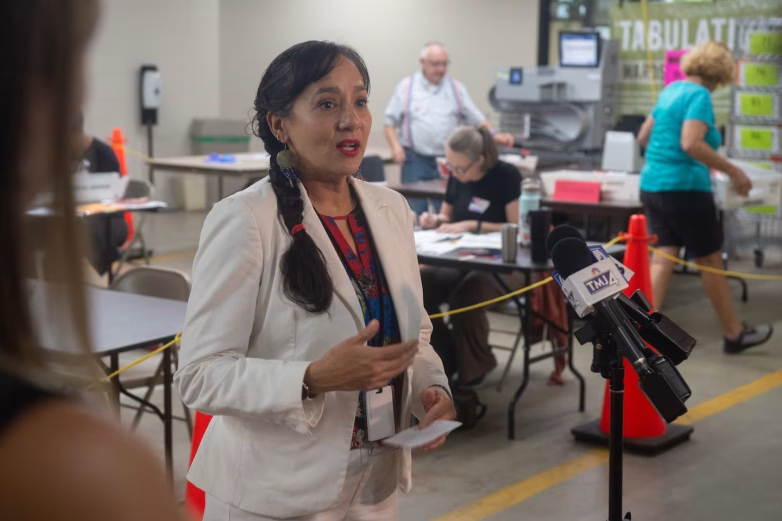
By then, the warehouse-like room was largely empty. Temporary workers had gone home. Election observers, believing the night was over, had left, too. Gutiérrez, wearing a white blazer and pants and maintaining an even-keeled expression as reporters surrounded her, said the results were secure, and that the city would determine how the error occurred and how to prevent it from happening in the future.
Her explanation did little to slow the criticism.
Within minutes, Dan Eastman, a right-wing lawyer who has filed election-related cases in Wisconsin, wrote on social media that there was no way central count could work for Milwaukee. Loomer Unleashed, a podcast hosted by right-wing pundit Laura Loomer, was more explicit: “Yeah, they cheated!”
Others, including Democrats, criticized the city without alleging wrongdoing.
“What an inauspicious ending to an otherwise quiet day,” said Ann Jacobs, a Democratic appointee on the Wisconsin Elections Commission and a regular observer at the city’s absentee ballot counting operation.
Mistakes add up for the state’s most scrutinized election operation
In November 2020, after arriving at the county clerk’s office to transmit Milwaukee’s election results, then-city election chief Claire Woodall realized that she forgot one of the facility’s 12 flash drives containing vote results at central count, a mistake some conservatives seized on as a flagrant oversight. That led her to create a checklist that the city has since used to avoid similar errors, outlining over two dozen steps for extracting, securing, and transmitting election results.
Four years later, at the next presidential election, Milwaukee election officials made the extraordinary decision to count 31,000 absentee ballots all over again because some staff didn’t lock tabulator doors in the early morning. Those panel doors, which cover the on/off switch and sometimes a slot for USB drives, were supposed to have been locked during counting.
The process Woodall created to prevent future such errors included a single official extracting results from each tabulator while accompanied by other staff. Officials appeared to have followed that process in November 2024, but not this time. Instead, different staff members downloaded the files from different tabulators and did so inconsistently, not realizing that results were not properly exported from five of the tabulators.
At the time, it appeared to take officials around 10 minutes to extract results from some tabulators, and only three minutes from others. In hindsight, the mistake was clear to Gutiérrez: Downloading results from tabulators takes more than three minutes, she told Votebeat.
“The fact that this happened five times seems more like a training issue,” Woodall told Votebeat. “Was this person trained on how to export results? Are they familiar with the machines and how you export results?”
But she also cautioned people not to get too carried away by a human error that wasn’t indicative of any fraud or fatal flaw in the election system.
Just after 1:15 a.m. Wednesday, Milwaukee County Clerk George Christenson stood beneath the bright fluorescent lights outside his courthouse office, facing roughly a dozen reporters who had stayed well past midnight waiting for the city’s results. Nearly two hours had passed since Christenson first expected those results to arrive.
Now, with the mistake finally corrected and the long election night stretching on, he told the assembled media that Milwaukee operates under constant scrutiny — and that people make mistakes.
“At the end of the day,” he continued, “what’s important is that we’re transparent, that the results are secure, and that we’re open and honest. And that’s what the City of Milwaukee election director did. She came up here and she explained it, went back, got the results, brought it back to us, and we got everything right.”
Errors undermine city efforts to build trust, lobby for policy change
Milwaukee officials have long argued that state law and limited resources make the city’s massive absentee-ballot operation harder than it needs to be. But the string of high-profile mistakes at Milwaukee’s central count operation has complicated their efforts to persuade lawmakers to give them more flexibility.
Wisconsin law prohibits municipalities from processing ballots before 7 a.m. on Election Day. That leaves Milwaukee — home to the biggest central count operation in the state — to open envelopes, verify signatures and witness addresses, and prepare tens of thousands of ballots for counting in a single day.
For years, election officials have pushed for legislation allowing municipalities to begin that process before Election Day. The proposal has been repeatedly stalled by the Republican-controlled Legislature, largely on the basis that Milwaukee cannot be trusted with additional time. That’s despite state Rep. Scott Krug, a high-ranking Republican, having spent years behind the scenes trying to gather support for the policy.
As liberals on Tuesday suggested the pre-processing law would have helped stave off mistakes, Krug said that the city wasn’t helping its cause.
“Complete incompetence at the facility isn’t helping anything here,” he said on social media. “This was human error that could have easily been double checked before leaving the facility. More than one answer to the problem not one silver bullet.”
How officials, experts think central count operation can improve
Allowing Milwaukee to start processing absentee ballots earlier would relieve some of the pressure on Election Day. But election experts say it would not solve all the other weaknesses in an operation handling more absentee ballots than any other in the state.
Jennifer Morrell, CEO of the Elections Group, said a successful central count operation depends on three things: experienced staff, a space designed for the work and the right equipment. Milwaukee, she said, falls short in each area compared with similarly sized cities that have invested more heavily in election administration.
The city election commission never had enough full-time staff to begin with, Morrell said, and currently has a small handful of vacancies. While central count relies on temporary employees, she added, it still needs enough experienced full-time staff to run an operation of that size.
The city also has no permanent home for its central count, meaning officials must adapt the operation to spaces that were not necessarily designed for processing tens of thousands of absentee ballots. Morrell also said the city lacks equipment that other cities of similar sizes have invested in, like a mail sorting machine. That means Milwaukee election workers sort tens of thousands of mail ballots — sometimes more than 100,000 — by hand. Madison’s sorting machine, by comparison, allows the city to sort hundreds of ballots in minutes.
Gretchen Macht, the founder of the Engineering for Democracy Institute and an associate professor of industrial and systems engineering at the University of Rhode Island, has spent the past few years assisting Gutiérrez to find more efficient ways to conduct its central count. In an interview with Votebeat, Macht invoked an old saying in both election administration and engineering: You can have something fast, accurate, or cheap, but you can only pick two.
For Milwaukee officials, sacrificing accuracy is an obvious nonstarter.
“Our number one priority is efficiency and accuracy,” Gutiérrez said, adding that she’ll never sacrifice election operations just to improve speed.
But without more money or changes to state law, there is only so much faster the city can go.
Just before midnight on Tuesday, that consequence was playing out on national television.
With more than 90% of the state’s unofficial results in and Milwaukee’s absentee ballots poised to determine the outcome of the Democratic gubernatorial primary, NBC News election analyst Steve Kornacki was waiting for the city’s numbers to arrive.
He stood flabbergasted — hands on his knees, mouth agape, eyebrows raised — in his studio as he learned about the snafu with the USB sticks.
“Are you serious?” he said.
“We’re kind of indefinitely waiting for them to get their act together here,” he said. “We waited 90 minutes for them. They did this whole procession, and then we find out there’s nothing on the sticks.”
Alexander Shur is a reporter for Votebeat based in Wisconsin. Contact Alexander at ashur@votebeat.org.
Votebeat is a nonprofit news organization reporting on voting access and election administration across the U.S. Sign up for Votebeat Wisconsin’s free newsletter here.
An election night error overshadowed Milwaukee’s improvements at processing absentee ballots is a post from Wisconsin Watch, a non-profit investigative news site covering Wisconsin since 2009. Please consider making a contribution to support our journalism.
