


Reading Time: 9 minutes
Click here to read highlights from the story
- Wisconsin’s largest utilities are on track to contribute less to political campaigns than in the last two gubernatorial election years, despite the enormous stakes for the state’s energy future.
- Neither Republican Tom Tiffany nor Democrat David Crowley received contributions from utility political action committees through September.
- Utilities have directed nearly all their campaign contributions toward state legislative races.
- Democrats are gaining ground in utility fundraising, receiving about 45% of contributions to legislative candidates and fundraising committees this year, compared with less than 20% in 2022.
Wisconsin’s multibillion-dollar energy infrastructure construction boom isn’t fueling a similar deluge of utility-related campaign spending ahead of the election.
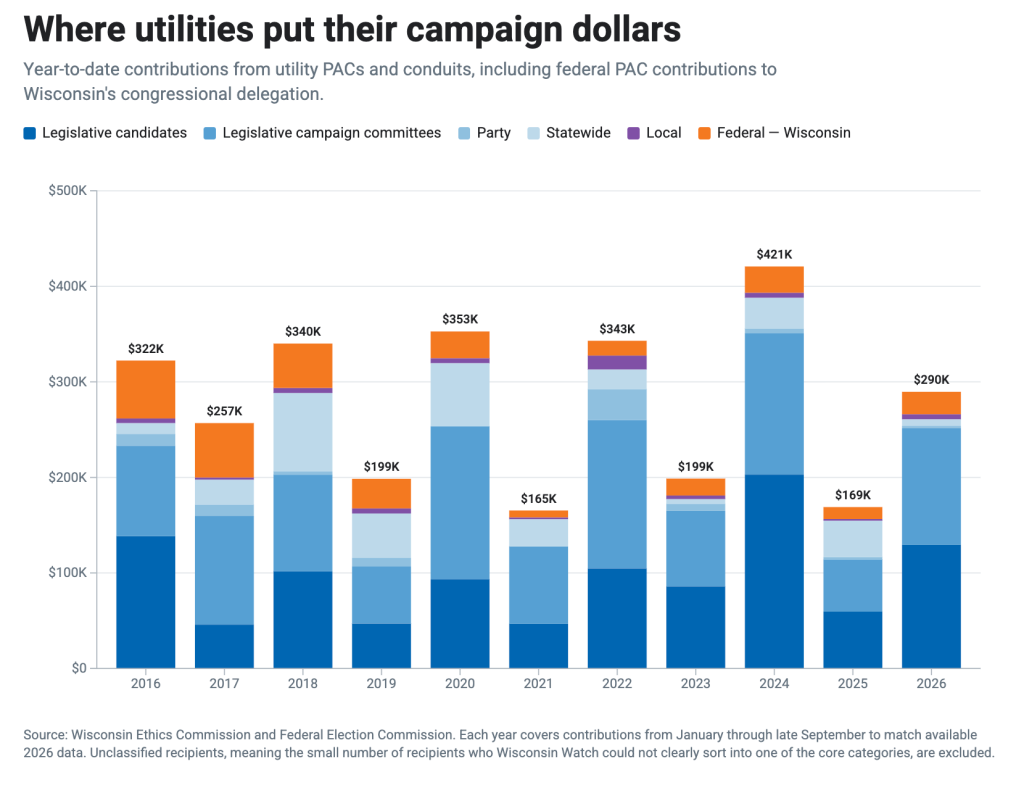
The state’s largest utilities are collectively on track to spend less supporting political candidates this year than in the last two gubernatorial election years.
Utility campaign contributions to Wisconsin’s local, state and federal campaigns — and state-level partisan fundraising groups — reached just under $300,000 by late September, down roughly $50,000 from the same point in 2022.
(function () {
const frame = document.querySelector(“#ww-utility-by-type iframe”);
window.addEventListener(“message”, function (event) {
if (
event.origin !== “https://wisconsin-watch.github.io” ||
event.source !== frame.contentWindow ||
!event.data ||
event.data.type !== “ww-utility-chart-height”
) return;
const height = Number(event.data.height);
if (
Number.isFinite(height) &&
height >= 100 &&
height = 2) {
frame.style.height = newHeight + “px”;
}
}
});
})();
Neither Republican gubernatorial candidate Tom Tiffany nor Democratic candidate David Crowley took in any contributions from the utilities’ political action committees (PACs) between January and September.
Utilities could still make last-minute contributions before the election, as they have in years past.
Utilities are dialing back contributions despite the influence the next governor and Legislature will wield over the industry. Next month’s winners will appoint and confirm a new majority to the state commission that regulates utilities and weigh in on legislation that could shape Wisconsin’s energy future for decades.
Some industry observers speculate that the mismatch between utilities’ political spending and the election’s ramifications reflect the mounting public hostility to the data center boom — and, by extension, to the utilities themselves.
“I think utilities are beginning to recognize that their brand is increasingly toxic,” said Jonathan Kim, a Chicago-based researcher for the Energy and Policy Institute, a nonprofit watchdog. As of August, Kim is also the institute’s registered lobbyist in Madison, focusing on residential ratepayer concerns.
If past ties to utilities put a target on a candidate’s back, Kim added, the companies would have good reason to avoid making direct contributions in hotly contested races.
Wisconsin isn’t the only state where utility political spending appears to be softening. In Michigan, for example, the state’s largest investor-owned utilities are on track to spend less supporting political candidates this year than they did in the last three midterm cycles.
The drop in political spending falls short of an all-out retreat in Wisconsin. Utilities have steered nearly all of their contributions toward state legislative contests — and, for the first time in at least a decade, divided their giving almost evenly between Democrats and Republicans. The shift coincides with Democrats’ improved prospects of securing a majority in at least one legislative chamber for the first time since 2010.
How utilities spend on politics
Three companies provide electricity for a majority of Wisconsin households: Alliant Energy, owner of Wisconsin Power and Light; WEC Energy Group, the parent company of We Energies and Wisconsin Public Service Corporation; and Xcel Energy, owner of Northern States Power Company.
Each company operates separate federal and state political action committees, or PACs. The committees collect voluntary contributions from company executives, employees and shareholders, then distribute those funds to political candidates and organizations chosen by their boards of directors. Candidates can spend donations on their current or future campaigns — or share them with other candidates. They cannot legally spend on personal expenses.
Can utilities use ratepayer dollars for campaign contributions? (Click to expand)
Wisconsin’s Public Service Commission doesn’t explicitly prohibit it, but utility spokespeople told Wisconsin Watch that their companies do not bill ratepayers for political contributions. We Energies said the same to the state’s Public Service Commission in April.
Voters in Michigan will decide in November whether to prohibit utilities from contributing to state political campaigns entirely.
Wisconsin law caps how much a PAC can contribute to a given state-level candidate in a single cycle — up to $2,000 for a Senate campaign, for instance, or $86,000 for a gubernatorial campaign. Federal rules similarly limit PAC contributions to individual candidates. Utilities’ federal PACs can give up to $5,000 to a federal candidate.
Utility employees and executives, meanwhile, can donate via employer-sponsored “conduits.” Alliant, WEC Energy and Xcel each sponsor conduits, as do Madison Gas and Electric and the American Transmission Company, Wisconsin’s largest transmission utility.
Like PACs, conduits serve as pass-throughs for political donations. Unlike PACs, employees choose which candidates receive their donations. The conduit’s sponsor may recommend candidates or races to support, and candidates who receive conduit contributions often also receive PAC donations.
Conduit contributions appear in campaign finance records under the individual donor’s name. Although state law limits how much individuals may contribute to a candidate, the combined donations routed through a utility’s conduit can exceed the amount a utility’s PAC may give in a single cycle.
How much have utilities spent on congressional races?
Alliant, WEC Energy and Xcel’s federal PACs gave roughly $23,500 to Wisconsin’s congressional delegation between January and late July.
U.S. Rep. Bryan Steil, facing a competitive race for a district stretching from Janesville to Racine, received $5,000 from Alliant’s PAC in early March — the largest Wisconsin utility contribution to a single candidate this year. Federal campaign finance records show no utility PAC contribution to Steil’s Democratic opponent, Mitchell Berman.
The state’s utilities have largely steered clear of the high-profile race in Wisconsin’s 3rd District, where incumbent Republican Rep. Derrick Van Orden and Democratic challenger Rebecca Cooke have tried to link each other to data center interests.
Utility PACs have donated to all eight Wisconsinites in the U.S. House in the last decade. But annual donations have plunged from 2016, when the three utilities’ PACs gave over $94,000 to the Wisconsin delegation, primarily to Paul Ryan, who was House speaker at the time.
U.S. Rep. Mark Pocan, the Madison area’s representative in Washington since 2013, hasn’t received a utility contribution since 2018.
How much have utilities spent on state races?
Contributions from the state-level utility PACs and their conduits to Wisconsin legislative candidates and legislative fundraising committees totaled roughly $250,000 between January and September.
Much of the decline in utility contributions from 2022 stems from reduced spending by WEC Energy’s PAC and conduit.
Democratic lawmakers have received about 45% of utilities’ year-to-date contributions, compared to just under 20% in 2022.
“We work with both sides,” WEC Energy President Scott Lauber told investors on a July quarterly earnings call. “It’s just a matter of how we make Wisconsin successful.”
Taylor Adams, an Alliant Energy spokesperson, said the utility’s political giving is bipartisan and varies from year to year based on the communities and elected officials within its service territory, not partisan preference. Adams added that his company focuses on policies that support “reliable and cost-effective energy.”
(function () {
const frame = document.querySelector(“#ww-utility-partisan iframe”);
window.addEventListener(“message”, function (event) {
if (
event.origin !== “https://wisconsin-watch.github.io” ||
event.source !== frame.contentWindow ||
!event.data ||
event.data.type !== “ww-utility-chart-height”
) return;
const height = Number(event.data.height);
if (
Number.isFinite(height) &&
height >= 100 &&
height = 2) {
frame.style.height = newHeight + “px”;
}
}
});
})();
Rep. David Steffen, chair of the Assembly Committee on Energy and Utilities, is the top individual recipient of utility dollars, campaign finance records show. He has received roughly $13,655 via utility PACs and conduits this year, accounting for roughly a third of his total 2026 fundraising as of September.
Alliant and WEC Energy’s PACs have already given Steffen’s campaign the maximum $1,000 allowed by state statute for an Assembly candidate in a single cycle. Three WEC executives have done the same through their company’s conduit.
The Assembly committee’s ranking Democratic lawmaker, Rep. Lisa Subeck, D-Madison, received $3,980.
Sen. Melissa Ratcliff of Cottage Grove, the ranking Democrat on the Senate Committee on Utilities, Technology and Tourism, received $5,250, including $2,000 from Alliant alone — the maximum state law allows for a Senate candidate. Ratcliff is not up for reelection until 2028.
Assembly Majority Leader Tyler August, R-Walworth, has received $7,500 from utilities and their conduits while Senate Minority Leader Dianne Hesselbein, D-Middleton, took in $5,560. With longtime Assembly Speaker Robin Vos set to retire, August is likely among top contenders to become speaker if Republicans keep the majority after Election Day.
August led Assembly’s Republicans through the two consecutive fights over utility-backed “right of first refusal” (ROFR) bills, which would grant Wisconsin’s transmission utilities first dibs on any electrical grid projects within their territory. Ratepayer advocates argue the proposal would risk driving up electricity prices by stifling competition in the transmission market.
Speaking at a June WisPolitics luncheon, Hesselbein blamed Republicans for the bill’s failure last session, casting the policy as a means to shore up Wisconsin-based businesses and union jobs.
Chamber leadership and members of the Senate and Assembly utilities committees received over a quarter of all utility PAC and conduit contributions this year.
That pattern isn’t unusual. Other industry interest groups, including in agriculture, also focus contributions on the committees most relevant to their businesses.
“Election spending from industry and wealthy special interests is about wanting access and sway over policy agendas that could affect their bottom line,” said Nick Ramos, executive director of the Wisconsin Democracy Campaign. “It’s no surprise that they assess the landscape and find who might have the most impact.”
(function () {
const frame = document.querySelector(“#ww-utility-leadership iframe”);
window.addEventListener(“message”, function (event) {
if (
event.origin !== “https://wisconsin-watch.github.io” ||
event.source !== frame.contentWindow ||
!event.data ||
event.data.type !== “ww-utility-chart-height”
) return;
const height = Number(event.data.height);
if (
Number.isFinite(height) &&
height >= 100 &&
height = 2) {
frame.style.height = newHeight + “px”;
}
}
});
})();
Some top recipients are less obvious.
Rep. Tip McGuire, D-Kenosha, has received $4,750 this year — more than many lawmakers on the Assembly utilities committee, despite not serving on it. McGuire is one of four Democrats on the Joint Finance Committee, which drafts the state’s two-year budget.
Other key lawmakers received relatively little this year. Senate utilities committee chair Sen. Julian Bradley, R-New Berlin, received $1,500 from utility PACs and conduits as of late September, and Assembly Minority Leader Greta Neubauer received $1,175.
Not all utility money reaches lawmakers directly. Utility PACs also contribute to partisan fundraising groups like the Republican Assembly Campaign Committee, which contributes to legislative campaigns.
Partisan committees also receive contributions directly from the utilities, rather than from their PACs. WEC Energy, for instance, gave $14,000 to partisan fundraising groups between January and June.
State law doesn’t cap contributions to party fundraising committees.
“There’s not supposed to be any sort of coordination between donors to the party committee and the campaigns that receive that money,” Kim said, making it difficult to know which candidates ultimately benefit from the utility’s committee contribution.
Scant spending on the governor’s race
About 2% of contributions from utility PACs and utility conduits between January and September flowed directly to gubernatorial candidates — including to candidates who lost their primary.
Wisconsin hasn’t held an open gubernatorial election since 2010, muddying comparisons with other recent elections.
Former Republican Gov. Scott Walker collected roughly $269,000 in contributions — not adjusted for inflation — between the launch of his gubernatorial campaign in 2009 and his exit in 2019, including about $86,000 ahead of his 2018 defeat by Democratic Gov. Tony Evers.
Evers received about $11,000 in utility contributions during that race. Utilities have since contributed roughly $330,000 to his campaign committee.
Ahead of the 2022 election, utilities contributed more than twice as much to Evers as they did Tim Michels, his Republican opponent.
Some gubernatorial spending in 2018 and 2022 came in late October, just after the candidates turned in their final pre-election fundraising reports.
(function () {
const frame = document.querySelector(“#ww-utility-governor iframe”);
window.addEventListener(“message”, function (event) {
if (
event.origin !== “https://wisconsin-watch.github.io” ||
event.source !== frame.contentWindow ||
!event.data ||
event.data.type !== “ww-utility-chart-height”
) return;
const height = Number(event.data.height);
if (
Number.isFinite(height) &&
height >= 100 &&
height = 2) {
frame.style.height = newHeight + “px”;
}
}
}
});
})();
Utilities haven’t transferred that financial support to Crowley, whom Evers backed during the chaotic final leg of this year’s Democratic primary. Utility PACs have yet to contribute to his or Tiffany’s gubernatorial campaigns.
Tiffany has received roughly $3,600 via WEC and MGE’s conduits while Crowley has drawn none during the campaign.
Still, both accepted utility contributions during previous runs for office.
Tiffany brought in at least $17,000 from utility PACs and through their conduits over a decade of state legislative campaigns, followed by another $11,500 during and after his U.S. House campaign in 2020.
Crowley’s state Assembly campaign committee raised just over $1,600 from utility PACs and conduits — mostly WEC, which serves households in the Milwaukee district he represented. His Milwaukee County executive campaign committee accepted another $9,900 from WEC’s PAC and via its conduit between 2020 and 2024.
Any additional contributions between Oct. 26 and Election Day will appear on the candidates’ next finance report in January.
Crowley and Tiffany’s visions for the PSC (click to expand)
Both Crowley and Tiffany are picking up the banner of energy affordability, promising to follow through in part via their appointments to the PSC.
“Under David Crowley, the PSC will become a watchdog for taxpayers, ensuring that Wisconsinites’ utility bills stay as low as possible while creating greater transparency in where their tax dollars are going,” Crowley spokesman Philip Schulman wrote in an email. “This includes empowering the PSC to reject rate hikes in favor of cheaper options and publishing a quarterly score card detailing everything from avoided outages to fuel cost savings.”
Tiffany doesn’t shy away from criticizing the current commission, in no small part because of his objections to converting cropland into solar farms. “Day one when I become governor, they will be replaced,” he said at a September town hall in Sauk County, referring to the two acting commissioners — Kristy Nieto and Marcus Hawkins — serving without Senate confirmation.
Utility allies spend more
Utilities share interests with other groups, some of which have poured far more into this year’s governor’s race.
Crowley has received separate $86,000 donations — the PAC cap for a single cycle — from at least four labor groups that often align with utilities on energy infrastructure projects: International Brotherhood of Electrical Workers PAC, International Union of Operating Engineers Local 139 PAC, Wisconsin Laborers’ District Council and Wisconsin Pipe Trades Association PAC. Two other construction trades unions contributed smaller sums to Crowley’s campaign; a PAC representing a carpenters’ union gave $82,500 and a PAC representing plumbers and steamfitters gave $25,000.
Those unions represent workers who build or operate power plants and transmission lines. The political director of the Wisconsin Laborers’ District Council sits on the board of Fair Rates for Wisconsin’s Dairyland alongside WEC and Alliant representatives.
Tiffany seized on that support in an attack ad that dubbed his opponent “Data Center David Crowley,” citing the labor groups’ vocal support for developing data centers and associated energy infrastructure.
“IBEW certainly supports responsible data center development,” the IBEW state conference vice chair, John Jacobs, wrote in an email. “We also support renewable energy and countless projects that support family supporting jobs, great healthcare, great retirement benefits and a path to the middle class. All priorities of David Crowley – and that’s why we support him.”
Those labor groups had not contributed to Tiffany’s campaign through September. But Robert Marchant, the Wisconsin Data Center Coalition’s sole lobbyist, donated $5,000 in early June. Alliant, WEC and Xcel are founding members of the coalition.
Spending strategically
Utilities’ spending this year leaves them far behind Wisconsin’s top political donors. Diane Hendricks, for example, has already given exponentially more than utilities in 2026 — all to the Wisconsin Republican Party, which has transferred most to Tiffany’s gubernatorial campaign.
But the companies’ political goals don’t match those of explicitly partisan spenders like Hendricks.
“They just want to be able to wield sufficient political power to get the things that they need,” Kim said. “They’re not going to spend dumb money.”

Wisconsin Watch is a nonprofit, nonpartisan newsroom. Subscribe to our newsletters for original stories and our Friday news roundup.
Despite high stakes for energy future, Wisconsin’s utilities scale back campaign spending — so far is a post from Wisconsin Watch, a non-profit investigative news site covering Wisconsin since 2009. Please consider making a contribution to support our journalism.
