

Close Menu
NCIJ Network NCIJ Network
    What's Hot

    0sec Labs Open-Sources 0, an AI Security Harness With Web UI, CLI and MCP

    November 9, 2026

    An ancient ocean full of giant predators reveals a surprising twist in evolution

    November 9, 2026

    South Korea’s beloved squid may vanish from its waters due to climate change, heat waves

    November 9, 2026
    Facebook X (Twitter) Instagram
    Trending
    • 0sec Labs Open-Sources 0, an AI Security Harness With Web UI, CLI and MCP
    • An ancient ocean full of giant predators reveals a surprising twist in evolution
    • South Korea’s beloved squid may vanish from its waters due to climate change, heat waves
    • Lawyers in This State Are Allowed to Ghost Clients for Years. Why Don’t More Judges Stop Them? — ProPublica
    • This grim story of marine park whales could yet have a positive outcome – if it teaches us to value other species | Elle Hunt
    • Reason Machines Open-Sources Aspen, a Git Server Built for AI Agents
    • Chesapeake Bay’s Osprey Population Is Falling. Is Its Food Supply a Factor?
    • The hill I will die on: Nobody just ‘rustles up’ a lasagne | Keren Levy
    • About
      • Our Team
      • Editorial Policy
      • Editorial Independence
      • International Support
    • Trust & Standards
      • AI Usage Policy
      • Conflict of Interest Policy
      • Corrections Policy
      • Ethics Policy
      • Fact-Checking Policy
      • Source Protection
    • Get Involved
      • Guide for Sources
      • Support Independent Journalism
    • Legal
      • Cookie Policy
      • Privacy Policy
      • Terms of Use
    Facebook X (Twitter) Instagram
    NCIJ Network NCIJ Network
    Monday, November 9
    • Home
    • World
    • Ai
    • Business
    • Politics
    • Health
    • Crypto
    • Science
    • Technology
    • Cybersecurity
    • Defense & Security
    • Economy
    • Energy
    • Europe
    • More
      • Fact Check
      • Investigations
      • Opinion & Analysis
      • Environment
    NCIJ Network NCIJ Network
    Home»Science

    An ancient ocean full of giant predators reveals a surprising twist in evolution

    NCIJ NETWNCIJ NETWORKBy NCIJ NETWNCIJ NETWORKNovember 9, 2026 Science No Comments4 Mins Read
    Share
    Facebook Twitter LinkedIn Pinterest Email

    An extraordinary collection of fossils in central Colombia is revealing a surprising chapter in Earth’s evolutionary history. Researchers have uncovered evidence of a time when ancient animal groups that were approaching extinction lived alongside newer groups that would eventually flourish. The discovery suggests that major evolutionary transitions can occur without the widespread destruction associated with mass extinctions.

    Scientists from McGill University and the Centro de Investigaciones Paleontológicas (CIP) identified this unusual pattern while studying fossils from Colombia’s Paja Formation. The ancient marine ecosystem preserves an exceptional mixture of surviving Jurassic lineages and emerging Cretaceous groups, offering a rare glimpse into a period of profound biological change.

    Drawing on these findings, McGill biology professor Hans Larsson and PhD graduate Dirley Cortés have proposed a new concept called a “Biotic Inflection.” The term describes an evolutionary turning point when older groups nearing extinction coexist with newer lineages that are beginning to expand and diversify.

    A Perfect Storm for Ancient Ocean Biodiversity

    The researchers believe an unusual combination of environmental conditions helped make this remarkable coexistence possible. Warm greenhouse temperatures, elevated sea levels, and coastal waters rich in nutrients may have supported an unusually diverse range of marine life.

    Another important factor was the emergence of new ocean connections between the eastern Pacific and the early Atlantic through the region that is now Colombia. Together, these conditions likely created opportunities for different groups of animals to thrive within the same ecosystem. Many of these environmental influences continue to shape biodiversity around the world today.

    “The Paja Formation records an extraordinary process in the history of life, when a ‘perfect storm’ of environmental factors we know to promote ecological complexity coincided with ancient lineages that were about to disappear. At the same time, new groups were beginning to flourish,” Larsson said.

    A Lost World of Giant Marine Reptiles and Predators

    The evidence comes from the Early Cretaceous Paja Formation near Villa de Leyva, Colombia. This fossil-rich region has preserved an astonishing variety of prehistoric marine animals, providing scientists with an unusually detailed picture of an ancient ocean ecosystem. Most of the fossils collected from the formation are housed at the CIP.

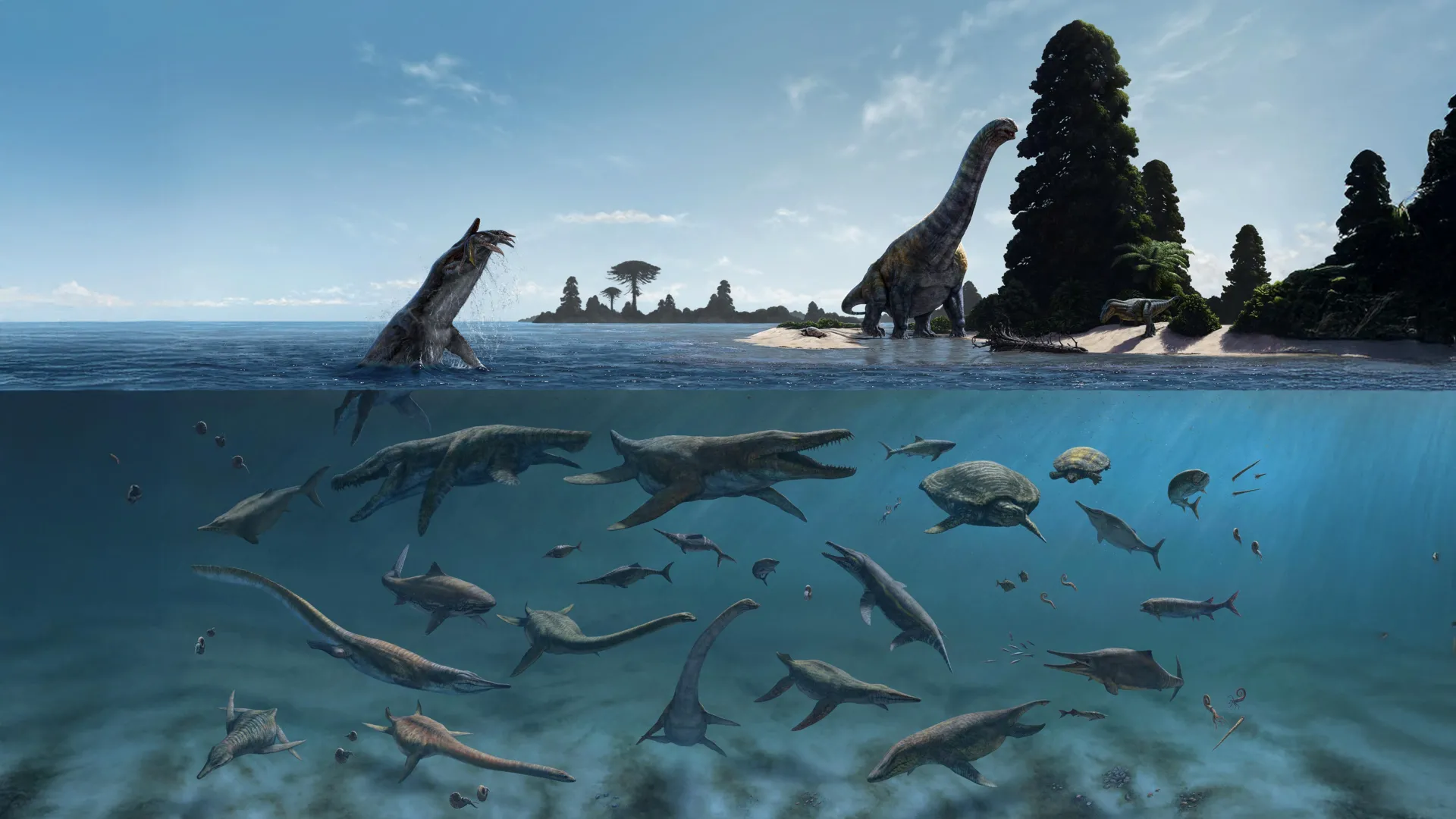
    “This geological formation has produced an exceptionally rich fossil record that includes giant marine reptiles like long-necked plesiosaurs and marine crocodile relatives, as well as turtles, sharks, crustaceans and others,” Cortés explained. “Together, these animals formed the Paja Biota, one of the most ecologically complex marine communities found to date.”

    In a previous study, the researchers reconstructed the feeding relationships among animals in the Paja Biota. Their analysis revealed an exceptionally intricate food web, with an unusually large variety of apex predators occupying the highest levels of the ecosystem.

    This remarkable complexity makes the Paja Formation especially valuable for investigating how ecosystems change as older evolutionary groups decline and new ones become established.

    Could This Discovery Change How Scientists Understand Evolution?

    The proposed Biotic Inflection offers a potentially important new way to understand major changes in Earth’s biodiversity. Rather than being driven by a mass extinction, some evolutionary transitions may involve periods of extraordinary diversity, when declining lineages and emerging groups coexist.

    However, the researchers emphasize that more evidence is needed to establish how common this pattern may have been. Additional fossil discoveries, more accurate estimates of fossil ages, and comparisons with geological formations in other parts of the world will help determine whether similar transitions occurred elsewhere in Earth’s history.

    “I think we’ve discovered a new model of global biodiversity change. Now we’ll need to see just how widespread this could be in Earth’s history and how we can quantify its impacts,” Larsson said.

    The research received funding from the Natural Sciences and Engineering Research Council of Canada, the Smithsonian Tropical Research Institute, the Anders Foundation, the 1923 Fund, Gregory D. and Jennifer Walston Johnson, the Fonds de recherche Nature et technologies Québec, and the McGill Biology Department Writing-Year Award 2024-2025.

    Ancient evolution Full giant ocean predators reveals surprising twist
    NCIJ NETWNCIJ NETWORK
    • Website

    Keep Reading

    Ozone Hole Reaches Its 2026 Maximum

    Scientists wipe out deadly brain tumors in every mouse tested with new cancer therapy

    Print commissioned by Nasa uncovered for Bradford exhibition

    Scientists discover stunning new Amazon fish that may already be endangered

    Hidden climate superpower: Why some ocean “snow” carries six times more carbon

    A little-known protein could be a major culprit in type 2 diabetes

    Add A Comment
    Leave A Reply Cancel Reply

    Editors Picks

    0sec Labs Open-Sources 0, an AI Security Harness With Web UI, CLI and MCP

    November 9, 2026

    An ancient ocean full of giant predators reveals a surprising twist in evolution

    November 9, 2026

    South Korea’s beloved squid may vanish from its waters due to climate change, heat waves

    November 9, 2026

    Lawyers in This State Are Allowed to Ghost Clients for Years. Why Don’t More Judges Stop Them? — ProPublica

    November 9, 2026
    Latest Posts

    Burnham Defies Russian Threats Over British Drone Deliveries to Ukraine

    August 18, 2026

    Nepal’s newest national parks drive tiger recovery, but emerging concerns threaten progress

    August 18, 2026

    Children’s stunted lungs show recovery in ultra low emission zone

    August 19, 2026

    Subscribe to News

    Get the latest sports news from NewsSite about world, sports and politics.

    NCIJ Network is an independent digital news platform delivering trusted investigative journalism, European and global news, in-depth analysis, and fact-based reporting with accuracy, transparency, and integrity.

    Facebook X (Twitter) Instagram Pinterest YouTube

    0sec Labs Open-Sources 0, an AI Security Harness With Web UI, CLI and MCP

    November 9, 2026

    An ancient ocean full of giant predators reveals a surprising twist in evolution

    November 9, 2026

    South Korea’s beloved squid may vanish from its waters due to climate change, heat waves

    November 9, 2026

    Subscribe to Updates

    Get the latest creative news from FooBar about art, design and business.

    Type above and press Enter to search. Press Esc to cancel.