


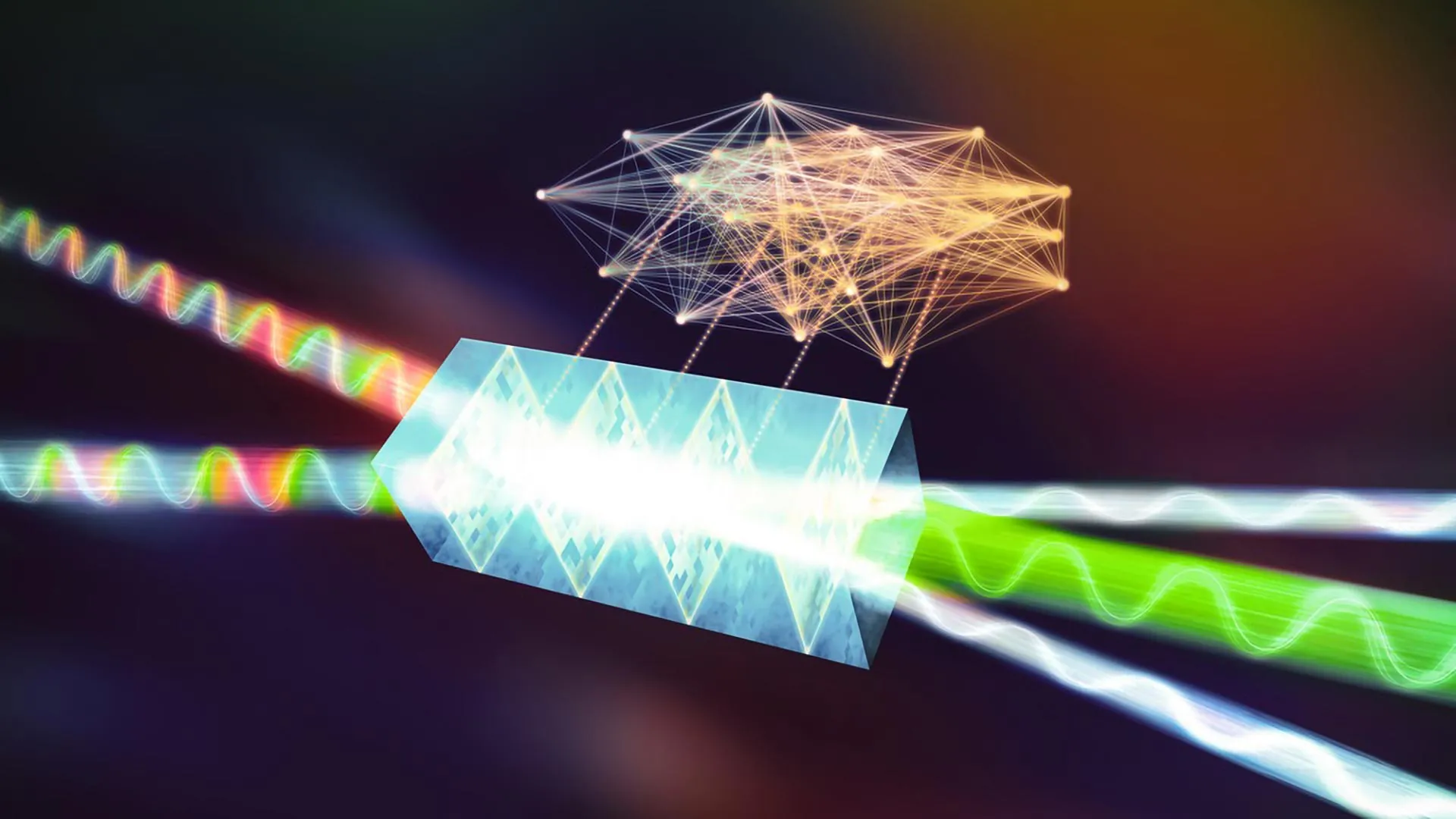
Simulating the complex behavior of light inside powerful laser systems requires enormous computing resources, making it difficult for researchers to predict and adjust laser performance quickly. Now, scientists at Stanford University, the University of California, Los Angeles (UCLA), and SLAC National Accelerator Laboratory have developed an artificial intelligence model that dramatically accelerates these calculations. Using deep learning, the new approach reproduces the results of conventional simulations in a fraction of the time while maintaining high accuracy across a wide variety of laser pulse shapes.
The advance focuses on a branch of physics called second-order nonlinear optics, also known as χ2 processes. These interactions occur when light waves exchange energy while traveling through specially designed crystals, allowing scientists to change the frequency of light and precisely control the shape of laser pulses. Such capabilities are particularly important at large scientific facilities that use lasers to generate intense X-rays.
How Laser Light Helps Generate Powerful X-Rays
At SLAC’s upgraded Linac Coherent Light Source (LCLS-II), laser pulses undergo a series of transformations before they can help produce X-rays. Infrared light is first converted into green light and then into ultraviolet (UV) light. The resulting UV pulse strikes a cathode, releasing a cluster of electrons that is accelerated and manipulated to generate powerful X-ray pulses.
The precise timing and shape of the UV pulse help determine the characteristics of the electron bunch. Those characteristics, in turn, influence the quality of the X-rays that researchers use in scientific experiments. Accurately predicting the conversion of light between different frequencies is therefore an important part of optimizing the system.
The new AI approach, described in the journal Advanced Photonics, was developed specifically to model the nonlinear χ2 interactions involved in this frequency conversion process.
AI Replaces Time-Consuming Laser Calculations
Traditionally, scientists simulate these interactions by solving a complex mathematical equation known as the nonlinear Schrödinger equation. A widely used technique called the split-step Fourier method (SSFM) calculates how light changes as it travels through a material, repeatedly switching between representations of the pulse in time and frequency.
Although the method produces accurate results, it demands substantial computing power. In the complete laser simulation examined by the researchers, this calculation alone accounts for approximately 95 percent of the total processing time.
To overcome that bottleneck, the team developed an AI model based on a type of recurrent neural network called LSTM (long short-term memory). Building on earlier research that used similar networks to predict how laser pulses travel through optical fibers, the scientists adapted the approach to handle more complicated interactions involving multiple light waves.
They tested the model using a process called noncollinear sum frequency generation, or SFG, in which three interconnected light fields evolve together inside a crystal. The simulations covered a wide variety of laser pulse shapes, providing a demanding test of the model’s ability to reproduce complex optical behavior.
One important innovation was the way the AI handles information. Rather than repeatedly converting calculations between time and frequency, as conventional simulations do, the neural network works entirely with a compressed representation of the light’s frequency characteristics. This eliminates much of the repetitive computation that makes traditional methods slow.
Complex Laser Simulations in Just Milliseconds
The results showed that the AI model could accurately recreate how laser pulses change over time and across different frequencies, even under particularly challenging conditions. These included pulses with pronounced gaps in their frequency spectra and strong variations in optical phase.
When the researchers processed multiple simulations together using graphics processing units, the average calculation time for each simulation dropped to just a few milliseconds. That represents an improvement of orders of magnitude over conventional methods, making it possible to obtain predictions far more quickly without substantially compromising accuracy.
The system also demonstrated an important ability to capture the interconnected behavior of the light waves. When the AI accurately predicted the main output of the SFG process, its predictions for the other interacting fields were generally accurate as well. This suggests that the network learned important features of the overall interaction rather than simply reproducing one output.
Toward Smarter Lasers and Real-Time Control
Beyond faster simulations, the researchers envision connecting AI models directly to operating laser systems. Their approach uses a modular design in which individual physical processes can be represented by separate trained neural networks. Combining these models could make it possible to predict the behavior of an entire experimental system while it is running.
One potential application is the creation of digital twins, detailed virtual models that mirror the behavior of real laser equipment. With sufficiently fast and accurate predictions, these systems could help researchers monitor experiments, anticipate changes, and adjust laser settings in response to changing conditions.
The technology could also support adaptive laser control and closer integration with diagnostic instruments that measure the results of experiments. By removing a major computational obstacle, the research brings the possibility of more responsive, precisely controlled laser systems closer to reality, with potential benefits for a wide range of scientific facilities that rely on powerful lasers.
