


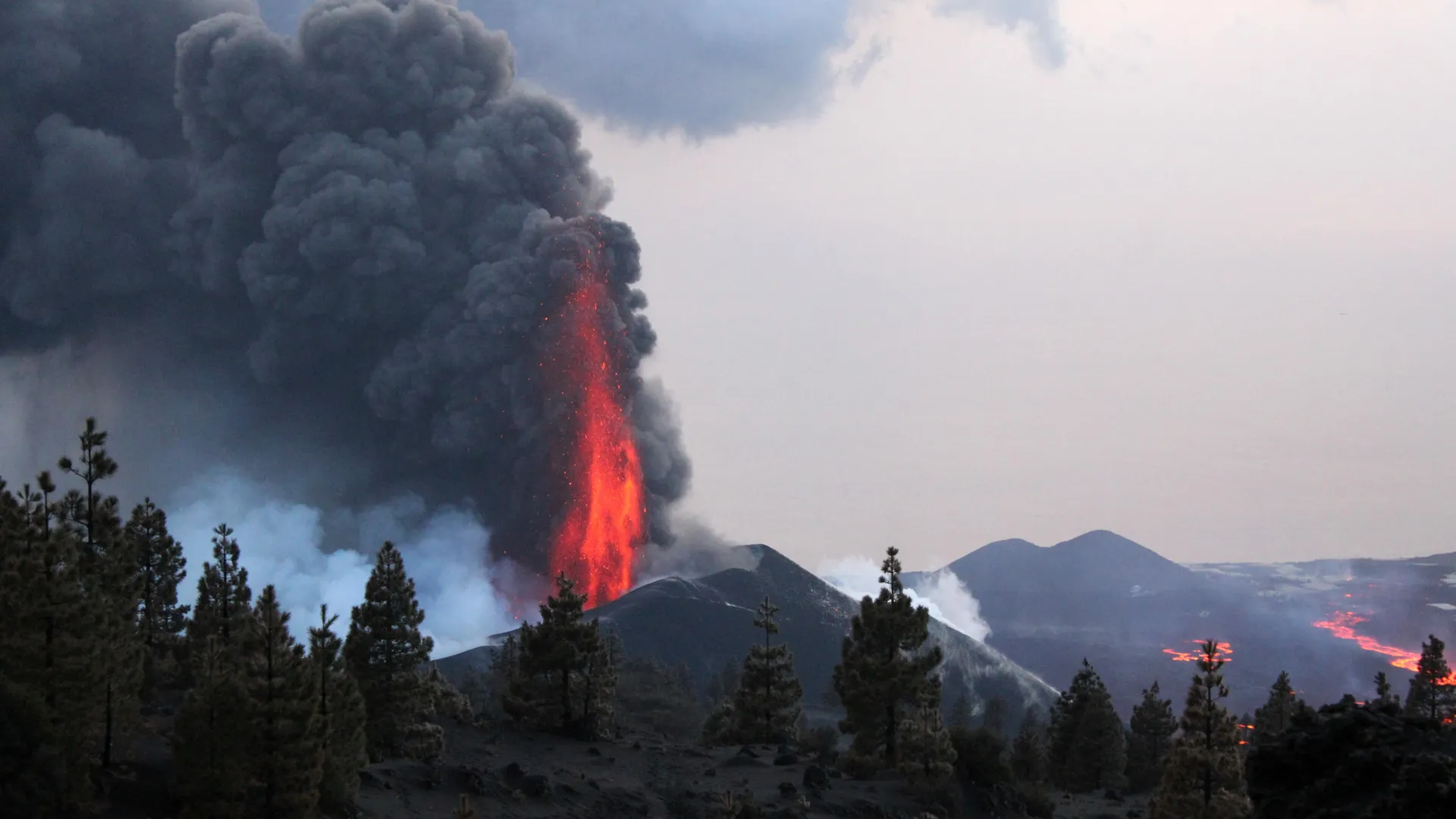
Why do some volcanoes send towering fountains of lava into the sky while others release molten rock in much calmer eruptions? Scientists have discovered that a hidden effect of extreme heat inside magma may help explain these striking differences.
An international research team led by The University of Manchester investigated volcanic material from the 2021 Tajogaite eruption on La Palma, Spain. Their findings reveal that a process known as “superheating” can dramatically slow the formation of crystals inside magma as it travels upward toward Earth’s surface.
Superheating occurs when magma reaches temperatures above those at which its crystals would normally remain stable. The researchers found that this extra heat can keep magma relatively fluid for much longer than expected, potentially allowing it to rise rapidly and produce spectacular lava fountains.
The discovery, published in Nature Communications, offers new insight into a long-standing question in volcanology: How does magma’s temperature history influence the way a volcano erupts?
How Extreme Heat Changes Magma Deep Inside Volcanoes
Magma is a mixture of molten rock, gases, and sometimes solid crystals beneath Earth’s surface. Once it emerges from a volcano, it is called lava. Although temperature and chemical composition are important in determining how magma behaves, the new research suggests that the heating it experienced before an eruption can also make a major difference.
Under normal conditions, crystals begin forming as magma cools. This process often starts around tiny existing crystals that act as “seeds,” providing surfaces on which additional crystals can grow.
Superheating can disrupt this process in two important ways. First, sufficiently high temperatures can dissolve the microscopic crystal seeds that would otherwise encourage new crystals to develop. Second, the heat changes the internal structure of the molten material, making it more uniform and less favorable for new crystal formation.
These changes matter because crystals affect magma’s viscosity, which describes how easily a substance flows. As more crystals develop, magma generally becomes thicker and more resistant to movement. This can influence both its speed of ascent and the way trapped volcanic gases escape.
Lead author Dr. Barbara Bonechi, Research Associate at The University of Manchester, explained:
“The history of crystal and bubble growth can dramatically control how a magma erupts, in particular as more crystals grow, they eventually have a dramatic effect on magma viscosity. Until now, we did not fully understand the dynamics of crystal growth for magmas that received an injection of superheat just before ascent. But using our exciting and newly developed X-ray transparent pressure vessel combined with synchrotron X-ray microtomography, we can actually observe these processes ‘in situ’.”
Scientists Discover an Eight-Hour Delay in Crystal Formation
To investigate what happens inside superheated magma, the researchers recreated volcanic conditions in the laboratory using material collected from the Tajogaite eruption. The magma involved in that eruption may have experienced superheating before reaching the surface and while rising through Earth’s crust.
The team conducted experiments under carefully controlled temperatures and pressures designed to reproduce conditions encountered by magma underground.
At Diamond Light Source, a major scientific research facility, the researchers used synchrotron X-ray microtomography to watch crystals develop in real time. This advanced imaging technique uses extremely powerful X-rays to examine the internal structure of materials in three dimensions without having to cut them open.
A specially developed pressure vessel that allows X-rays to pass through it made these observations possible while the magma was subjected to volcanic conditions.
The team also performed complementary experiments in Prague, where samples could be examined over longer periods outside the real-time imaging setup. Together, these approaches allowed the researchers to observe how different heating conditions affected the timing of crystal formation.
The results revealed a remarkable difference.
Magma that had not undergone superheating began producing crystals after approximately 20 minutes. However, when magma was subjected to strong superheating, the beginning of crystallization was delayed for more than eight hours.
This substantial delay suggests that intense heating can leave magma without newly forming crystals for far longer than scientists might otherwise expect, with potentially important consequences for volcanic eruptions.
Why Superheated Magma Could Produce Towering Lava Fountains
The researchers next explored how these laboratory findings might affect real volcanoes.
They incorporated the measured delays in crystal formation into computer models that simulate how magma rises through Earth’s crust. These models account for changes in magma properties as the molten material moves toward the surface.
The simulations revealed two very different possibilities.
When superheating delays crystallization, magma can remain relatively fluid as it rises. Because it encounters less resistance to flowing, it may travel upward more rapidly, potentially creating conditions that favor dramatic lava fountains.
These spectacular eruptions occur when escaping volcanic gases propel molten rock high above a vent, producing jets and fountains of glowing lava.
In contrast, magma that begins crystallizing earlier becomes more viscous and tends to ascend more slowly. This slower movement gives volcanic gases additional time to escape, favoring gentler eruptions in which lava flows out onto the surface rather than being thrown high into the air.
Such behavior is known as an effusive eruption, a type of volcanic activity characterized primarily by flowing lava.
The findings suggest that even when volcanic systems have similar characteristics, differences in their earlier heating histories may help explain why their eruptions look and behave so differently.
A New Clue for Predicting Volcanic Eruptions
Understanding what happens to magma before it reaches the surface is essential for assessing volcanic hazards. Scientists monitor signals such as earthquakes, ground deformation, and volcanic gas emissions to identify changes within active volcanoes.
However, predicting exactly how an eruption will unfold remains difficult. Two volcanoes with seemingly similar magma compositions and gas conditions can still display markedly different eruptive behavior.
The new research suggests that the effects of superheating and the timing of crystal formation deserve greater attention in volcanic forecasting models.
By accounting for these previously underappreciated processes, researchers may eventually be able to better interpret volcanic monitoring data and assess whether rising magma is more likely to produce vigorous lava fountains or gentler lava flows.
The results do not mean that magma temperature alone determines how explosive an eruption will be. Instead, they identify another important piece of the complex physical processes that shape volcanic activity.
Co-author Dr. Margherita Polacci, Senior Lecturer in Volcanology at The University of Manchester, highlighted the potential importance of the findings for understanding volcanic hazards:
“Current volcanic hazard models typically focus on magma chemistry, gas content and pressure changes. This work suggests that pre-eruptive thermal history and crystallization kinetics may also play an important role in controlling magma ascent and eruptive behavior, with implications for volcanic hazard assessment.”
