


Welcome to Foreign Policy’s China Brief.
The highlights this week: China grapples with a slowly deflating artificial intelligence bubble, officials in Beijing keep their eyes on the U.S. midterms, and China and Pakistan launch an “information corridor” amid anxiety around their Belt and Road Initiative projects.
China’s Slowly Deflating AI Bubble
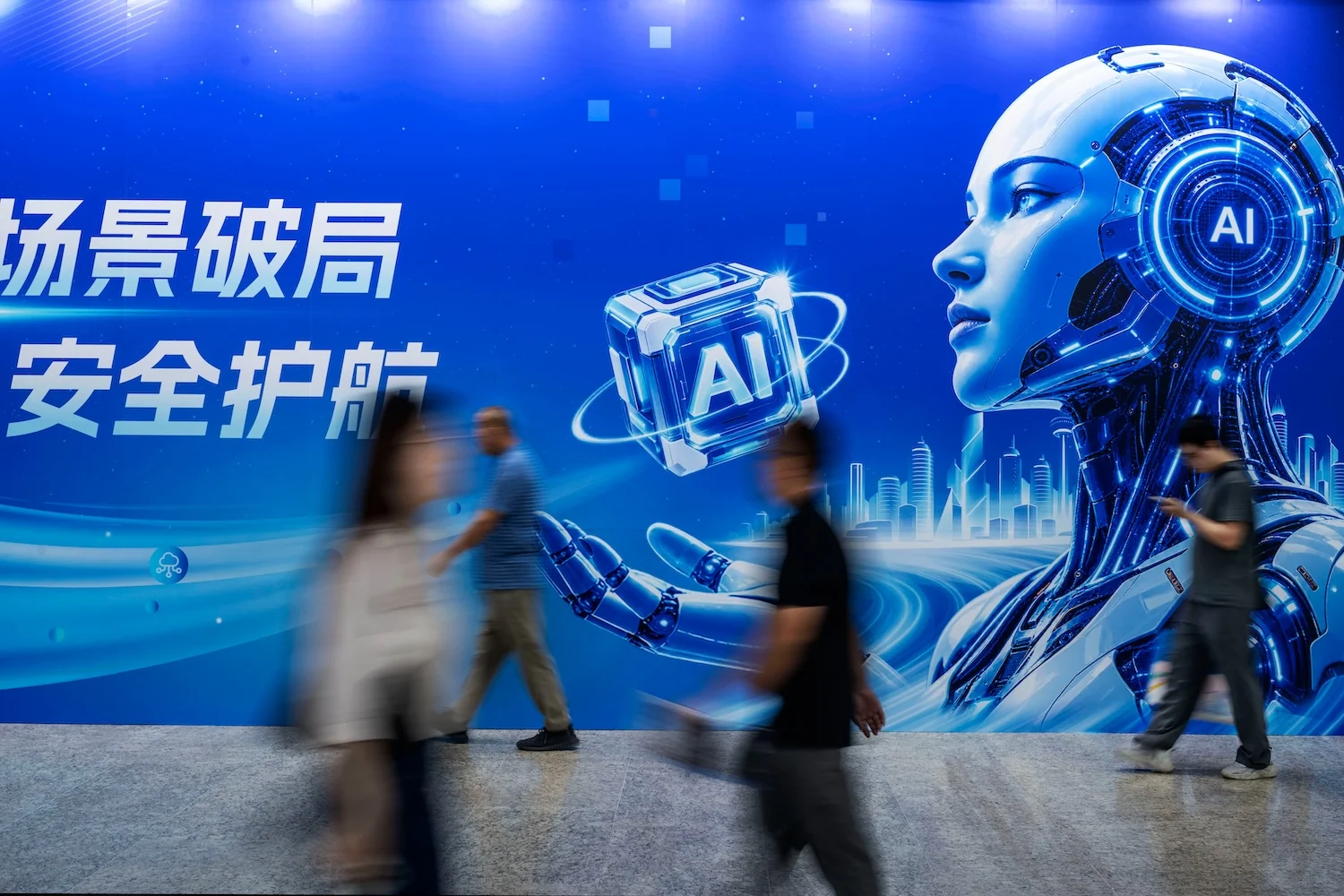
U.S technology stocks are suffering a downturn amid worries about artificial intelligence overvaluation, but China’s AI market bubble has been slowly deflating for months.
The country’s STAR 50 index of science and technology companies is down by more than 40 percent since July, leaving it nearly 200 points below where it was at the start of the year. The overall Shanghai stock exchange has also drifted down this year, but tech companies saw a significant rise until the summer, followed by a larger decline.
It’s hard to pinpoint a clear reason for this drop. My own feeling is that the highest-quality U.S. AI models widened the distance with their Chinese counterparts this year, but that isn’t widely reflected in standard AI performance indexes, where the gap has largely stayed constant, falling somewhere between six to eight months for Chinese models to catch up with their U.S. equivalents.
The increasingly strenuous compute demands of high-end AI are hard on Chinese firms, which possess a fraction of the computing power of their U.S. counterparts. That caused some cutbacks in providing services through the AI agents that are uber-popular in the country, but that was already the case when Chinese AI stocks were still rising in the first part of the year.
My sense is that the stock decline isn’t specific to AI, but reflects a wider downturn in market confidence among the small Chinese investors who make up the majority of the market. That fits with the general doldrums of China’s post-COVID economy; Beijing is struggling to get the wind back in its sails, but the public isn’t willing to play along.
As usual, state-backed investment firms are injecting capital back into the markets under official instructions; this is still unlikely to staunch the bleeding. But the correction isn’t as painful for Chinese AI firms as for their U.S. equivalents.
The stock market is much less central to the Chinese economy, accounting for just 5 percent-6 percent of household investments. And Chinese AI firms have less private investment than their U.S. counterparts; the real backing likely comes from opaque government funding, especially since DeepSeek’s ferocious takeoff in early 2025.
Still, while U.S. President Donald Trump’s White House froths about so-called superintelligence, the Chinese government is more skeptical—especially about AI’s impact on labor. Recent official comments confirm that Beijing wants more balanced investment. AI firms may find it hard to get traction with the Chinese leadership if they’re not delivering for the whole economy.
Conveniently, one of the best tests of Chinese economic sentiment is upon us. Nov. 11, or “Double 11” day, usually sees large e-commerce discounts and a bonanza of spending. It once concentrated on the day itself but now spreads across a few weeks. Battered consumer confidence may produce worse sales numbers than normal.
Online spending on goods is up by 4.3 percent so far this year—respectable, but a far cry from the double-digit growth of the pre-COVID years. A weaker spending season points to another quest for any way to get the economic engine revving again in 2027.
What We’re Following
Beijing’s U.S. midterms reaction. With a Democratic Party comeback likely in the U.S. midterms on Tuesday, China could welcome a weakened Trump—set to be more concerned with maintaining his slipping grip on power than in starting new trouble abroad. Trump has been meek toward China since it turned off the flow of critical minerals, scoring a victory in their trade war.
Meanwhile, Chinese state media coverage of the U.S. elections has hit the usual notes used to try to discredit foreign democracies, emphasizing that financial influence and corrupt interests supposedly dominate voting.
China has benefited from the fracturing of U.S. politics in a number of ways. Chief among them is that counterintelligence work has fallen apart thanks to the politicizing of U.S. agencies and the reluctance to share information. But there is some caution that Democrats might return focus to human rights issues ignored by Trump—and subsequent investigations into China.
China-Pakistan corridor doubts. There is some anxiety around the future of the China-Pakistan Economic Corridor (CPEC), the most vaunted part of the Belt and Road Initiative. Last week, the two countries launched a “China-Pakistan Information Corridor” to rebuke criticism—but there is clearly doubt on the Chinese side.
Only about half the promised funding for CPEC has ever materialized, and Beijing refused to cough up for a major railway upgrade, leaving the U.S.-backed Asian Development Bank to step in. Attacks by Baloch separatist militants along the corridor have intensified in recent months; China has offered to provide further security, but Pakistan seems cautious.
Threats to Chinese nationals in Pakistan have risen, making firms reluctant to send personnel. Chinese scholars have told me that kidnappings for ransom in the country have gone unreported after the Chinese companies involved paid up.
FP’s Most Read This Week
Tech and Business
Moon landing plans. China’s ambitious space plans now officially include a crewed moon landing before 2030. That has been in the cards for a while and will be an occasion of genuine patriotic joy when it happens. Chinese science fiction has imagined a place among the stars for the nation for more than a century.
I don’t think a moon landing will reignite a space race with the United States, though. After all, nearly 60 years have passed since the United States made it to the moon; crewed rockets are mostly a PR stunt given how much more robotic probes can do for actual science.
The real Sputnik moment will come when China manages something that the United States hasn’t achieved, such as the not-so-distant prospect of a manned Mars mission in the 2030s.
Nvidia’s Chinese links. U.S. intelligence last year exposed a woman with a “close relationship” with Jensen Huang, the CEO of Nvidia and a Trump tech ally, as an alleged Chinese asset—to no avail. The White House refused to act on the news or to create any firewalls to limit Huang’s considerable access within the administration.
China hawks inside the U.S defense world have expressed concern about Huang’s influence for some time, largely because Nvidia’s interests and U.S. interests do not correlate. Huang advocates selling advanced chips to China and was able to persuade Trump to allow some such exports in return for the White House getting a 25 percent cut.
Nvidia may be trying to reduce the impact of the spy plot story by imposing new restrictions on its data center partners, which can now only let Chinese firms make up a minority of their sales.
