

Close Menu
NCIJ Network NCIJ Network
    What's Hot

    Did Trump not renew Biden-era funding for air traffic control upgrades?

    November 29, 2026

    Swinney insists Scotland’s NHS is safe despite hospital scandal

    November 28, 2026

    Climate change campaigner confronts company in documentary

    November 28, 2026
    Facebook X (Twitter) Instagram
    Trending
    • Did Trump not renew Biden-era funding for air traffic control upgrades?
    • Swinney insists Scotland’s NHS is safe despite hospital scandal
    • Climate change campaigner confronts company in documentary
    • Albania’s Independence Day rocked by violent protests over corruption – POLITICO
    • Burnham’s No 10 influencer row shows reach matters – but so does scrutiny
    • Kinahan Cartel-Linked Pilot Flew Cocaine From South America to Australia in Hobby Plane, Police Say 
    • Greek junior minister resigns amid public contracts controversy – POLITICO
    • Spanish election: Leaders clash in final debate as housing dominates run-in
    • About
      • Our Team
      • Editorial Policy
      • Editorial Independence
      • International Support
    • Trust & Standards
      • AI Usage Policy
      • Conflict of Interest Policy
      • Corrections Policy
      • Ethics Policy
      • Fact-Checking Policy
      • Source Protection
    • Get Involved
      • Guide for Sources
      • Support Independent Journalism
    • Legal
      • Cookie Policy
      • Privacy Policy
      • Terms of Use
    Facebook X (Twitter) Instagram
    NCIJ Network NCIJ Network
    Sunday, November 29
    • Home
    • World
    • Ai
    • Business
    • Politics
    • Health
    • Crypto
    • Science
    • Technology
    • Cybersecurity
    • Defense & Security
    • Economy
    • Energy
    • Europe
    • More
      • Fact Check
      • Investigations
      • Opinion & Analysis
      • Environment
    NCIJ Network NCIJ Network
    Home»Environment

    Aerial photos show recovery of Florida Bay, US, as restoration sends Everglades water

    NCIJ NETWNCIJ NETWORKBy NCIJ NETWNCIJ NETWORKNovember 27, 2026 Environment No Comments7 Mins Read
    Share
    Facebook Twitter LinkedIn Pinterest Email

    • Freshwater flows into Florida Bay, significantly reduced by decades of Everglades drainage, are slowly increasing under the Comprehensive Everglades Restoration Plan.
    • Helicopter surveys by avian ecologist Mark Ian Cook document returning wading birds, wintering waterfowl, American flamingos and threatened American crocodiles.
    • Wading bird nesting reached a record high in 2018 but has since declined, while a severe 2025–2026 drought underscored the birds’ sensitivity to water fluctuations.

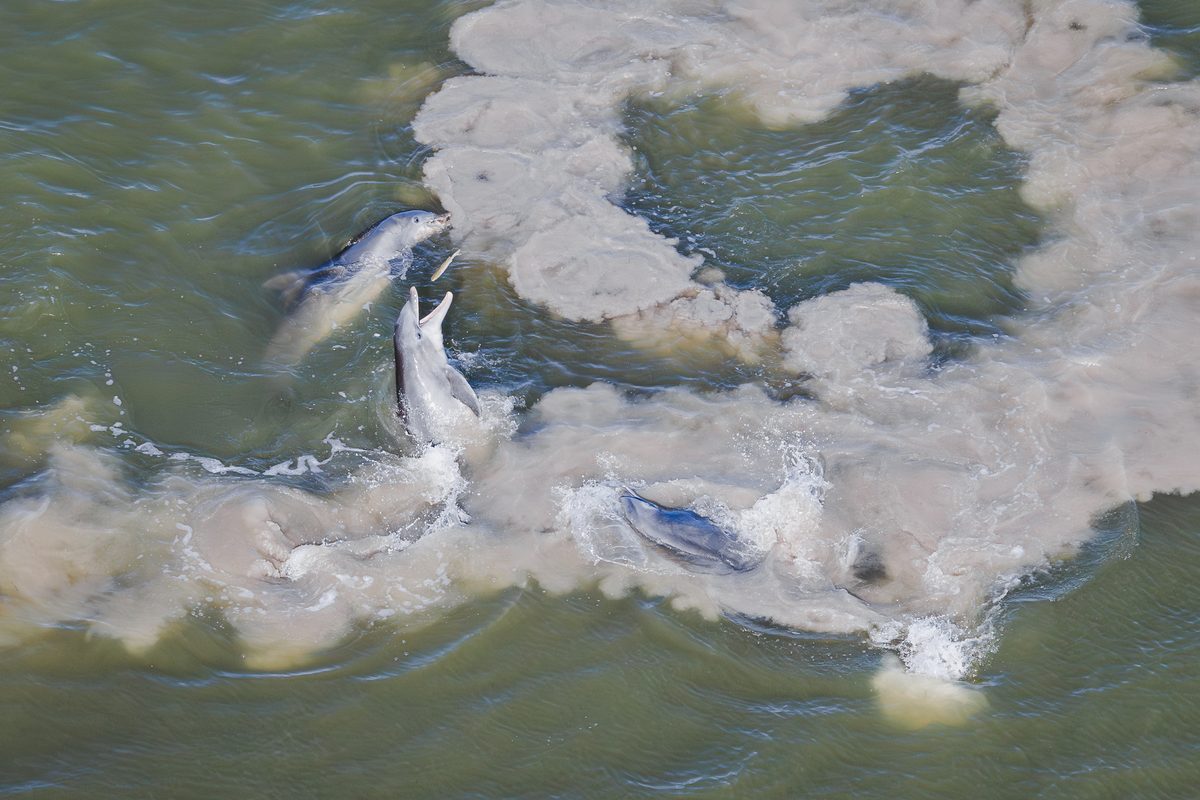
    From a low-flying helicopter above the coastal Everglades in southern Florida, U.S., Mark Ian Cook looks down at dense mangrove forests and silty shallows rarely seen by others. Below him, bottlenose dolphins trap mullet in rings of mud, nurse sharks mate in sheltered waters and flamingos forage on remote mudflats.

    Mating Nurse Sharks. Two nurse sharks (Ginglymostoma cirratum) mate off Shark Point in Everglades National Park. Unlike bony fish, sharks must make physical contact to reproduce: The male grips the female’s pectoral fin in his mouth to hold position. Image by Mark Ian Cook.

    Cook, an avian ecologist who heads the South Florida Water Management District’s Everglades Research Group, tracks how wading birds respond to the Comprehensive Everglades Restoration Plan (CERP), a decades-long federal-state effort to return freshwater to the southern Everglades and Florida Bay. He conducts a flying survey about every two weeks during the birds’ breeding season, photographing nesting colonies through a small flap in the helicopter door.

    Some colonies hold tens of thousands of nests, too many to count by eye, so photos are the most reliable way to tally them, he told Mongabay in a video call. His best frames also help persuade water managers. “My information was so much more effective when I had an image rather than just data or a boring old graph with counts on it,” he said.

    Cook said he has two advantages when capturing his images: an ecologist’s sense of where and when to find unusual animal behavior and wildlife events, and regular flights over thousands of square miles of remote subtropical wilderness.

    One American avocet (Recurvirostra americana) breaks formation. Resting shorebirds usually face into the wind to cut drag, keep their feathers smooth, save energy and take off quickly if threatened. Image by Mark Ian Cook.
    The Nonconformist. One American avocet (Recurvirostra americana) breaks formation. Resting shorebirds usually face into the wind to cut drag, keep their feathers smooth, save energy and take off quickly if threatened. Image by Mark Ian Cook.
    Pyramid of Scaup. Part of a massive flock of lesser scaup (Aythya affinis) briefly forms a pyramid on a mangrove-lined coastal lake in Everglades National Park. Image by Mark Ian Cook.
    Pyramid of Scaup. Part of a massive flock of lesser scaup (Aythya affinis) briefly forms a pyramid on a mangrove-lined coastal lake in Everglades National Park. Image by Mark Ian Cook.

    His photos play with shape, color and texture, like a flock of lesser scaup (Aythya affinis) that briefly formed a pyramid on a coastal lake after returning in large numbers. Striking images hold a viewer’s attention longer, he said, and “while they’re trying to figure out what they’re looking at, they are more likely to soak in my conservation message.” In those moments, Cook sees nature as the artist and his job as “simply to recognize the art and frame it appropriately.”

    Wading birds such as storks, ibises, spoonbills and herons respond quickly to water levels, making them good indicators of restoration. Historically, summer rains caused Lake Okeechobee, approximately 182 kilometers (113 miles) away, to overflow, sending a shallow, slow-moving sheet of water south across the Everglades — the so-called River of Grass — to Florida Bay. Here it mixed with seawater to create the brackish conditions the estuary’s fish, crocodiles and birds depend on.

    Roseate spoonbills (Platalea ajaja) fly over a lemon shark (Negaprion brevirostris) hunting mullet. Spoonbills feed by touch, sweeping their bills through shallow water to catch fish. Florida Bay was once the species’ main U.S. nesting ground, but rising seas are making mangrove pools too deep for feeding. Image by Mark Ian Cook.
    Birds’ Eye View of the Hunt. Roseate spoonbills (Platalea ajaja) fly over a lemon shark (Negaprion brevirostris) hunting mullet. Spoonbills feed by touch, sweeping their bills through shallow water to catch fish. Florida Bay was once the species’ main U.S. nesting ground, but rising seas are making mangrove pools too deep for feeding. Image by Mark Ian Cook.
    March of the Flamingos. Once hunted out of Florida for food and feathers, American flamingos (Phoenicopterus ruber) are slowly returning to the coastal Everglades. The birds feed head-down, filtering tiny crustaceans, insect larvae, algae and plankton from the shallows with their bills. Image by Mark Ian Cook.
    March of the Flamingos. Once hunted out of Florida for food and feathers, American flamingos (Phoenicopterus ruber) are slowly returning to the coastal Everglades. The birds feed head-down, filtering tiny crustaceans, insect larvae, algae and plankton from the shallows with their bills. Image by Mark Ian Cook.

    In the 1930s and early 1940s, the region supported more than 200,000 nests, most along the coast, Cook said. Canals, levees and roads then significantly reduced the freshwater reaching Florida Bay and coastal nesting collapsed.

    “When inches of water can make a huge difference in such a flat landscape, that just really affected everything,” Cook said.

    Reversing that damage is CERP’s main objective. Authorized by the U.S. Congress in 2000, it is the largest environmental restoration program in the South Florida region, addressing the quantity, quality, timing and distribution of water, with healthy wading bird populations a central goal. The most recent report to Congress projects it will take about 50 years at a cost of $26.9 billion in 2023 dollars, equivalent to roughly $29.8 billion in 2026.

    When Hurricane Irma dumped heavy rain across South Florida in 2017, enough freshwater flowed through the Everglades to reach the coast. South Florida recorded 138,834 wading bird nests in 2018, the most since system-wide surveys began in 1995 according to the South Florida Wading Bird Report, which Cook edits. Nests topped 100,000 again in 2021.

    “The response was just amazing,” Cook said. “The wading birds came back in really high numbers.”

    Crocodile Mudflats American crocodiles (Crocodylus acutus) bask on the mudflats of Garfield Bight in Florida Bay. Young crocodiles can’t survive long in salty water until they develop salt glands as adults, making restored freshwater flows key to this federally threatened species’ recovery. Image by Mark Ian Cook.
    Crocodile Mudflats. American crocodiles (Crocodylus acutus) bask on the mudflats of Garfield Bight in Florida Bay. Young crocodiles can’t survive long in salty water until they develop salt glands as adults, making restored freshwater flows key to this federally threatened species’ recovery. Image by Mark Ian Cook.
    Pelican Flats. Wintering American white pelicans (Pelecanus erythrorhynchos) rest on the mudflats of Snake Bight, tinted blue by algae and bacteria. Unlike brown pelicans, they don’t dive for food; they herd fish cooperatively and scoop them from the surface. Image by Mark Ian Cook.
    Pelican Flats. Wintering American white pelicans (Pelecanus erythrorhynchos) rest on the mudflats of Snake Bight, tinted blue by algae and bacteria. Unlike brown pelicans, they don’t dive for food; they herd fish cooperatively and scoop them from the surface. Image by Mark Ian Cook.

    Other species are rebounding too. American crocodile (Crocodylus acutus) populations are increasing, as are waterfowl numbers. In 2024, tens of thousands of waterfowl, including blue-winged teal (Spatula discors) and lesser scaup, returned to the area’s coastal lakes in concentrations not seen in roughly 80 years. American flamingos, hunted out of Florida more than a century ago, are back as wintering birds. They haven’t nested yet, but “even if they don’t nest, that doesn’t mean that they’re not native,” Cook said.

    But progress has been uneven. After exceptional nesting seasons in 2018 and 2021, wading bird nesting has declined for several consecutive years. In 2025, drought contributed to the lowest nesting levels recorded in roughly 30 years in Everglades National Park, according to a recent wading bird report. Rising seas have also cut Florida Bay’s roseate spoonbill (Platalea ajaja) nests from about 400 in 2012 to 157 in 2022, even as the birds have established new nesting colonies farther north in Florida.

    Dabbling Impressionism. Freshwater from the Everglades, stained the color of tea by tannins from decaying mangrove leaves, flows past wintering blue-winged teal (Spatula discors) feeding on algae and microorganisms in Florida Bay. Image by Mark Ian Cook.
    Dabbling Impressionism. Freshwater from the Everglades, stained the color of tea by tannins from decaying mangrove leaves, flows past wintering blue-winged teal (Spatula discors) feeding on algae and microorganisms in Florida Bay. Image by Mark Ian Cook.
    Waterbirds & Bubblegum Wetlands. Reddish egrets (Egretta rufescens), black-necked stilts (Himantopus mexicanus) and dabbling ducks feed in a wetland on Florida Bay’s northern shore, tinted pink by purple sulfur bacteria that bloomed after a hurricane killed the mangroves and let in sunlight. Image by Mark Ian Cook.
    Waterbirds & Bubblegum Wetlands. Reddish egrets (Egretta rufescens), black-necked stilts (Himantopus mexicanus) and dabbling ducks feed in a wetland on Florida Bay’s northern shore, tinted pink by purple sulfur bacteria that bloomed after a hurricane killed the mangroves and let in sunlight. Image by Mark Ian Cook.

    Storage remains a bottleneck: Without room to hold Lake Okeechobee’s excess water, managers release much of it to nearby coastal estuaries. The Everglades Agricultural Area Reservoir, built to store that water and send it south, is due to be completed in 2029.

    Even so, new bridges along the Tamiami Trail, a highway and levee system that for decades blocked water from flowing south into Everglades National Park, are making a difference. About 10 times more water flowed beneath the road from January through July 2026 than in the same months of 2015, despite a harsher drought, according to the Everglades Foundation. That water moves through the park toward the coast, helping keep Florida Bay’s salinity low enough to avoid a repeat of the 2015 seagrass die-off.

    “I like wet years, because that’s when we have very productive wildlife years,” Cook said.

    More of Cook’s photography can be found via his Facebook page.

    Banner Image: The Corral. In a cooperative hunt rarely seen outside Florida Bay, a bottlenose dolphin (Tursiops truncatus) kicks up a ring of mud around a school of mullet. Fish that leap the silty barrier are snatched midair by podmates, which take turns in the prime catching position. Image by Mark Ian Cook.

    aerial Bay Everglades Florida photos recovery Restoration Sends show water
    NCIJ NETWNCIJ NETWORK
    • Website

    Keep Reading

    Climate change campaigner confronts company in documentary

    The Climate Hero Hiding Beneath the Ocean’s Surface

    Some Hawaiian Birds Face Extinction as Mosquitoes Spread Avian Malaria to Higher Forests

    Will my glacier go extinct? Interview with Lander Van Tricht

    Sri Lanka deploys ‘elephant army’ to protect rare tuskers, but experts urge caution

    Whales return to Patagonia, but face new threats in Argentina

    Add A Comment
    Leave A Reply Cancel Reply

    Editors Picks

    Did Trump not renew Biden-era funding for air traffic control upgrades?

    November 29, 2026

    Swinney insists Scotland’s NHS is safe despite hospital scandal

    November 28, 2026

    Climate change campaigner confronts company in documentary

    November 28, 2026

    Albania’s Independence Day rocked by violent protests over corruption – POLITICO

    November 28, 2026
    Latest Posts

    Can Burnham justify giving the go ahead to oil drilling? Yes, but these must be the conditions | Michael Jacobs

    August 24, 2026

    MODEC’s FPSO reaches Guyana as ExxonMobil’s fifth oil project nears start-up

    August 24, 2026

    The Trump Administration Has Spent Billions Boosting Gas Exports, Spurring More Fracking

    August 24, 2026

    Subscribe to News

    Get the latest sports news from NewsSite about world, sports and politics.

    NCIJ Network is an independent digital news platform delivering trusted investigative journalism, European and global news, in-depth analysis, and fact-based reporting with accuracy, transparency, and integrity.

    Facebook X (Twitter) Instagram Pinterest YouTube

    Did Trump not renew Biden-era funding for air traffic control upgrades?

    November 29, 2026

    Swinney insists Scotland’s NHS is safe despite hospital scandal

    November 28, 2026

    Climate change campaigner confronts company in documentary

    November 28, 2026

    Subscribe to Updates

    Get the latest creative news from FooBar about art, design and business.

    Type above and press Enter to search. Press Esc to cancel.