


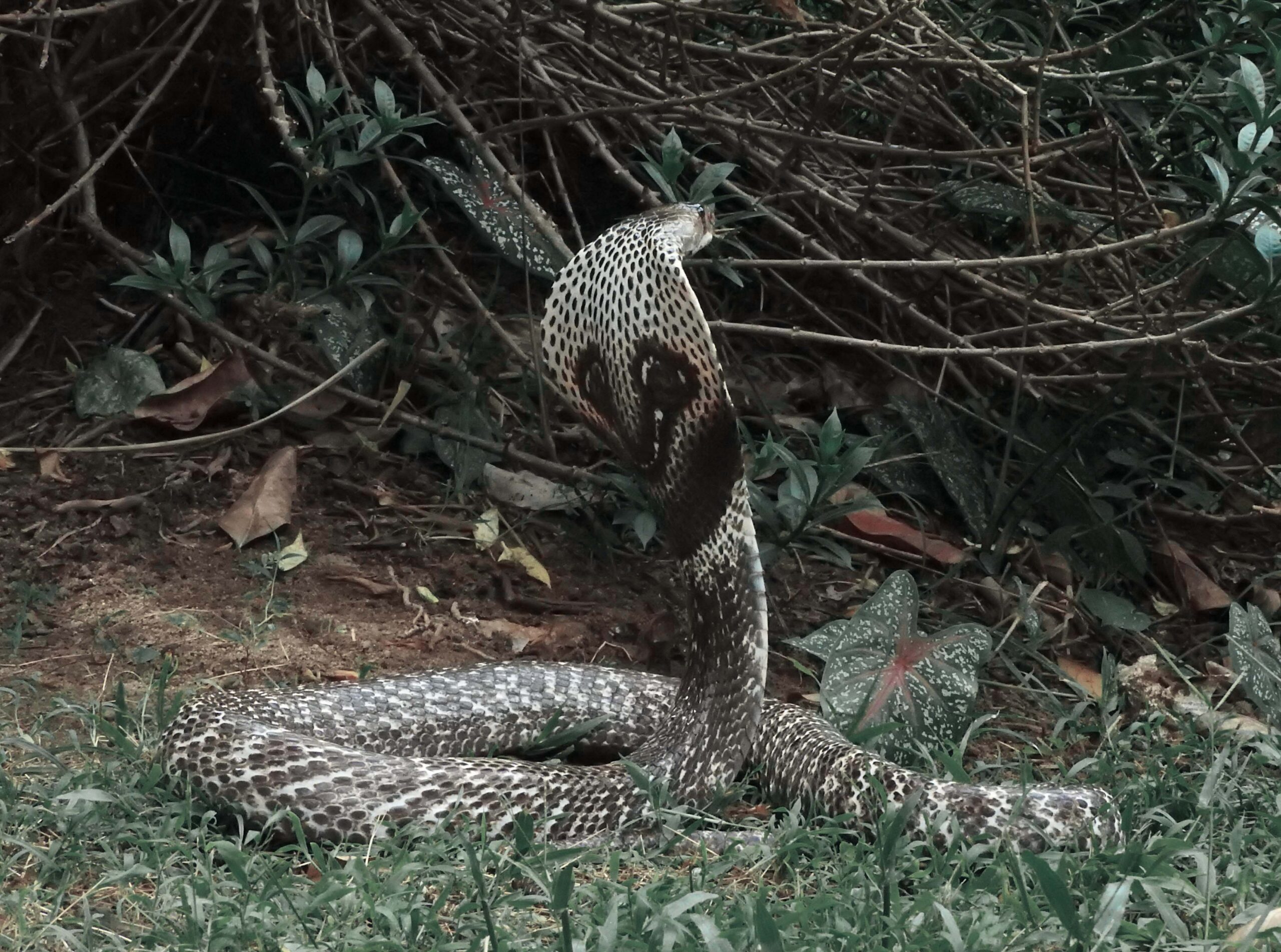
- A new study estimates that Sri Lankan and the Indian subcontinent cobra lineages diverged around two million years ago, evolving from an African ancestor and potentially linked to past sea-level changes separating the island from India.
- In 1939, Sri Lankan zoologist P. E. P. Deraniyagala first recognized an unusual Sri Lankan cobra form and named it Naja naja polyocellata where it was later synonymized and resurrected as a species in 2022 only to be challenged in 2023.
- The latest findings confirm the genetic distinctiveness of Sri Lankan cobra but does not formally establish them as a separate species, leaving taxonomists to determine whether the lineage warrants species-level recognition.
- Beyond science, the cobra is deeply woven into Sri Lanka’s history, folklore and traditions, making its identity a part of the island’s natural and cultural heritage.
COLOMBO – Sri Lanka’s spectacled cobra (Naja naja) carries a two-million-year-old genetic mystery, and a new study finds that the island’s cobras form a genetically distinct lineage, reopening a taxonomic question raised by a Sri Lankan zoologist nearly nine decades ago.
The study also established that the spectacled cobra has evolved from an African ancestor that reached the region via the Middle East.
The story dates back to 1939, when Sri Lankan zoologist P. E. P. Deraniyagala described a distinctive form of the spectacled cobra with additional eye-like markings on its hood. He named it Naia naia colour var. polyocellata. At the time, it was treated as a color morph of the Indian spectacled cobra than a distinct subspecies native to Sri Lanka.
Deraniyagala returned to cobra taxonomy in 1945, proposing several geographical races of the spectacled cobra across the Indian subcontinent, and in 1960, revisited cobra taxonomy. Subsequent morphological work, however, consolidated these geographical forms under Naja naja.
Then, in 2022, the question was reopened. A genetic study proposed resurrecting Deraniyagala’s polyocellata as a separate species as Naja polyocellata, after finding substantial genetic differences between Sri Lankan cobras and the Indian mainland cobras.
However, that proposal was challenged the following year. In 2023, herpetologists Wolfgang Wüster of Bangor University, U.K., and Frank Tillack of Museum für Naturkunde, Germany, argued that the evidence for a species-level split was insufficient, as the sampling was limited to peninsular India, and the study relied heavily on mitochondrial DNA. They also uncovered that two historical cobra specimens preserved in the Museum für Naturkunde in Berlin were rediscovered and verified by researchers to have originated from Sri Lanka. One was designated the lectotype – specimen chosen to be the official standard example for a species – restricting the type locality of Naja naja to Sri Lanka and making polyocellata a junior synonym of Naja naja.
The new study has brought the question back into the spotlight and provides the most geographically comprehensive genetic assessment yet of the spectacled cobra. “Rather than simply comparing a handful of Sri Lankan and mainland snakes, we examined 67 individuals and used nine mitochondrial and nuclear genetic markers to investigate the evolutionary history of the species,” noted Kartik Sunagar, an evolutionary biologist at the Centre for Ecological Sciences, Indian Institute of Science.

“The result of our study is significant as Sri Lanka’s spectacled cobras form a genetically distinct lineage and is geographically isolated from Indian mainland populations. But we haven’t hurried to identify the Sri Lankan cobra as a separate species, as such needs a different scientific approach and more studies,” Sunagar told Mongabay.
A cobra divided by the sea
The spectacled cobra, Naja naja, is widely distributed across the Indian subcontinent, occurring in India, Pakistan, Bangladesh, Nepal, Bhutan and Sri Lanka. Despite India’s vast size, the study found little genetic difference between cobras from different parts of India, Sunagar said.
Sri Lanka was different. The Indian Ocean island’s cobras formed a distinct genetic group, suggesting they have followed a separate evolutionary path from Indian cobras for a long time. The researchers estimate that the two groups may have separated around two million years ago, during the late Pliocene or early Pleistocene. They suggest changes in sea levels may have helped drive this separation.
When sea levels were lower, India and Sri Lanka were connected by land, allowing animals to move between the two landmasses. When sea levels rose, the connection disappeared, leaving populations isolated. The researchers say this history could help explain the genetic differences seen today, although it has not been proven as the direct cause.
From Africa to South Asia
The study also leaned heavily into history. Using phylogenetic and ancestral-area analyses, the researchers found evidence supporting an African origin for the genus Naja, followed by the dispersal of Naja naja into South Asia during the Miocene period.

The cobras belonging to the genus Naja had even dispersed into Europe as well. Sunagar told Mongabay that fossil evidence showed that members of the genus Naja lived across parts of Europe during the Miocene and Pliocene periods, when the continent was much warmer than today.
One extinct species, Naja romani or the European cobra, was widespread across Central Europe, while Naja iberica also known as the Spanish cobra, appears to have belonged to a distinctive Iberian lineage found in modern day Spain. Fossils show that cobras survived in parts of Europe until the Pliocene period but eventually disappeared as the climate became cooler.
And the spectacled cobra’s taxonomic saga is not over yet. Sunagar and other researchers also identified the venom composition of the spectacled cobra to be different from region to region in India.
A similar study carried out in Sri Lanka has specified that Sri Lankan cobras from different regions may have slightly different effects in their venom. Researchers tested venom of cobras from five regions of North, Central, Western, Southern and Sabaragamuwa provinces on mice and found differences in how the venom affected their organs and muscles.
Northern cobra venom caused more muscle damage and inflammation, while Central-region venom showed stronger effects on the heart, said Duminda Dissanayake, an adjunct professional associate at the University of Canberra. Dissanayake told Mongabay that the Sri Lankan cobra venom was found to be more toxic than Indian cobra venom in LD50 tests, a lethal dose test that measures the quantity of venom required to kill half of the test animals.

A new book on cobras
Meanwhile, a new book examining Sri Lanka’s centuries-old relationship with the cobra was released at the recent World Congress on Snakes 2026, held in Kandy, Sri Lanka. The book authored by congress secretary general Nimal Rathnayake is titled “The Cobra: The Hooded Icon of Sri Lanka” and explores how the island’s most feared venomous snake also became a powerful symbol of religious traditions, folklore, art and the collective imagination.
Launched at a gathering of researchers and snake enthusiasts, the book brings together archaeological and historical evidence, folklore, museum collections and public accounts to trace the cobra’s influence from ancient times to the present.
“The cobra is a fascinating creature treated as a guardian and symbol of prosperity and fertility as well as representations of immortality, and evil; highlighting how deeply the cobra is woven into Sri Lanka’s cultural heritage,” Rathnayake told Mongabay.
Banner Image: Indian cobra (Naja naja) is the third largest and the largest venomous snake found in Sri Lanka, which can grow 100-180 cm (3-5 feet). Image courtesy of Bhasuru Prabashwara.
Citations:
Kanunjna, P. D., Gond, P. G., Unawane, A., … Sunagar, K. (2026). Spectacular Saga: Phylogenetics and phylogeography of the Indian spectacled cobra (Naja naja Linnaeus, 1758). Molecular Phylogenetics and Evolution, 223, 108654. doi: 10.1016/j.ympev.2026.108654
Shi, S.-C., Vogel, G., Ding, L., Rao, D.-Q., Liu, S., Zhang, L., Wu, Z.-J. … Chen, Z.-N. (2022). Description of a New Cobra (Naja Laurenti, 1768; Squamata, Elapidae) from China with Designation of a Neotype for Naja atra. Animals, 12(24), 3481. doi: 10.3390/ani12243481
Wüster, W. and Tillack, F. (2023). On the importance of types and the perils of “en passant” taxonomy: a brief history of the typification of Coluber naja Linnaeus, 1758 (Serpentes: Elapidae) and its implications, with the designation of a lectotype. Zootaxa, 5346(4), 403–419. doi:10.11646/zootaxa.5346.4.3
Dissanayake, D.S.B., Thewarage, L.D., Waduge, R.N., Ranasinghe, J.G.S., Kularatne, S.A.M. … Rajapakse, R.P.V.J. (2018). The Venom of Spectacled Cobra (Elapidae: Naja naja): In Vitro Study from Distinct Geographical Origins in Sri Lanka. Journal of Toxicology, 2018(1), 7358472. doi:10.1155/2018/7358472

