

Close Menu
NCIJ Network NCIJ Network
    What's Hot

    Critical x402 SDK Flaw Could Let Malicious APIs Drain AI Agents’ Token Balances

    October 25, 2026

    Does video show Trump waving at, saluting nobody before boarding Marine One?

    October 25, 2026

    Researchers Demonstrate Node2Shell RCE Exploit on Node.js Build Using Crafted Brotli Data

    October 25, 2026
    Facebook X (Twitter) Instagram
    Trending
    • Critical x402 SDK Flaw Could Let Malicious APIs Drain AI Agents’ Token Balances
    • Does video show Trump waving at, saluting nobody before boarding Marine One?
    • Researchers Demonstrate Node2Shell RCE Exploit on Node.js Build Using Crafted Brotli Data
    • Andy Burnham says he wants ‘honest discussion’ about freedom of movement with EU | Andy Burnham
    • This 150-million-year-old bird had dinosaur teeth and a strange secret
    • Protests sweep across Europe from France to Albania, Italy, Spain and Portugal.
    • Healey’s first budget to include big devolution package to boost growth | Budget 2026
    • Abercynon woman, 93, waits 10 hours on floor for an ambulance
    • About
      • Our Team
      • Editorial Policy
      • Editorial Independence
      • International Support
    • Trust & Standards
      • AI Usage Policy
      • Conflict of Interest Policy
      • Corrections Policy
      • Ethics Policy
      • Fact-Checking Policy
      • Source Protection
    • Get Involved
      • Guide for Sources
      • Support Independent Journalism
    • Legal
      • Cookie Policy
      • Privacy Policy
      • Terms of Use
    Facebook X (Twitter) Instagram
    NCIJ Network NCIJ Network
    Sunday, October 25
    • Home
    • World
    • Ai
    • Business
    • Politics
    • Health
    • Crypto
    • Science
    • Technology
    • Cybersecurity
    • Defense & Security
    • Economy
    • Energy
    • Europe
    • More
      • Fact Check
      • Investigations
      • Opinion & Analysis
      • Environment
    NCIJ Network NCIJ Network
    Home»Science

    A SpaceX rocket smashed into the Moon — NASA just revealed the crater

    NCIJ NETWNCIJ NETWORKBy NCIJ NETWNCIJ NETWORKAugust 21, 2026 Science No Comments3 Mins Read
    Share
    Facebook Twitter LinkedIn Pinterest Email

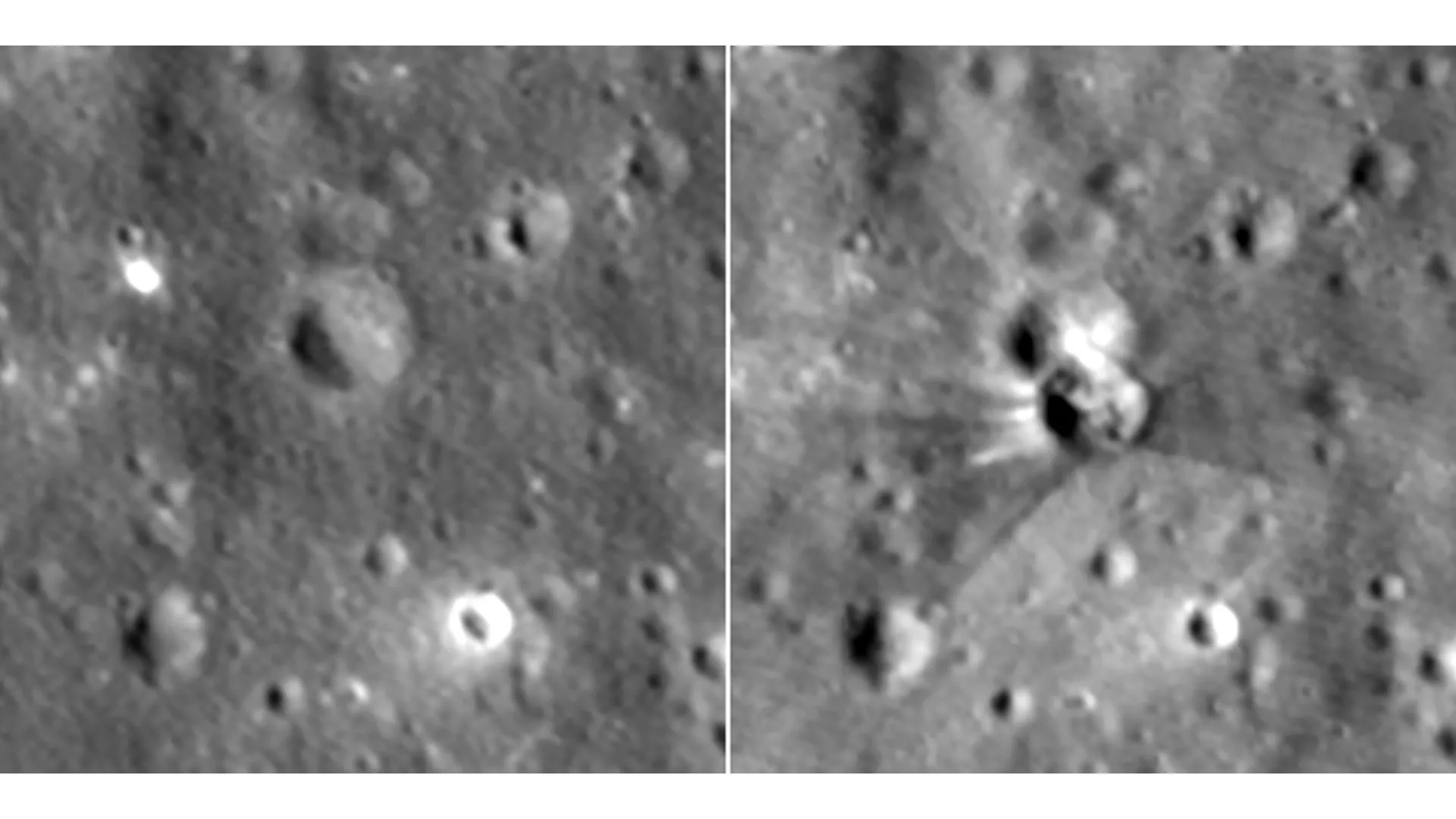
    Between Aug. 11 and 12, NASA’s Lunar Reconnaissance Orbiter (LRO) photographed a newly formed crater on the Moon. The crater appeared after a SpaceX Falcon 9 upper stage struck the lunar surface on Aug. 5. The rocket stage had previously launched in January 2025 as part of the Firefly Blue Ghost 1 mission.

    Capturing the impact site required careful maneuvering. Engineers tilted LRO so its cameras could point toward the crater as the spacecraft passed roughly 60 miles above the lunar surface at a speed of about 1 mile per second.

    The orbiter circles the Moon from pole to pole once every two hours as the Moon slowly rotates beneath it. Because of this motion, LRO must wait for a particular location to rotate into a position where it can be observed. In this case, six days passed before the spacecraft had the right opportunity to photograph the new crater.

    Timing was just as important as pointing the camera in the correct direction. A photograph taken only 10 seconds too early or too late would place the target about 10 miles away from the center of the image.

    Scientists observed the crater from several angles and under different lighting conditions, allowing different features to become visible. Images that clearly showed the crater rim allowed researchers to measure its width at about 60 feet. By studying the length of the crater’s shadow, they also determined that it is less than 10 feet deep.

    LRO recorded these details with its Narrow Angle Camera, which is capable of detecting features as small as 3 feet across.

    Fresh Lunar Material Revealed by the Impact

    The images show both bright and dark rays extending outward from the crater. The darker streaks contain surface dust and rocks that have been altered over long periods by solar wind, galactic cosmic rays, and impacts from micrometeorites.

    The collision blasted this weathered material from as deep as 1.5 feet beneath the lunar surface. Closer to the crater rim, brighter streaks reveal fresher material that was excavated from greater depths underground.

    An International Search for the Impact Site

    Locating the crater involved cooperation among professional researchers and amateur observers around the world. Independent astronomers first determined the rocket’s trajectory using information that was publicly available.

    NASA’s Center for Near Earth Object Studies, which monitors natural objects that could potentially threaten Earth as part of the agency’s Planetary Defense program, used the event as an opportunity to test and confirm methods for predicting impacts.

    The center, based at NASA’s Jet Propulsion Laboratory in Southern California, repeatedly refined its calculations until it identified the expected impact location. That prediction was then shared with the Republic of Korea and its Korea Pathfinder Lunar Orbiter (Danuri) team.

    A few hours later, the Danuri team used the spacecraft’s high-resolution LUTI camera to photograph the crater. The observation showed that NASA’s predicted impact location had been accurate to within about 0.6 miles.

    After imaging the site, the Danuri mission provided the crater coordinates to NASA’s LRO team, helping researchers improve the targeting of their own observations.

    The LRO team then compared the new images with photographs taken before the impact. Using those comparisons, researchers refined the location of the crater’s center to 19.4759°N, 266.7138°E, at an elevation of 511 meters.

    crater moon NASA revealed Rocket smashed SpaceX
    NCIJ NETWNCIJ NETWORK
    • Website

    Keep Reading

    This 150-million-year-old bird had dinosaur teeth and a strange secret

    Scientists discover a hidden switch that burns fat and blocks new fat cells

    Your blood could reveal inflammatory bowel disease 10 years before diagnosis

    These tiny snakes roll four times faster than they slither

    Astronomers uncover a mysterious magnetic web above the Sun

    Scientists propose a way to detect dangerous “mirror life” before it exists

    Add A Comment
    Leave A Reply Cancel Reply

    Editors Picks

    Critical x402 SDK Flaw Could Let Malicious APIs Drain AI Agents’ Token Balances

    October 25, 2026

    Does video show Trump waving at, saluting nobody before boarding Marine One?

    October 25, 2026

    Researchers Demonstrate Node2Shell RCE Exploit on Node.js Build Using Crafted Brotli Data

    October 25, 2026

    Andy Burnham says he wants ‘honest discussion’ about freedom of movement with EU | Andy Burnham

    October 24, 2026
    Latest Posts

    Google AI health coach to use Abbott glucose data

    August 14, 2026

    CMF hit the balance between cheap and good clip earbuds

    August 14, 2026

    David Hearn’s Lawyers Ask Court to Bar Future Reflecting Pool Charges

    August 14, 2026

    Subscribe to News

    Get the latest sports news from NewsSite about world, sports and politics.

    NCIJ Network is an independent digital news platform delivering trusted investigative journalism, European and global news, in-depth analysis, and fact-based reporting with accuracy, transparency, and integrity.

    Facebook X (Twitter) Instagram Pinterest YouTube

    Critical x402 SDK Flaw Could Let Malicious APIs Drain AI Agents’ Token Balances

    October 25, 2026

    Does video show Trump waving at, saluting nobody before boarding Marine One?

    October 25, 2026

    Researchers Demonstrate Node2Shell RCE Exploit on Node.js Build Using Crafted Brotli Data

    October 25, 2026

    Subscribe to Updates

    Get the latest creative news from FooBar about art, design and business.

    Type above and press Enter to search. Press Esc to cancel.