


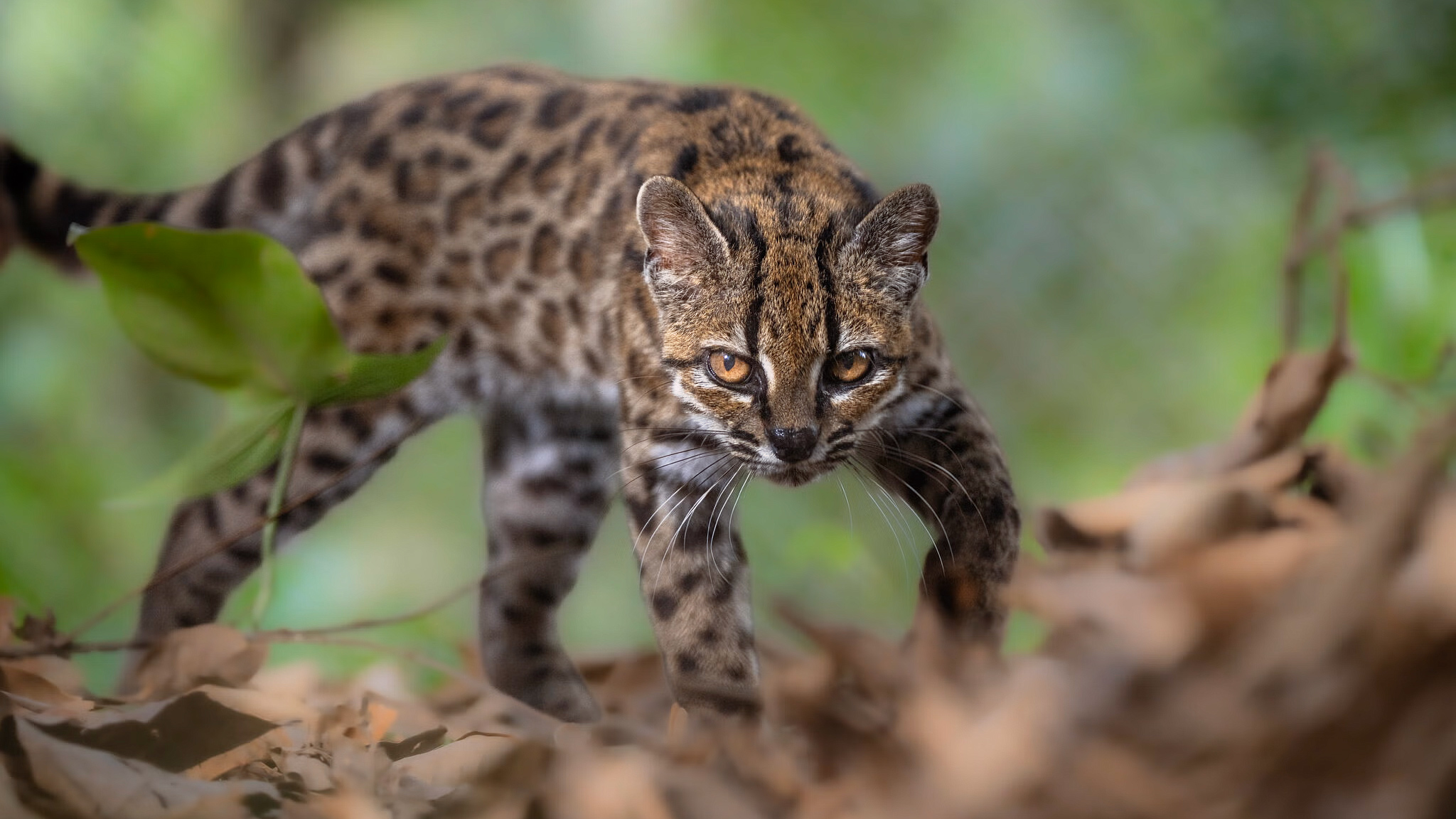
- The recent description of the tilcayo (Leopardus tilcayo) from Bolivia comes amid a broader reassessment of wild cat taxonomy, with genetic research suggesting that several additional species may be waiting to be recognized
- Brazilian biologist Tadeu Gomes de Oliveira says the number of recognized tiger-cat species could increase from three to six or even seven, while new research is also raising questions about the taxonomy of margays and other small cats.
- These distinctions can have direct conservation consequences: Oliveira estimates that no more than about 200 munoai pampas cats remain and argues that recognizing the population as a distinct species could help unlock targeted protection and funding.
- In September 2026, Panthera board chair Jon Ayers interviewed Oliveira about the changing taxonomy of small cats, emerging genetic research, threatened populations, and plans for a global monitoring program for small wild cats.
Editor’s note: Last week, the description of a “new” cat species from Bolivia made headlines around the world. The tilcayo (Leopardus tilcayo), a small spotted cat from Bolivia’s Yungas cloud forests, was described as the first new living cat species discovered in more than a century.
Unlike several cats recognized as new species in recent years through taxonomic revisions, the tilcayo had never been formally described by science. Genetic analysis indicates its lineage diverged from other tiger cats around 1.4 million years ago.
The discovery comes amid a broader reassessment of cat taxonomy. Several populations once considered subspecies or regional forms are now recognized, or have been proposed, as separate species. And there may be considerably more to come, according to Tadeu Gomes de Oliveira, a Brazilian wildlife biologist and conservationist who has spent several decades studying the small wild cats of the Neotropics.
Oliveira is one of the co-chairs of the IUCN Species Survival Commission Cat Specialist Group. He is also a professor in the biology department at Maranhão State University (UEMA) in São Luís and a researcher and scientific adviser with Brazil’s Instituto Pró-Carnívoros. He leads the Wild Cats Brazil/Americas Conservation Program and is founder and chair of the Tiger Cats Conservation Initiative.
Much of Oliveira’s work has focused on the tiger-cat complex, including Leopardus tigrinus, L. guttulus, and L. pardinoides. He has also been involved for many years in IUCN Red List assessments and conservation planning in Brazil.
“The tiger-cat group is undergoing a genetic revolution,” Oliveira told Jon Ayers during a recent conversation. “It went from two to three and could go from three to six or even seven.”
The distinctions are not merely academic. “If the pampas cat is not split, munoai is doomed,” Oliveira said of one highly threatened population. “Formal species recognition is the key to unlocking focused conservation efforts and funding.” Oliveira estimates that no more than about 200 munoai remain.
Ayers is a philanthropist and board chair of the wild cat conservation group Panthera. Trained in molecular biophysics and biochemistry, he spent 17 years as president and CEO of IDEXX Laboratories, a veterinary diagnostics and software company. A serious bicycle accident in 2019 left Ayers largely paralyzed. Conservation subsequently became a major focus of his work. He and his wife, Helaine, established the Ayers Wild Cat Conservation Trust in 2018. [Disclosure: The trust has supported Mongabay’s wild cat reporting initiative] In 2021, the trust committed at least $20 million over 10 years to wild cat conservation through Panthera’s Global Alliance for Wild Cats, with a particular emphasis on small cats..
Ayers and Oliveira discussed the rapidly changing taxonomy of small cats, what genetic research is revealing about previously overlooked species, and why those distinctions matter for conservation. Their conversation ranged from the possibility of additional tiger-cat and margay species to the precarious status of the munoai pampas cat and a new effort to establish a global monitoring program for small wild cats.
The interview has been edited and condensed.

Jon Ayers interviews Tadeu Gomes de Oliveira
Cat Specialist Group Leadership Transition and Governance
Jon Ayers: How did you become one of the co-chairs of the Cat Specialist Group?
Tadeu: So, the way it happened—there was a motion to split the Cat Specialist Group into a separate Small Cat Specialist Group. Vivek Menon, who heads the Species Survival Commission, instituted a new policy: henceforth, there will always be two co-chairs—one from the small cat world and one from the big cat world. That was a direct response to that motion.
Jon Ayers: And why did they pick you?
Tadeu: I think it is because of my prior involvement with the group, my conceptual work, and my research on the split of Neotropical species. They told me, “You are the perfect choice for us.” And I felt I could make a difference, particularly for small cats. The small cats have always been neglected, and we needed to change the scenery. It took me a while to say yes, because it’s a huge challenge. But I decided to do it for the cats.
Jon Ayers: Had you worked with the other co-chair before?
Tadeu: No. Before I was formally accepted, the other co-chair, Dr. Sugoto Roy—he’s the big cat representative—confirmed that he was comfortable with my appointment. We didn’t know each other beforehand, except that we were both part of an advisory team for the CSG. But now there’s a strong partnership. There’s not I. There is we. We back each other 100%. There’s no more Tadeu and Sugoto. There is us.

Jon Ayers: How big is the Cat Specialist Group now?
Tadeu: 90 new members have been invited to join. That will bring the total to just under 300—approximately 270—280 members.
Taxonomic review
Jon Ayers: How does the taxonomy review process work? How do you consider changes in taxonomy?
Tadeu: The taxonomy review group—we call it the “taxonomy task force”—has been active since 2025, since before I became co-chair. Its purpose is to reassess species classifications. It consists of Cat Specialist Group members who deal with taxonomy in various ways, including the researchers who conducted the relevant studies. For example, Fabio Nascimento, who did the Pampas cat work, was invited to join, even though he was not a member of the CSG at the time.
Jon Ayers: What’s the process?
Tadeu: A study proposes a species split or change. The taxonomy group evaluates the evidence. Once the taxonomy review is finalized, changes are accepted by the IUCN. Then the official IUCN website is updated. And the key thing—changes all go through at once when the taxonomy review is finalized. They do not roll out piecemeal. That’s why some species, like the 41st Felidae species, Leopardus pardinoides, have been accepted by the Cat Specialist Group but are not yet reflected on the IUCN website (pending the taxonomy review underway for updates).
Jon Ayers: What is the basis to make a decision that it’s a species versus a subspecies?
Tadeu: We use a “traffic light system” that requires consensus across three distinct areas of evidence. First—biogeography. The species’ habitats are geographically separate and do not overlap. They’re distinct. I’ll show you with the Tiger-cat distribution maps—the Atlantic Forest tiger-cat, red on the map, is distinct from the Savanna tiger-cat. Second—morphology. The species are physically and visually distinct. For some groups, like Pampas cats, morphology is clear—you can look at them, you can know that they’re totally different. But for Tiger-cats, morphology is not helpful at all for distinguishing species. Genetics is the only way to tell them apart. Third—genetics. There is significant genetic divergence between the populations, determined through advanced genetic studies—specifically genomics.
Jon Ayers: And within genetics, what’s the critical factor?
Tadeu: The time of split—how long ago the populations diverged, measured through genomic analysis. The current standard for cats requires a genetic separation of one million years for populations to be considered distinct species. I personally disagree with that threshold—but let me come back to that.
Jon Ayers: You mentioned Tiger-cats can’t be told apart by looks.
Tadeu: Right—that’s the cryptic species problem. Populations that are morphologically indistinguishable but genetically distinct. Let me show you photos of Tiger-cats—Leopardus tigrinus complex—from Brazil and the Guyanas. The two cats can look to be almost the same individual. And yet they’re separated by a million years of evolution. There’s no way that these are different unless genetics say so. And fortunately, the genetics confirmed the difference.
Jon Ayers: So you think the 1-million-year threshold is wrong?
Tadeu: In my personal view, it’s excessive, and I believe we need to reconsider this time limit. Fabio Nascimento made a powerpoint presentation that demonstrated much shorter speciation times in other mammal groups. Polar bears and grizzly bears—about 400,000 years, South American foxes—about 300,000 years, Otters—about 400,000 years, Giraffes—about 200,000 years. So why in heaven’s name do cats need a million years? We need to reconsider this position.
Jon Ayers: What would you propose?
Tadeu: Lowering the threshold to approximately 400,000 years. That’s a decent number that would allow recognition of different species. It would resolve classification issues for species five species in the Pampas cat group whose genetic splits occurred around 500,000 years ago. That’s well below the current 1-million-year bar but above my proposed 400,000-year threshold. I still need to be bring this up to the Taxonomy Task Force.
Jon Ayers: Can you explain the “shallow” versus “deep” terminology?
Tadeu: A shallow split is less or around 10,000 to 50,000 years of separation. A deep split exceeds 500,000 years. I’ll tell you in a moment—at a Pro-Carnivoros meeting in Brazil, Eduardo Eizirik, a highly respected genomics authority, pulled me aside to share news from his student, Jonas Lescroart. Eduardo said, “Tadeu, Jonas just called me, and he said that the time split within the Pampas cat group is deep. It’s, like, close to a million years for some pairs. We could have five different species if done properly.” That was surprising—we had been expecting the split to be shallow, not deep.
Jon Ayers: Could you see speciation at 100,000 years of separation?
Tadeu: Yes. That would solve the problem between two species in the Pampas cat group whose time split is around 500,000 years. But under the current 1-million-year standard, these populations might not yet be recognized as separate species.
Jon Ayers: What’s stalling the taxonomy review?
Tadeu: Several issues help delaying the process, like our availabilities and sometimes some opposite opinions that requires more time. One taxonomy review of Tigers concluded there are only two subspecies: one for the mainland and one for the Sunda Islands.
Jon Ayers: And the other side?
Tadeu: Research by Dr. Shu-Jin Luo—she’s at Peking University, Tiger and wild cat genetics—has demonstrated six distinct extant Tiger subspecies and three extinct subspecies. So the two positions are in direct conflict. We are finding ways to settle this issue.
Pampas Cat Speciation and the Munoai Crisis
Jon Ayers: Tell me about the Pampas cat work.
Tadeu: Fabio Nascimento proposed in 2020 or 2021 to split the single Pampas cat species (Leopardus colocola) into five distinct species. But his genetic support was not good initially. More recent genomic analysis has provided stronger evidence—that’s what Eduardo Eizirik was telling me, that Jonas found the time split within the Pampas cat group to be deep, sometimes close to a million years.
Jon Ayers: So what happens if you apply the current 1-million-year threshold?
Tadeu: Then you’d get at least three Pampas cat species. A combined braccatus and munoai group, a standalone colocola species, and a combined pajeros and garleppi group.
Jon Ayers: And under your proposed lower threshold?
Tadeu: If the speciation time limit were lowered to ~400,000 years, it would be possible to recognize all five distinct species originally proposed by Nascimento, if not likely at least three groups.
Jon Ayers: What are the conservation stakes here?
Tadeu: If the pampas cat is not split, munoai is doomed. Formal species recognition is the key to unlocking focused conservation efforts and funding. Without it, the munoai population has no dedicated conservation status or protection pathway in its range countries (Brazil, Uruguay and Argentina, where it is indeed already recognized as a distinct species from L. braccatus). We’ll come back to just how small that population is.
The munoai Crisis
Jon Ayers: Let’s come back to munoai. How small is the population?
Tadeu: At most perhaps 200 individuals.
Jon Ayers: That’s, like, on the verge of extinction.
Tadeu: Munoai is indeed on the very brink of extinction.
Jon Ayers: What’s driving that?
Tadeu: Satellite data shows munoai are dependent on a very specific grassland habitat maintained by grazing. Historically, this grazing was done by native megafauna, which are now extinct. The grazing role is now filled by cattle. If the grazing is heavy, bushes replace grass. And if it gets bushy, the munoai doesn’t use it.
Jon Ayers: And there’s a highway paradox, you said?
Tadeu: Yes—ironically, the most suitable habitat is now often found along highways. Brazilian legislation requires native vegetation buffers along highways, and since this buffer is grass, not trees, it creates ideal munoai habitat. But this proximity to roads has led to a high incidence of roadkill.
Jon Ayers: What do we actually know about the population?
Tadeu: Researchers led by Fabio Mazim have collected 252 photographs of munoai. The only known population that I’m aware of consists of two males and three females—though other researchers have mentioned another population, I haven’t seen it. In total, 19 adult individuals and two kittens have been identified. The presence of kittens is a positive sign—they are breeding—offering hope. My colleague Fabio Mazim, who has worked with me since 2004, is exceptionally skilled at live-trapping—he sets a trap, he catches animals. If he doesn’t catch a cat, nobody will. During one 10-day effort with 10 live-traps, he caught nine Geoffroy’s cats but no munoai—that illustrates how rare and difficult to detect they are.
Jon Ayers: Is there a recovery model that could work?
Tadeu: The successful recovery program for the Iberian lynx—Lynx pardinus—is a potential model for munoai recovery.
Jon Ayers: That was a big success.
Tadeu: Yes. And to be clear—there has not been an extinction event with munoai. But the population is critically small and requires concentrated conservation effort.
Tiger-Cats
Jon Ayers: So where are we now with the Tiger-cats?
Tadeu: The Tiger-cat group is undergoing a genetic revolution. Genetics have revealed cryptic species that are morphologically indistinguishable but genetically distinct. The species count has been rapidly increasing. The official IUCN website shows 2 species. The Cat Specialist Group has accepted three—that includes L. pardinoides, that was accepted in 2024. Recent research suggests there might be three new species—a Guyana population and two others. There is a paper by Jonas Lescroart, from Dr. Eduardo Eizirik’s team, about to come out in Current Biology presenting the new findings. And I personally believe that potentially there could be another new species—a Northwestern Argentina cat (photo only, no samples). More research is vitally needed.
Jon Ayers: So the number of Tiger-cat species could go from three to six or even seven Tiger-cats.
Tadeu: It went from two to three and could go from three to six or even seven.

Jon Ayers: Tell me about the 41st species—pardinoides.
Tadeu: The 41st official Felidae species is a Tiger-cat named pardinoides—Leopardus pardinoides—recognized in 2024 from a study proposed by me with genetics by Jonas Lescroart. It’s accepted by the Cat Specialist Group but not yet updated on the official IUCN website pending the full taxonomy review. And further research revealed that pardinoides from Peru and Bolivia are genetically distinct from pardinoides from Costa Rica and Colombia—though there was some intermixing way, way, way, way, way back in the past. Not recent.
Jon Ayers: Show me the cryptic species example again.
Tadeu: The Savanna tiger-cat population was thought to include the population in the Guianas, because they’re morphologically nearly identical. Look—these are live cats from Brazil and the Guianas. These two cats, these are living individuals, not flat museum skins. They appear to be the same individual. But genetic data revealed they are separated by a million years of evolution. Photos of individuals from Brazil—Mirador field site—and Guyana look identical in every sense, yet they are genetically a million years apart. There’s no way that these are different unless genetics say so. And genetics confirms they are different species.


Jon Ayers: And the potential seventh species?
Tadeu: This is a Tiger-cat from Northwestern Argentina—look at the photo. This is totally different from the others, but that’s the only picture that we have. I believe it could be a seventh Tiger-cat species. But there are no samples, and no one is currently searching for samples. That’s a big gap in research.

Jon Ayers: Could you get DNA from a museum specimen?
Tadeu: Yes—through museomics, extracting DNA from old museum specimens. I know of a specimen in a museum in a Province in Argentina. All the samples for the Guiana cat came from museum specimens—they drilled, like, they even got the DNA from the root canal from the specimen. Even a single whole-genome sample would be acceptable for analysis.
Jon Ayers: And how would you get DNA from a living animal?
Tadeu: Through blood samples, ear notches—a small piece of the ear—or from carcasses, even rotten ones. You can just take it off the meat of the muscle, put it in alcohol, and you can go for that. Roadkill or trapped animals could also provide samples.
Jon Ayers: Do you have partners in that region?
Tadeu: There is a Tiger Cat Conservation Initiative member in northern Argentina, but none in northwestern Argentina. I have partners there, but they didn’t want to join because they are doing Jaguar study. They send information on small cats but don’t want to do small cat work specifically. We must search for this, for sure.
Hybridization and Introgression: The guttulus / Geoffroy’s Cat Case
Jon Ayers: The fact that they might be able to hybridize and have productive offspring, is that not a factor in deciding species?
Tadeu: It’s a good question, and the picture is complex. L. guttulus—Leopardus guttulus, the Atlantic forest tiger-cat—and L. tigrinus—Leopardus tigrinus, the Savanna tiger-cat, and the Clouded tiger-cat L. pardinoides—were formerly considered the same species L. tigrinus. But they do not interbreed. Not in nature, because their ranges don’t overlap, and not even in zoos. If you try to breed them, they will not make offspring. That was noted as early as the 1970s by Paul Leyhausen, who first suggested guttulus and tigrinus were different species based on their inability to hybridize in zoos. If the two were the same species, they would breed.
Jon Ayers: But hybridization does happen elsewhere in the genus?
Tadeu: Yes. L. guttulus interbreeds with Geoffroy’s cat—Leopardus geoffroyi—and the offspring are productive, viable. This occurs in the contact zone where their ranges overlap. And tigrinus interbred with braccatus. But guttulus does not interbreed with tigrinus. They were supposed to be the same species, and they did not breed. But tigrinus interbred with braccatus, and guttulus interbred with Geoffroy’s cat, but they didn’t breed themselves. So that was odd.
Jon Ayers: And the introgression goes both ways?
Tadeu: Yes. The genetic introgression between guttulus and Geoffroy’s cat flows both ways. L. guttulus DNA from Geoffroy’s cat—about 38%. Geoffroy’s cat DNA from guttulus—about 42%. This occurs specifically in the mixing/contact zone. Even in Uruguay, guttulus DNA can be found in Geoffroy’s cats. However, there is no data yet on how far Geoffroy’s cat DNA extends northward beyond the contact zone.
Jon Ayers: Is that unusual for cats? I know the African wildcat—Felis lybica cafra—interbreeds with domestic cats.
Tadeu: Canids interbreed relatively easily, but cats do not—cats don’t do that as easily. The African wildcat does interbreed with Felis catus, yes. But Leopardus species are particularly resistant to hybridization. Leopardus doesn’t interbreed easily. It’s really tough.
Margay: A Hidden Multi-Species Complex
Jon Ayers: Anything surprising come out of the Tiger-cat study?
Tadeu: Yes—one of the most surprising findings was about Margays. When the Tiger-cat study was being conducted by Dr. Eduardo Eizirik’s team led by Jonas Lescroart, researchers needed outgroups—samples from other species within Leopardus for comparison. So they obtained Margay samples—Leopardus wiedii—from four different areas across its range. Surprisingly, all four populations were found to be one million years apart from one another genetically. That means they would qualify as at least four distinct Margay species—not subspecies, but distinct species. And this has not yet been published.
Jon Ayers: You had a sense about that already?
Tadeu: I had noticed something. People send a lot of pictures of cats, and I noticed that Margays from Bolivia, they have a different spot pattern. It’s unique. But I didn’t know it would get to one million years apart to species level. And the Bolivian population’s spot pattern is similar to Tiger-cats—Leopardus tigrinus complex—of northeastern Brazil, which is weird.
Jon Ayers: How did this surface?
Tadeu: It was a sub-product of the Tiger-cat phylogenomics study being published by Current Biology, led by Lescroart/Eizirik. It appeared on a slide that Jim Sanderson noticed, showing “one million years” of separation. I then asked my colleague Alejandra Bonilla to verify the data, confirming the split among areas. The finding has not been formally published and requires a dedicated full study to formalize. This new information demands we sort out Margay. It’s not been published. It’s just in line for more research.
Jon Ayers: Show me that Peru specimen.
Tadeu: This is a Margay specimen from Peru that was found dead. Through AI, I had the specimen visually resurrected—reconstructing how it would have looked alive.
Tadeu: I’m doing resurrection now.

Other Speciation Under Consideration
Jon Ayers: What about speciation across Asia and other genera?
Tadeu: Several groups. The Wildcat lineage Felis has been settled. At her presentation, Dr. Shu-Jin Luo showed the different groups and where they are.
Jon Ayers: And the marbled cat?
Tadeu: The Marbled cat—Pardofelis marmorata—is currently the only species found on both the Asian mainland and the Sunda Islands. I would expect it to be split into two species: mainland and Sunda Islands. This follows the precedent set by the Clouded leopard—Neofelis nebulosa—and the Leopard cat—Prionailurus bengalensis—which have already been split across this divide. If Clouded leopards, if Leopard cats are split into two species, why would the Marbled cat be only one species? It makes no sense. The separation is driven by the Wallace Line—everything on the Sunda Islands is at least a million years apart from mainland counterparts.
Jon Ayers: Ocelots?
Tadeu: Ocelots—Leopardus pardalis—will likely be separated into distinct species as well, given their huge range across Central and South America. But there is still a long way to go before that happens. It should take a while before this could become a fact.
Jon Ayers: And the Andean cat?
Tadeu: In contrast, the Andean cat—Leopardus jacobita—has the lowest genetic variation within the genus Leopardus. That’s attributed to naturally slow gene flow due to its patchy habitat—not a human-induced problem. That’s natural for the species. That’s always been like that. While this slow gene flow could eventually lead to speciation, no significant differentiation has been identified yet.
Jon Ayers: Jaguarundi and Geoffroy’s cat—they have enormous ranges.
Tadeu: Despite their enormous ranges—Jaguarundi, Herpailurus yagouaroundi, range from northern Mexico to central Argentina—both Jaguarundi and Geoffroy’s cat are each considered one single, wide-ranging genetic population with no significant differentiation.
Jon Ayers: Why does the Puma stay one species? Its range is incredible.
Tadeu: Puma is versatile and wide-ranging Unlike habitat-specialist small cats, Puma—Puma concolor—adapt across diverse environments, maintaining gene flow across their range.
The Sri Lankan Fishing Cat
Jon Ayers: Anything new on the fishing cats?
Tadeu: Yes—a study from Dr. Shu-Jin Luo’s lab at Peking University revealed significant differences between the Sri Lankan fishing cat—Prionailurus viverrinus—population and its mainland counterpart. Genetic separation of approximately 500,000 years. Morphological differences—Sri Lankan fishing cats are larger. Biogeographical differences confirmed. And a behavioral difference—Sri Lankan fishing cats are known to kill and eat dogs. Mainland Fishing cat is associated with lowland wetlands. This is not so in Sri Lanka where Fishing cats survive where there are no lakes or streams.
Jon Ayers: But Sri Lanka hasn’t been an island for 500,000 years. So geographic isolation alone doesn’t explain it?
Tadeu: Correct. I’d suggest that past habitat changes likely created a barrier that broke gene flow—maybe some habitat change that happened in the past that made them too far apart, that they could not exchange. Once gene flow was broken, the populations began developing differently.
Jon Ayers: I’ve heard reports of Fishing cats that don’t fish living in mountains.
Tadeu: That is true for the Sri Lankan population—there are fishing cats in the mountains in Sri Lanka that don’t fish. And they also eat dogs.
The Global Wild Cat Monitoring Program
Jon Ayers: What else came out of the meetings this week?
Tadeu: A major announcement. A decision was reached yesterday—Sunday, August 9—to establish a Global Wild Cat Monitoring Program as a formal program within the Cat Specialist Group.
Jon Ayers: That’s a historic first.
Tadeu: It is. The mission is to monitor all small wild cat species across the globe. The primary goal is to establish and maintain surveillance at key population sites for every cat species to determine if their populations are stable, fluctuating, increasing, or declining. This monitoring data is critical because it provides the concrete evidence required by IUCN for Red List assessments. For IUCN, you need to prove everything. If the population is declining—to say that it’s vulnerable, you need to show that it’s dropping. That there are real, measurable population drops. If you’re not monitoring, you will not know that. So it’s like, it makes it tougher.
Jon Ayers: And you’re leading the implementation?
Tadeu: I am personally leading the implementation. I’m already in talks to set up monitoring sites for newly identified species in northern Brazil, near the Guyanas. I told the group: We are making history now.
Jon Ayers: A global monitoring system for small cats has never been done before.
Tadeu: No, it hasn’t. The time has arrived.
IUCN Red List Assessment
Jon Ayers: What’s the Red List assessment workload looking like with all these new species?
Tadeu: I’ll be responsible for conducting the Red List assessment for all six new Tiger-cat species. It’s gonna be tough. The Jaguarundi is complete and published—it was upgraded from “Least Concern” to “Near Threatened.” The Margay is in progress. The Ocelot is in progress. L. braccatus (the Cerrado black-footed cat) is next. And then the Tiger-cats—all new species.
Jon Ayers: Walk me through the Jaguarundi upgrade.
Tadeu: The Jaguarundi’s status was elevated from “Least Concern” to “Near Threatened” based on monitoring data from 75 different areas across its range. The data revealed Jaguarundi is actually rare in most locations—consistently falling below the established rarity threshold for trail camera in the Neotropics. In very few areas was it more abundant. I told Panthera: You see that stuff that we did? It would cover the gap from the Panthera paper on Jaguarundi range. The monitoring part we evaluated showed that Jaguarundi was actually rare in most sites around its range and not abundant. That finding from 75 monitored areas was significant enough (with population declines) to warrant the status change.
Jon Ayers: I really enjoyed reading the last IUCN Cat News Special Issue #11 regarding taxonomy. Is there a new version coming?
Tadeu: That’s what we’re doing.
Jon Ayers: What’s the timeline?
Tadeu: I believe the work was originally supposed to begin in late 2023 or 2024 (not sure), but it ended up starting only in 2025. It is a complex undertaking, and so, I estimate it will likely be finished in 2026 and published in 2027.
How People Can Help—Support and Funding
Jon Ayers: How can people like me and the Baskins be helpful in these goals of conservation and monitoring and scientific work such as taxonomy?
Tadeu: I know you make a small contribution to the Cat Specialist Group through Panthera. And Big Cat Rescue supports the Tiger-Cats Conservation Initiative and that support enabled us to collect samples and to do the work. The area where support is most needed right now is the Global Wild Cat Monitoring Program.
Jon Ayers: Agreed. A global monitoring system for small cats has never been done before.
Tadeu: And it’s essential. Without systematic monitoring, it’s impossible to provide the population data that IUCN requires for Red List assessments—that creates a bottleneck for conservation action.

