


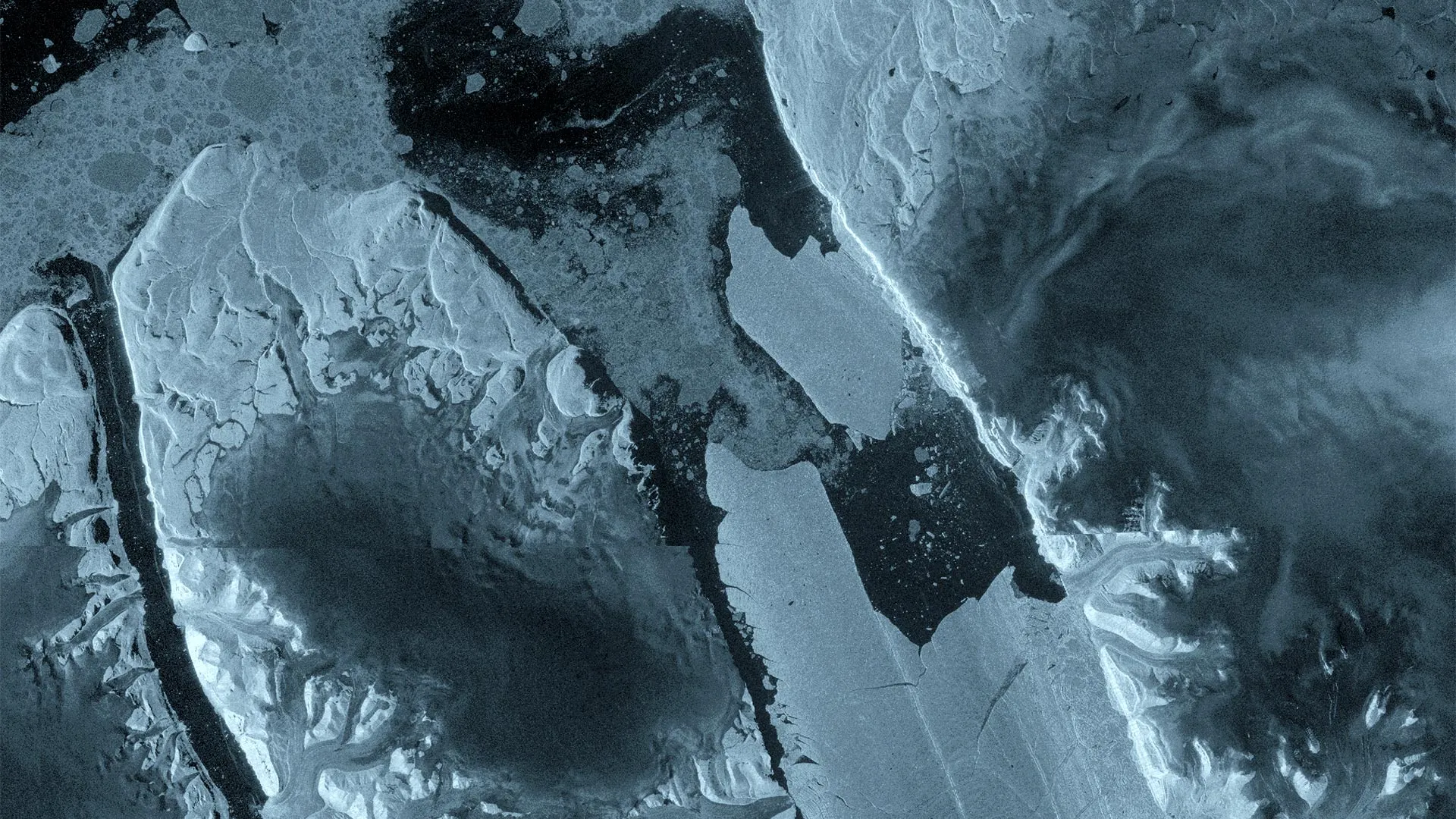
Europe’s Copernicus Sentinel-1 mission has documented a major change at Petermann Glacier in northwest Greenland, where a 76 sq km section of the glacier’s floating ice tongue broke away on August 4, 2026.
The break represents Petermann Glacier’s largest loss of floating ice since 2012 and the biggest calving event recorded in the Arctic since 2020. It offers another striking example of how quickly conditions can shift across Earth’s polar regions.
The newly formed tabular iceberg, also known as an ‘ice island’, is roughly the size of Manhattan and may be as much as 150 meters thick.
Sentinel-1 Captures the Breakup
Radar images from Sentinel-1 taken on August 3 showed significant deterioration developing along the center of the ice tongue. Just one day later, the enormous ice island had separated from the glacier’s eastern side.
Sentinel-1 is especially valuable for monitoring remote glaciers because its radar instruments can collect observations both day and night and can see through cloud cover.
An international research team has used Sentinel-1 imagery to monitor Petermann Glacier since 2019. The work is partially funded through ESA’s FutureEO ARCTEX project.
The collaboration includes researchers from the University of Ottawa in Canada, the Universities of Stirling, Lancaster and Leeds in the UK, and the Canadian Ice Service of Environment and Climate Change Canada. Over several years, the team has tracked expanding fractures and growing evidence that the glacier’s floating ice tongue was becoming unstable.
Cracks Had Been Growing for Months
Interferometric observations collected over Petermann Glacier in April revealed deformation and fractures within the floating ice tongue. Those measurements gave researchers a detailed view of changes that had been developing months before the eventual calving event.
Adam Garbo, a PhD student from the University of Ottawa, said, “Petermann Glacier has long been one of Greenland’s largest remaining ice tongues. We’ve anticipated this break for years, and seeing it finally happen is remarkable. It’s a powerful reminder of how quickly these systems can change.”
Petermann Glacier has experienced several major calving events in the past, producing large ice islands in 2008, 2010 and 2012. Since 2012, however, the floating ice tongue had remained comparatively stable, aside from several smaller calving events.
The latest break may not be the final major change. Two additional ice islands, with estimated areas of about 97 and 87 sq km, could eventually detach as existing rifts continue spreading across the floating ice tongue.
Anna Crawford, from the University of Stirling, commented, “While large, tabular icebergs are relatively common in the Southern Ocean around Antarctica, Arctic ice islands are far rarer.
“By studying Arctic ice islands, we will gain knowledge that can be transferred across polar regions. This is critical for understanding how the calving and deterioration of ice islands impact glacier dynamics, sea-level rise and the ocean environment.”
Radar Reveals Rapid Fracture Growth
A detailed Sentinel-1 interferogram showing where fractures formed and how they expanded across Petermann Glacier was possible because of one-day repeat Sentinel-1 synthetic aperture radar observations gathered during the Sentinel-1C and Sentinel-1D tandem phase while the newly launched Sentinel-1D satellite was being commissioned.
The observations allowed scientists to make highly detailed measurements of how cracks spread across the ice shelf and how the surface of the ice tongue moved in response to ocean tides before the iceberg finally broke away.
Molly Hammond, a PhD student from the University of Leeds, who processed the Sentinel-1 data, said, “The changes we observed on Petermann Glacier were occurring very rapidly in the lead-up to the iceberg calving event, so it was incredibly exciting to monitor the crack propagation with interferometry in near-real time. This has demonstrated the incredible value of one-day repeat synthetic aperture data.”
ESA’s Martin Wearing noted, “This type of large tabular iceberg is relatively rare in the Arctic, making this calving event a unique opportunity to study how such a vast ice mass drifts, evolves and eventually breaks apart.
“Satellite missions such as Sentinel-1 provide the systematic, long-term observations needed to track these changes, helping scientists better understand the processes driving calving and the wider impacts on the polar environment, and ultimately the Earth system as a whole.
“Alongside Europe’s excellent Earth observation missions, we are pleased to see the ARCTEX project supporting this work and enabling further scientific investigation of the rapidly evolving Arctic.”
Tracking the Ice Island and Its Risks
Researchers will continue monitoring both Petermann Glacier and the newly formed iceberg using satellite imagery, aerial observations and tracking data. By following the ice island as it moves and gradually fragments, scientists hope to learn more about the behavior of large Arctic ice islands and the forces driving the continuing evolution of Petermann Glacier.
The calving event also has practical consequences for navigation and offshore activity in the Arctic.
Environment and Climate Change Canada is tracking the iceberg’s path and evaluating possible threats to shipping routes and infrastructure. Ice masses of this size can remain in the ocean for years, slowly fragmenting into smaller pieces that may become progressively harder to detect and follow.
